Tesla Reality View takes up only half of one TRIP accelerator on the AI4 chip. The trade-off is fairly high latency, which Tesla is now looking to cut by about 35%.
- Reality View ships with FSD (Supervised) v15.0.1 and uses a diffusion model of roughly 1 billion parameters running on the car itself, replacing traditional 3D graphics
- The model generates batches of 8 images at 36 fps, yet uses just half of one of the three TRIP accelerators on the AI4 chip
- Latency is still fairly high. Tesla says it could drop by about 35% by changing how UVE features are interleaved
- The visuals are only AI-generated illustrations, and the 25x improvement in major interventions is a figure the company published itself
Table of Contents
An image-generation model running alongside the driving network
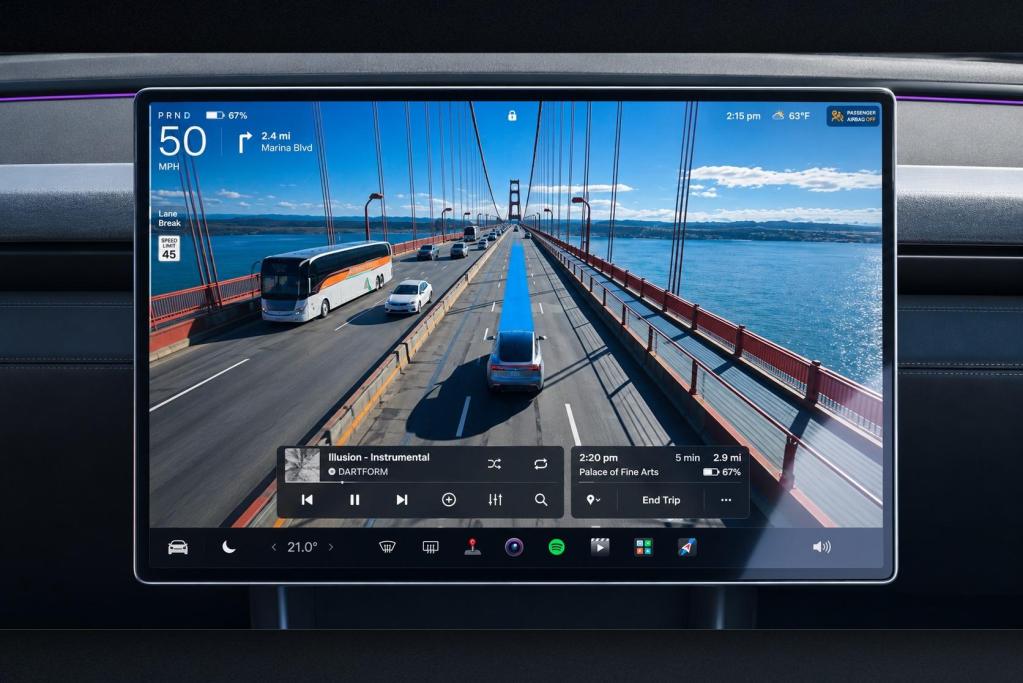
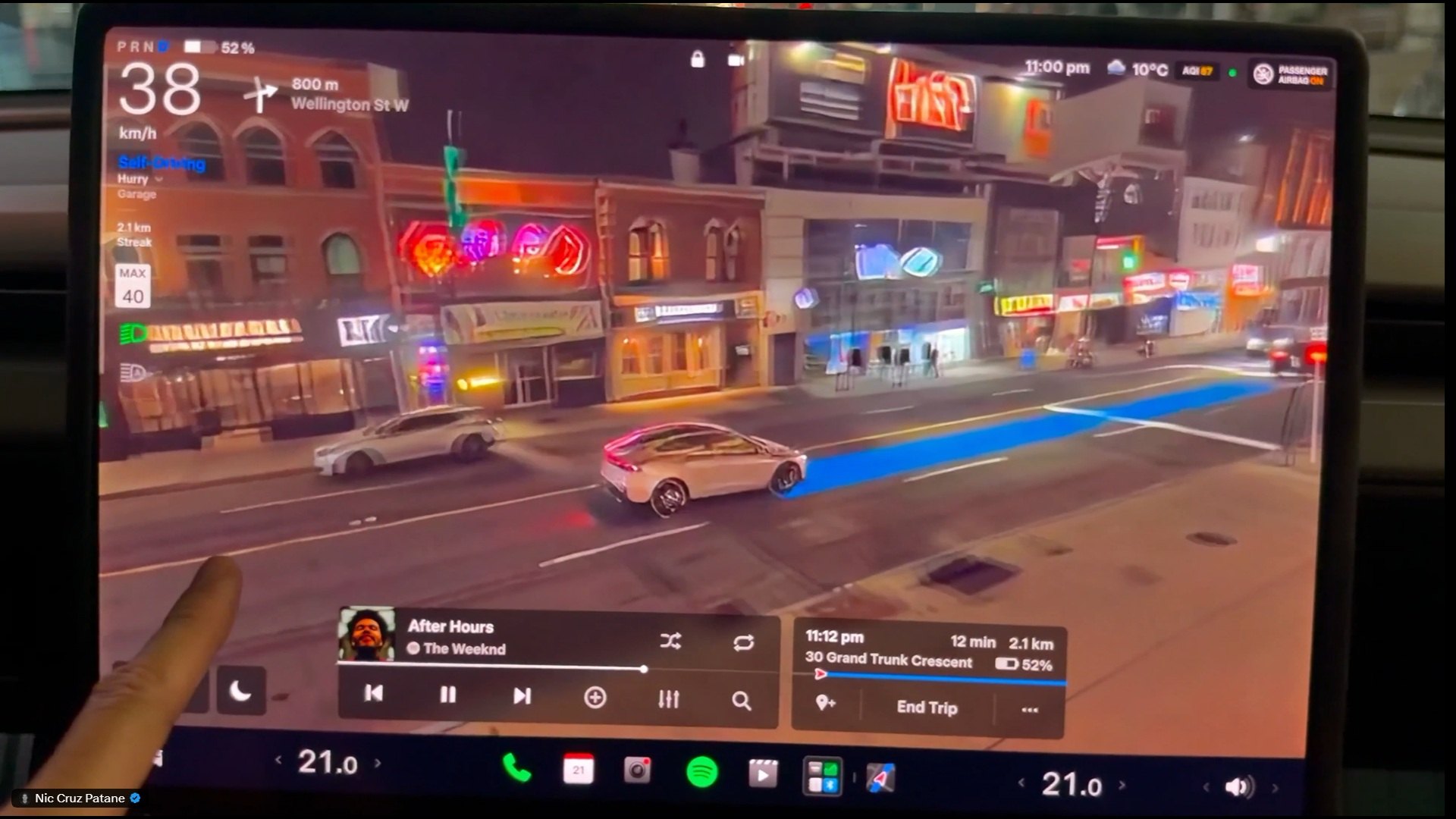
The FSD (Supervised) v15.0.1 update began reaching select vehicles on November 21 and brings Tesla Reality View. The feature redraws vehicles, roads, and buildings around the car using AI-generated imagery instead of conventional 3D graphics. According to CEO Elon Musk, it is powered by a diffusion model of about 1 billion parameters running directly on the vehicle, and Tesla pulled this off with fairly modest compute resources.
Musk said Tesla has had a nearly pixel-accurate world model since 2025, mainly used to generate synthetic data, but the version running in the car is much smaller and follows a conditional mean-flow approach. The foundation of the system is the Universal Vision Encoder (UVE), the processor for imagery from the cameras. The features UVE extracts are split between two destinations: a 3-billion-parameter network that decides driving actions, and a separate image-generation model of about 1 billion parameters. That model takes the Reality View image it produced previously, adds noise, and then denoises it step by step to produce an updated version of the scene. This keeps the visuals seamless without Tesla having to build each object through a traditional graphics pipeline.
On speed, Musk said the model generates batches of 8 images at 36 fps, matching the resolution of the in-car interface. The computation is spread across four processing cycles while UVE runs at 18 Hz. In other words, the car is running a real-time AI video generator next to its driving system. Both draw on the same visual input, but the display side is kept separate from the network that makes driving decisions.
AI4 hardware and its limits
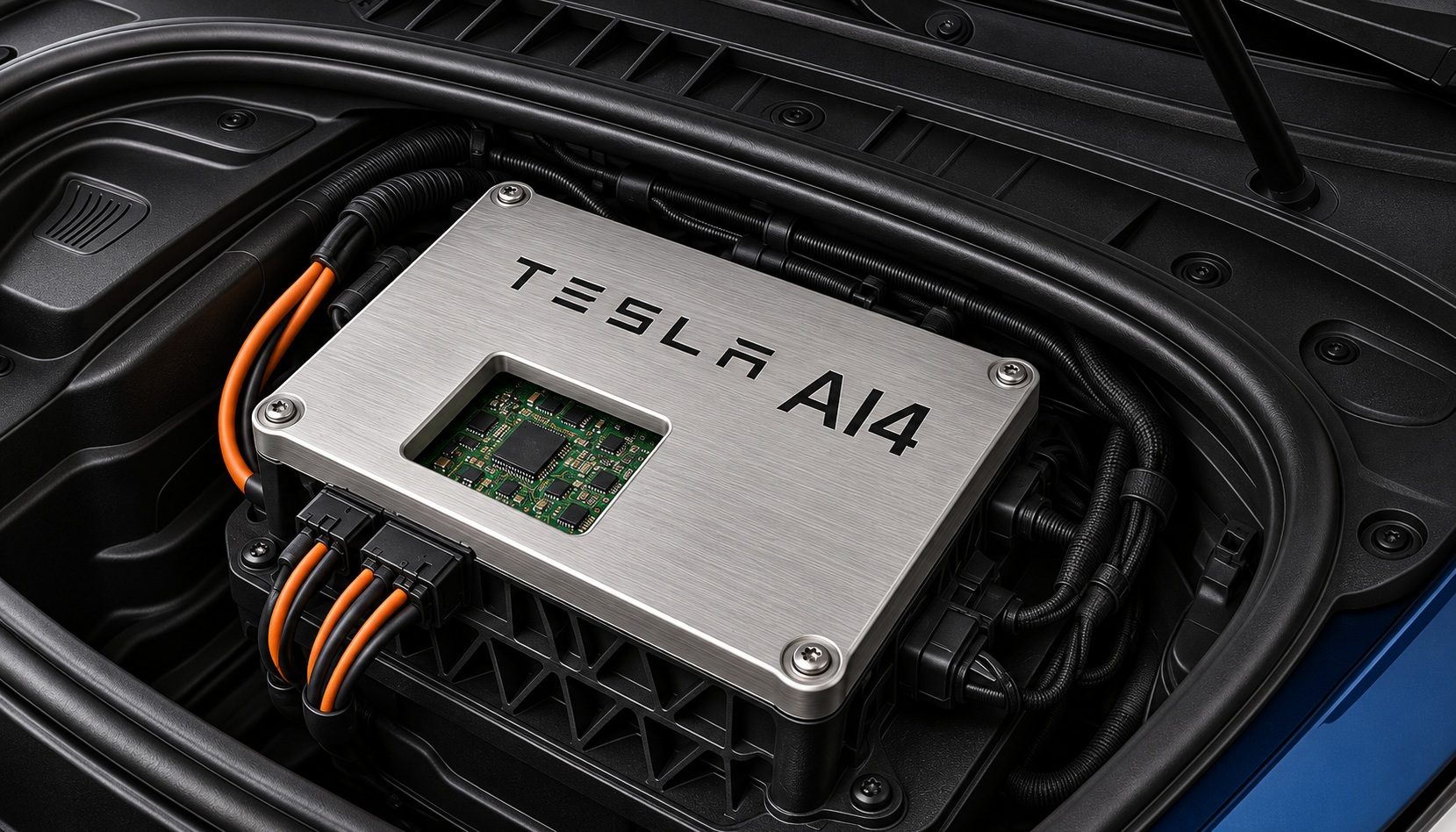
The most notable detail is how little hardware Tesla devotes to this. In a follow-up post, Musk explained that moving a small decoder into SRAM freed up enough resources to run the display side on just half of one TRIP accelerator, out of the three on the chip. The hardware constraints are tight: TRIP mainly handles 8-bit integer math, and softmax has to be emulated in 28 steps, so running a transformer-based image-generation model is hard to begin with.
Those limits show up directly in responsiveness. Musk acknowledged that Reality View currently has fairly high latency, and Tesla believes that interleaving new UVE features into the layers of the diffusion transformer could cut it by about 35%. He also said the upcoming AI5 hardware offers roughly 12 times more compute, but Tesla cars will stay on AI4, with AI5 reserved for products such as Optimus. Even so, fitting a billion-parameter image-generation model onto existing automotive hardware shows how far specialized inference optimization has come.
What Reality View actually is
The FSD v15 release notes also say the rate of major interventions has improved 25x thanks to an upgraded vision encoder shared across FSD, Robotaxi, and Optimus, but that remains a figure published by the company itself. Reality View should not be treated as evidence of better autonomous driving. It is only an AI-generated reconstruction of the surroundings and the behavior the car intends to carry out, and there is no guarantee that every detail matches reality. FSD is also still a driver-assistance system that requires a person behind the wheel to supervise. Version v15.0.1 has so far reached only the first customers, with a wider rollout expected in December.
Migovi thinks the most interesting part of Reality View is how Tesla works around older hardware, more than whether the visuals look good. Running a 1-billion-parameter model on half of one accelerator shows the company pushing the AI4 chip's on-device (edge) inference very hard. On the other hand, the high latency and Tesla's decision to separate the display entirely from the driving decision network suggest the feature mainly helps drivers visualize what the car "sees," and says little more about whether the car drives more safely. For users in Vietnam, this is a story to follow as one direction for in-car generative AI, while figures like the 25x reduction in interventions should wait for independent verification before being believed.
Source: Wccftech
Reviewed by: Hero Association