
Intel Texture Set Neural Compression: The Cure for AAA Gaming's VRAM "Thirst"?
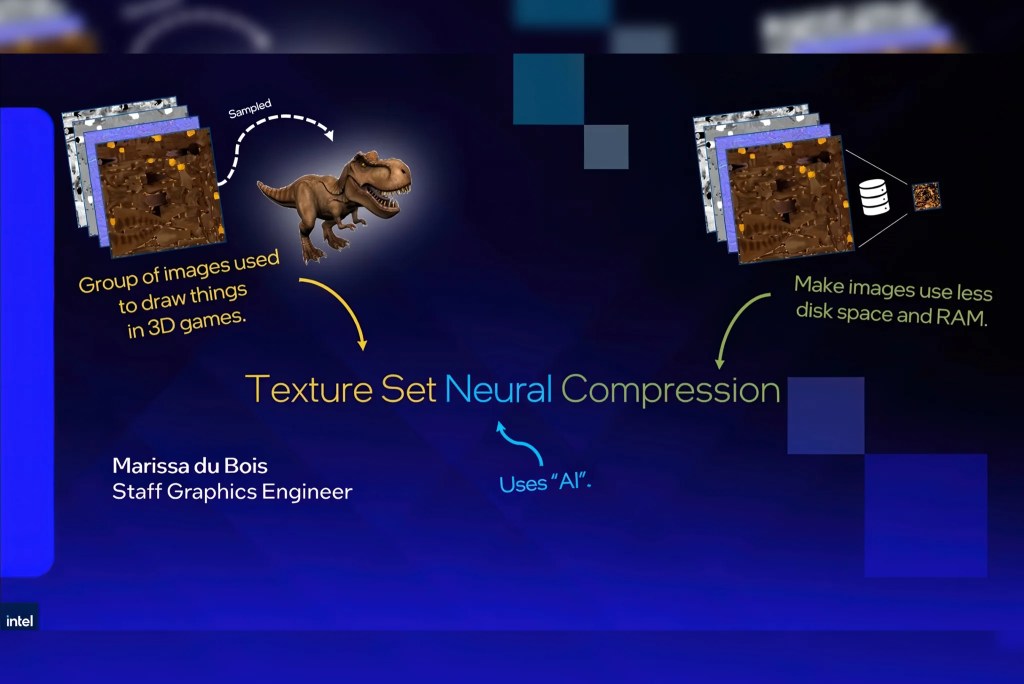
Texture Set Neural Compression - Intel's novel texture compression technique - promises to decisively solve the severe bottlenecks in memory bandwidth and VRAM capacity.
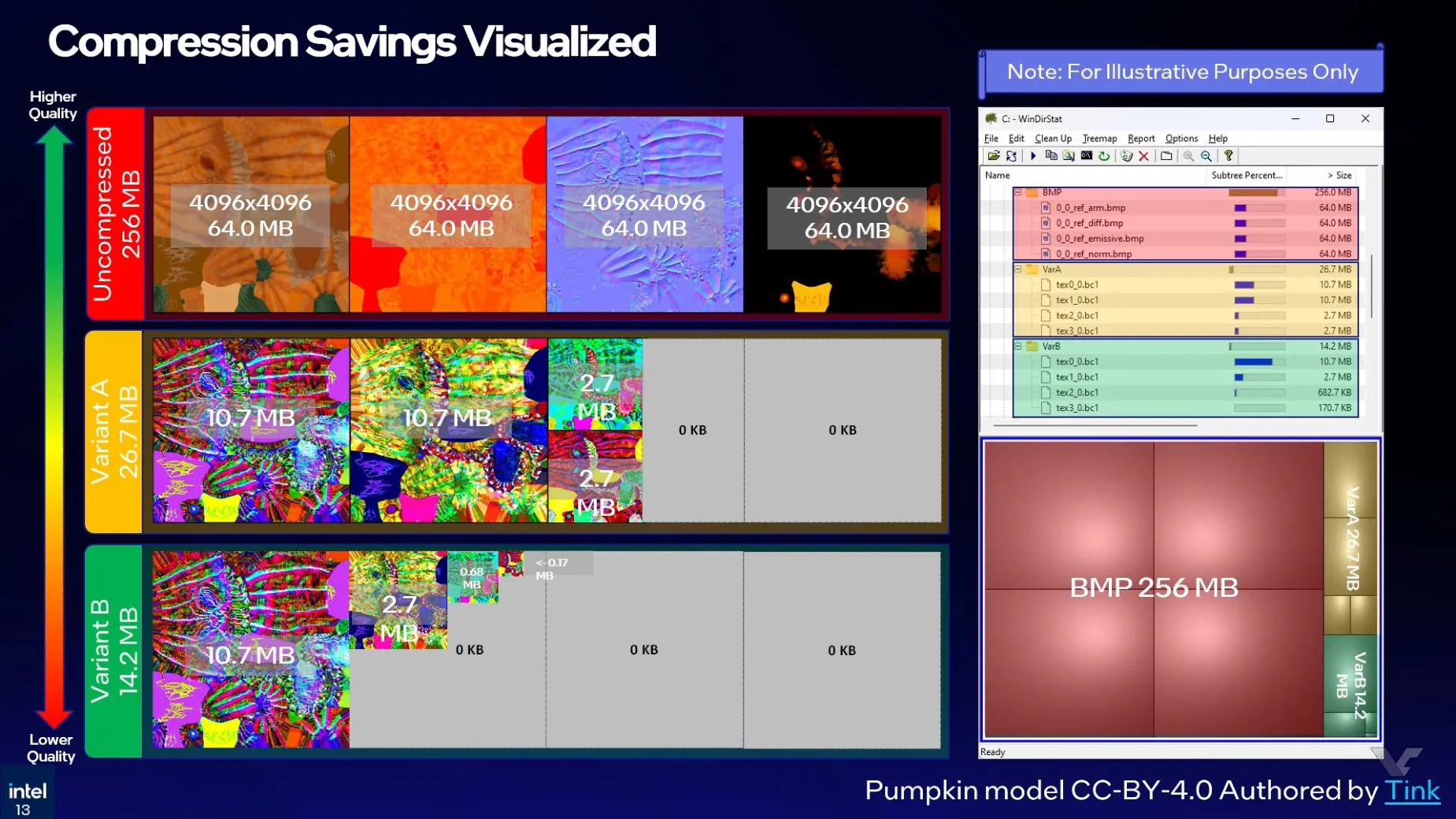
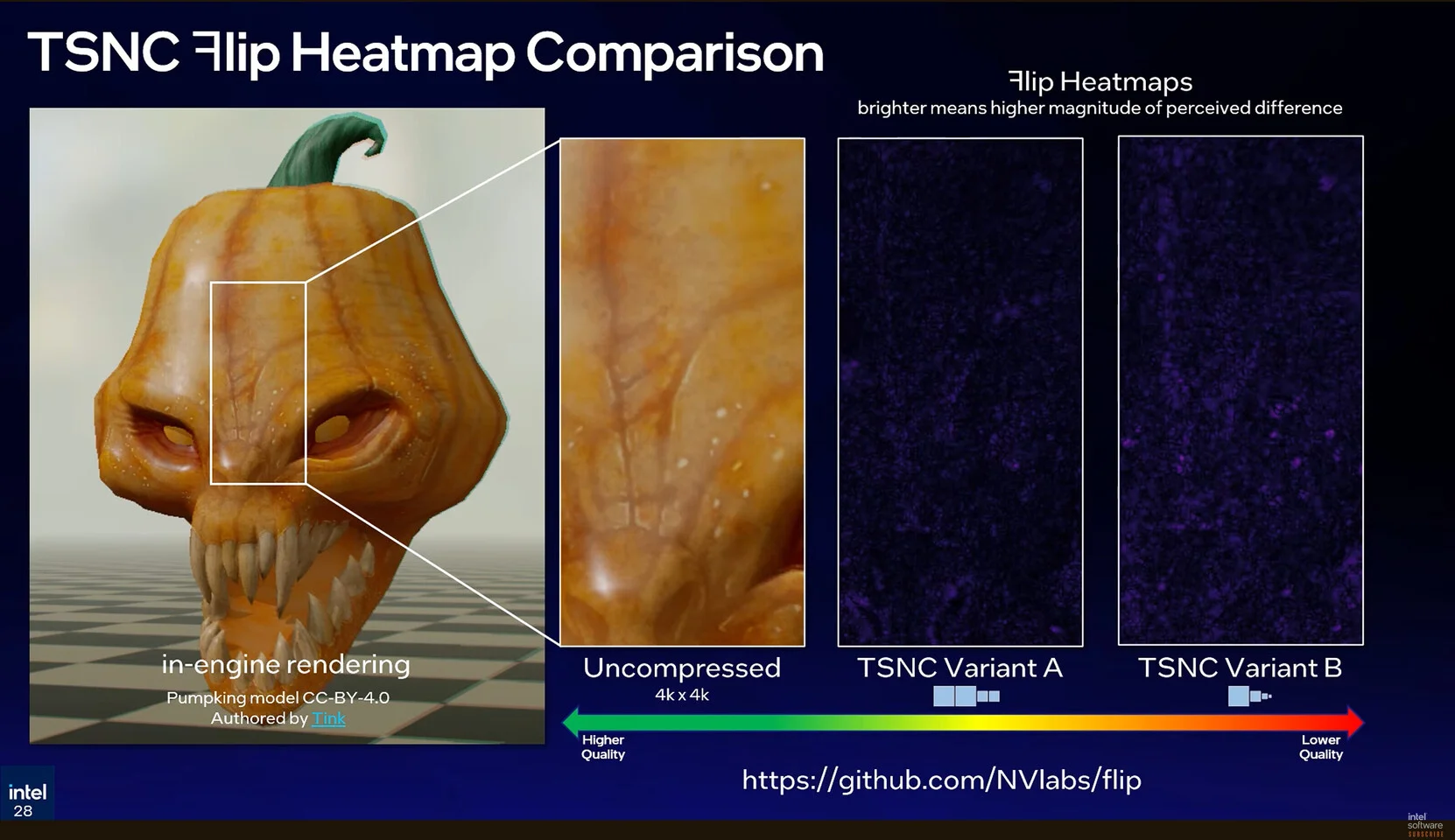
- Intel Texture Set Neural Compression (NTC) delivers significantly higher visual quality than traditional formats (like Block Compression) at the exact same bitrate.
- Instead of compressing individual images in isolation, this technology optimizes entire texture sets simultaneously (color, roughness, normal maps). This allows the AI network to identify and effectively share redundant data across different material layers.
- NTC shifts the workload from memory bandwidth to the Arithmetic Logic Units (ALUs) on the GPU, decompressing data in real-time using a Multi-Layer Perceptron (MLP) neural network.
- Intel's technical paper demonstrates the strong potential for integrating this algorithm directly into modern rendering pipelines without requiring any new hardware architectures.
Article content
The VRAM obsession and the exhaustion of Block Compression
When discussing recent 3D graphics projects or AAA titles, the voracious "appetite" for VRAM (Video Random Access Memory) is consistently the most significant technical hurdle. Development studios regularly pack their installation files with arrays of 4K and 8K textures to ensure peak visual fidelity. The consequence is that even top-tier graphics cards frequently hit a hard VRAM ceiling. A typical modern 3D scene demands gigabytes of texture data to be continuously streamed from storage into VRAM, creating a severe bottleneck at the memory bus.
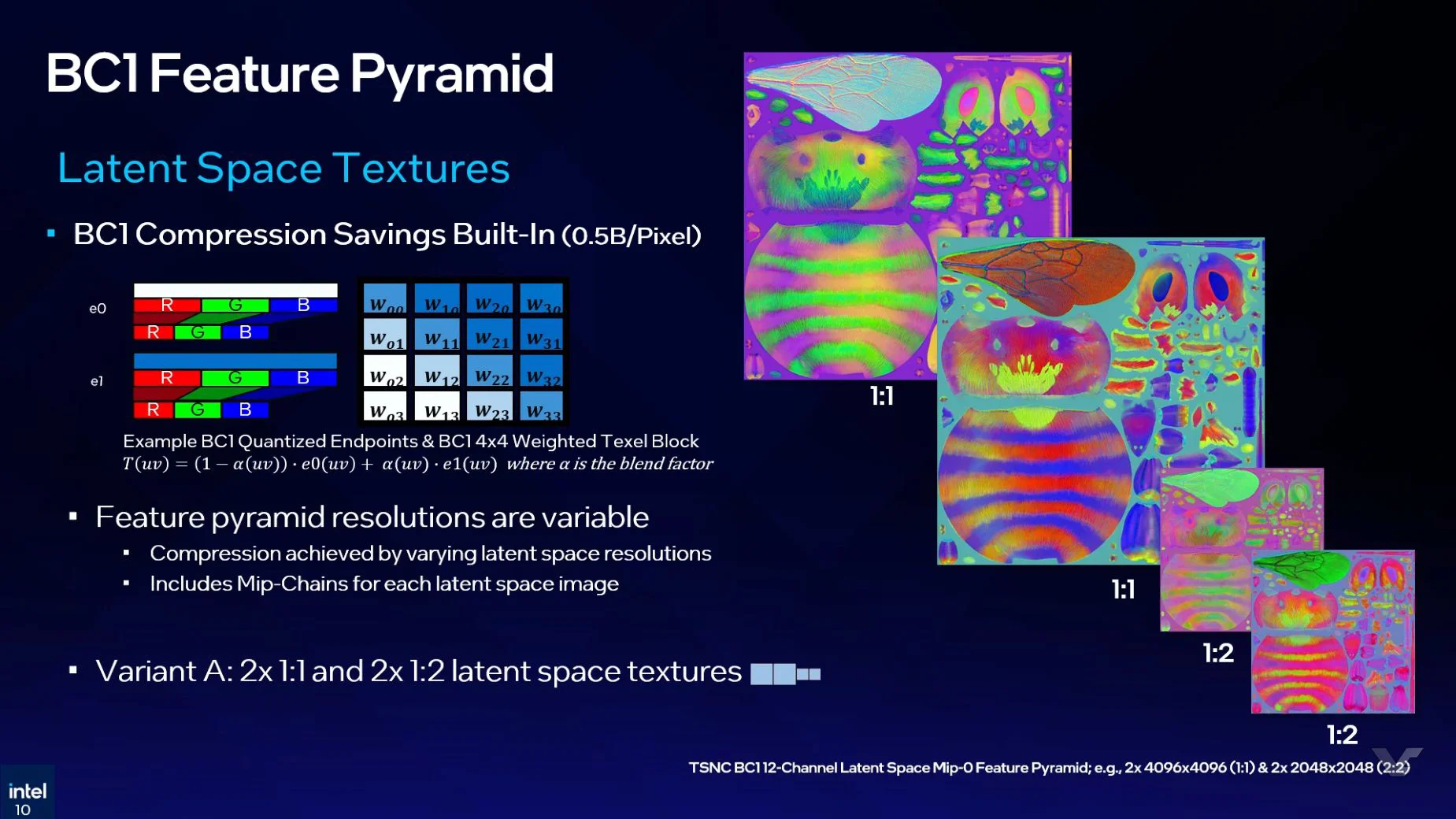
For over a decade, the standard solution has been Block Compression (BC), spanning formats from BC1 to BC7. This standard slices an image into small pixel blocks (typically 4x4) and stores a representative color code. Block Compression allows for blistering fast, hardware-accelerated decompression, but suffers from a fatal flaw: its compression ratio is strictly limited. If the data is compressed too aggressively, the image suffers from highly distracting, blocky artifacts. Legacy formats like BC have simply hit a brick wall within the context of modern rendering environments.
The core mechanics of Neural Texture Compression (NTC)
To overcome the limitations of BC, Intel's graphics research team published an in-depth technical paper titled "High-Quality Neural Texture Compression," introducing the concept of leveraging artificial intelligence for texture compression. Unlike standard image formats like JPEG or WebP - which require the entire image to be decompressed before use - textures within a 3D environment demand random access. This means the GPU only calls for the exact pixels currently visible to the camera. Intel's technique caters precisely to this strict requirement.
An MLP is a fundamental class of deep learning networks. In Intel's technique, a highly optimized, microscopic MLP (micro-MLP) is embedded directly into the GPU's shader pipeline. Its job is to "guess" and reconstruct the color of a specific pixel based on provided coordinates, rather than pulling raw color data from memory.
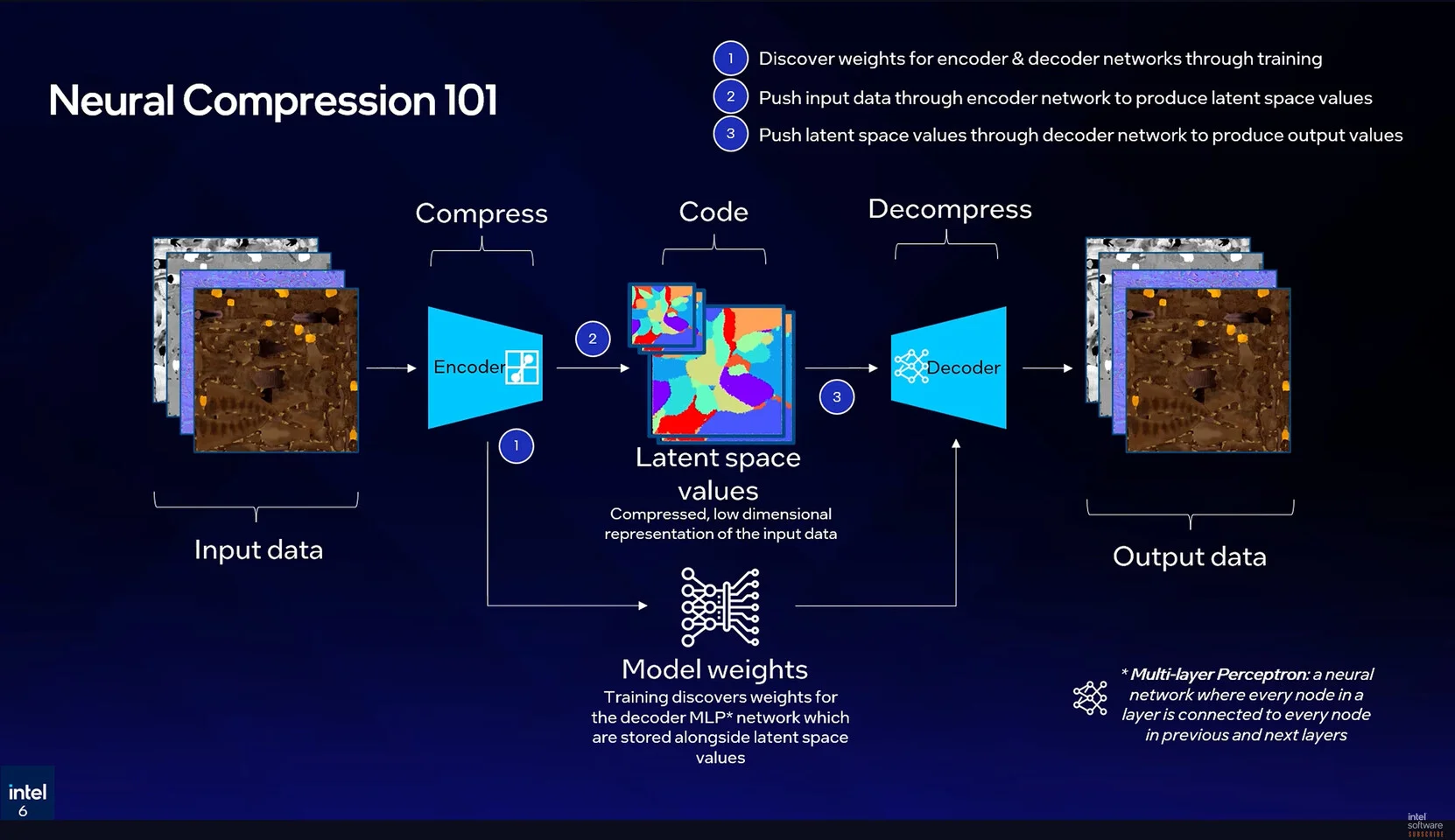
Intel abandons the traditional method of storing individual pixels as hardcoded color values. Instead, the entire dataset of an image is converted into the weights of an MLP network. When the GPU needs to determine the color of a specific point on an object, it feeds the UV coordinates into this neural network. The AI instantly computes and returns the correct color output. Because of the non-linear nature of neural networks, the storage footprint required for these weights is vastly smaller than storing conventional pixel blocks, all while maintaining excellent visual sharpness.
Unlike the 3D spatial axes (X, Y, Z), U and V are 2D coordinate axes used to "flatten" the surface of a 3D model onto a square 2D image plane. The neural network uses these UV coordinates to determine precisely which color must be decoded for a specific pixel on the 3D object.
Texture Set - The key to optimization
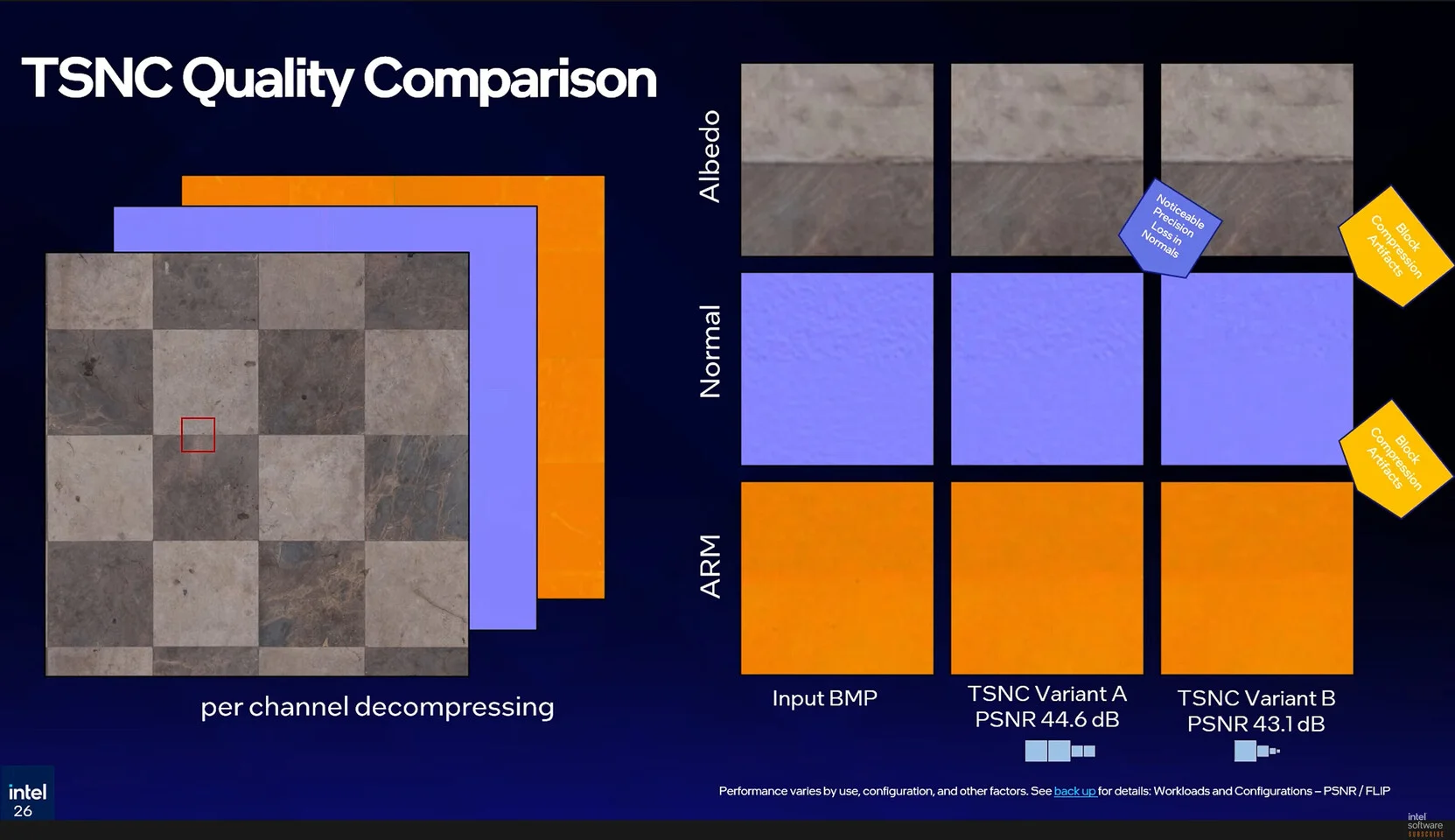
The most lucrative breakthrough of this algorithm lies in the word "Set." In Physically Based Rendering (PBR) workflows, a material surface isn't defined by a single color map (Albedo/Base Color) alone. It is accompanied by a complex stack of parameters, including Normal maps (surface bumps and dents), Roughness maps and Metalness maps. If each of these channels is compressed individually using legacy formats, the resulting storage bloat is catastrophic.
PBR is a graphics standard that simulates how light interacts with physical materials in the real world. A PBR surface utilizes an entire suite of parameters (a Texture Set) that includes base color (Albedo), surface detailing (Normal map), micro-surface scattering (Roughness) and reflectivity (Metalness). The game engine uses this data to dynamically calculate light reflection, yielding photorealistic visuals from any angle.

Intel's research highlights that these maps often exhibit strong spatial structural correlation (for instance, a scratch on a metal surface will be visible on both the color map and the roughness map). Intel Texture Set Neural Compression aggregates all the textures of a single material into one unified set and trains the AI on them simultaneously. The neural network autonomously detects redundant, overlapping details across these layers and shares those features within its hidden network layers. This approach allows for the simultaneous compression of multiple complex data channels without causing a linear increase in the size of the AI model.
The decompression process is executed entirely as a software compute algorithm directly within the GPU's Shader Cores. This implies that the Texture Set Neural Compression technology does not require hardware manufacturers to redesign dedicated fixed-function decoding blocks on the silicon die, unlike what was necessary for legacy BC formats or AV1 decoding.
These are rigid blocks of silicon hardwired onto the GPU die to perform a single, specific task (e.g., an AV1 decoding block). While they are blistering fast and highly power-efficient, their core algorithms cannot be updated. NTC decompression occurs via software directly inside the generalized Shader Cores, meaning manufacturers don't have to spend capital redesigning these inflexible hardware blocks.
Trading bandwidth for compute overhead

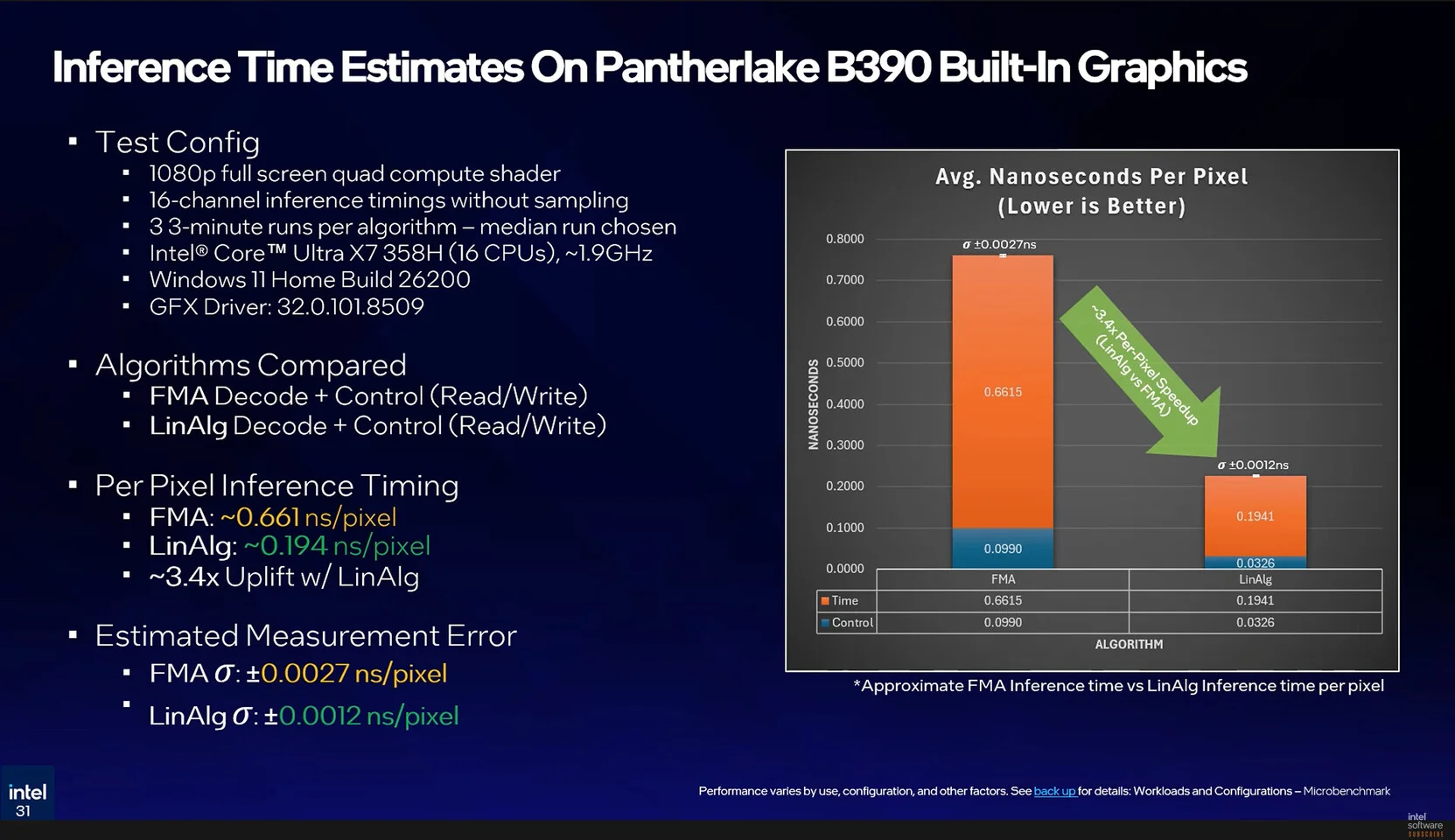
Naturally, in the realm of computer engineering, everything is a trade-off. Offloading decompression to a neural network necessitates siphoning mathematical compute resources (Arithmetic Logic Units - ALUs) to compensate for the reduction in memory bandwidth usage. The GPU must expend additional compute cycles running the internal AI algorithm, rather than dedicating 100% of its horsepower to rasterizing geometric polygons. If a GPU possesses a weak AI compute architecture, this overhead could drag down the overall frame rate (FPS).
The ALU serves as the primary mathematical "muscle" of the GPU, dedicated to executing integer operations (addition, subtraction, multiplication, division) and floating-point math, alongside logical operations (AND, OR, NOT, XOR) on binary data. Instead of focusing 100% of the ALU cores on drawing polygons or calculating lighting, the GPU must now share clock cycles to run NTC's internal AI algorithm. If the hardware architecture is weak, this will result in lower FPS.

However, Texture Set Neural Compression is a brilliant strategic move by Intel. Given the current trajectory of graphics hardware design, scaling up the sheer number of compute cores (such as Tensor Cores or XMX Matrix Engines) is significantly cheaper and less complex than widening physical VRAM bandwidth on the PCB (which requires expensive memory bus routing and premium GDDR chips). Intel's approach leverages the massive, often surplus compute power of next-generation microarchitectures to decisively attack the most crippling bottleneck in modern graphics pipelines, especially for AAA gaming.
Intel Texture Set Neural Compression is far more than a mere technology demo. While it has not yet achieved widespread adoption across major game engines, the aggressive industry trend of integrating potent AI accelerators (NPUs) directly into CPU and GPU microarchitectures (as seen in the Core Ultra generation and new GPU architectures) makes the application of micro-neural networks for VRAM offloading an inevitable near-future reality. Moving forward, when building high-end rigs, enthusiasts may find themselves stressing far less over raw VRAM capacity constraints, as intelligent optimization algorithms like NTC will soon shoulder the bulk of the internal bandwidth burden.