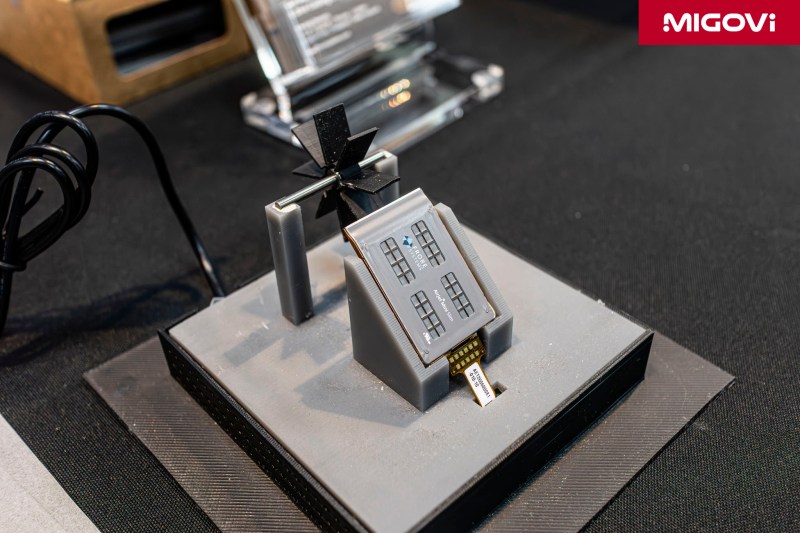

Intel Arc G-Series technical deep dive: The next-gen handheld PC processor
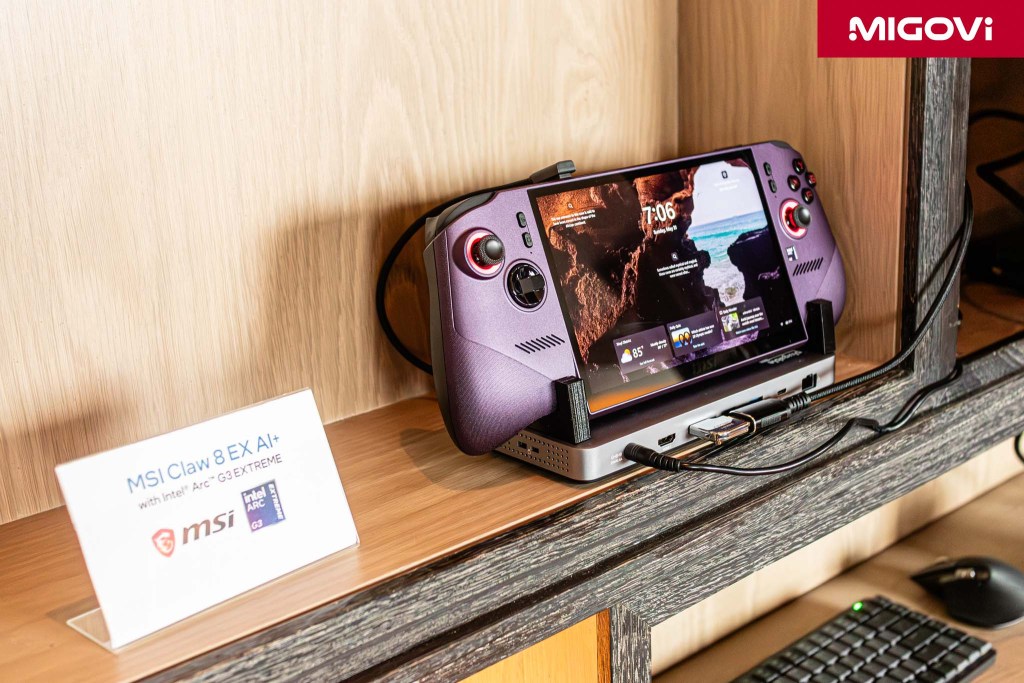
Ahead of COMPUTEX 2026, Intel has unveiled its Arc G-Series processors, spearheaded by the flagship Arc G3 Extreme, squarely aimed at powering a completely new generation of handheld PCs.
- As the first SoC purpose-built for handheld PCs on the Panther Lake architecture, it leverages 3D Foveros packaging to finally tackle the segment's persistent thermal and battery life bottlenecks.
- Under the hood is a 14-core, 14-thread configuration (having officially ditched Hyper-Threading), integrated Xe3 Battlemage graphics and roughly 160 TOPS of total AI compute to drive the complete XeSS 3 suite (XeSS-MFG, XeSS-SR and XeSS-LL).
- The silicon decisively outpaces the AMD Ryzen Z2 Extreme across the entire power curve (12W - 35W), leaning on the IBC v3.5 smart power algorithm for battery optimization while delivering double the performance-per-watt of its primary rival.
- It is slated to hit the market inside 2026 flagship handhelds like the MSI Claw 8 EX AI+ (launching June 23rd) and the Acer Predator Atlas 8, backed by a concrete silicon roadmap stretching into 2027.
The Arc G-Series CPUs are Intel's first SoCs designed from the ground up on the Panther Lake platform, rather than being retrofitted from standard laptop chips. The fatal flaw of that older approach historically lay in thermals, which ultimately tanked battery life—but the Arc G-Series changes the equation entirely. For the past half-decade since 2021, the handheld PC space has been almost entirely dominated by Team Red, but as of today, the tides may be turning.
Article content
Disaggregated architecture and 3D Foveros
The real breakthrough of the Intel Arc G3 Extreme and the Arc G-Series as a whole, lies in its chiplet packaging, leveraging Intel's advanced 3D Foveros technology. This allows Intel to disaggregate functional blocks (tiles) and optimize each one using the most ideal manufacturing nodes. Inside the Arc G3 Extreme, the Compute Tile (CPU) is fabbed on the Intel 18A node, utilizing RibbonFET transistors and PowerVia backside power delivery. Meanwhile, the Graphics Tile (iGPU) is manufactured on TSMC's N3E node, packing 12 Xe3 cores into a compact 53.6 mm² die footprint.

- Compute Tile (Intel 18A): The central processing block utilizes the Intel 18A process. This node introduces two critical innovations: RibbonFET (Gate-All-Around) transistors for maximum leakage control and the PowerVia backside power delivery system, which optimizes signal routing, mitigates voltage droop and drastically improves direct current density to the processing cores.
- Graphics Tile (TSMC N3E): The integrated Arc B390 graphics tile is outsourced by Intel to TSMC for manufacturing on its 2nd-generation 3nm class (N3E) process. This strategic choice shrinks the graphics die down to 53.6 mm², optimizing component density—an absolutely crucial factor within the thermally constrained chassis of a handheld—while still delivering performance on par with entry-level discrete GPUs.
Restructuring CPU cores for thermal optimization
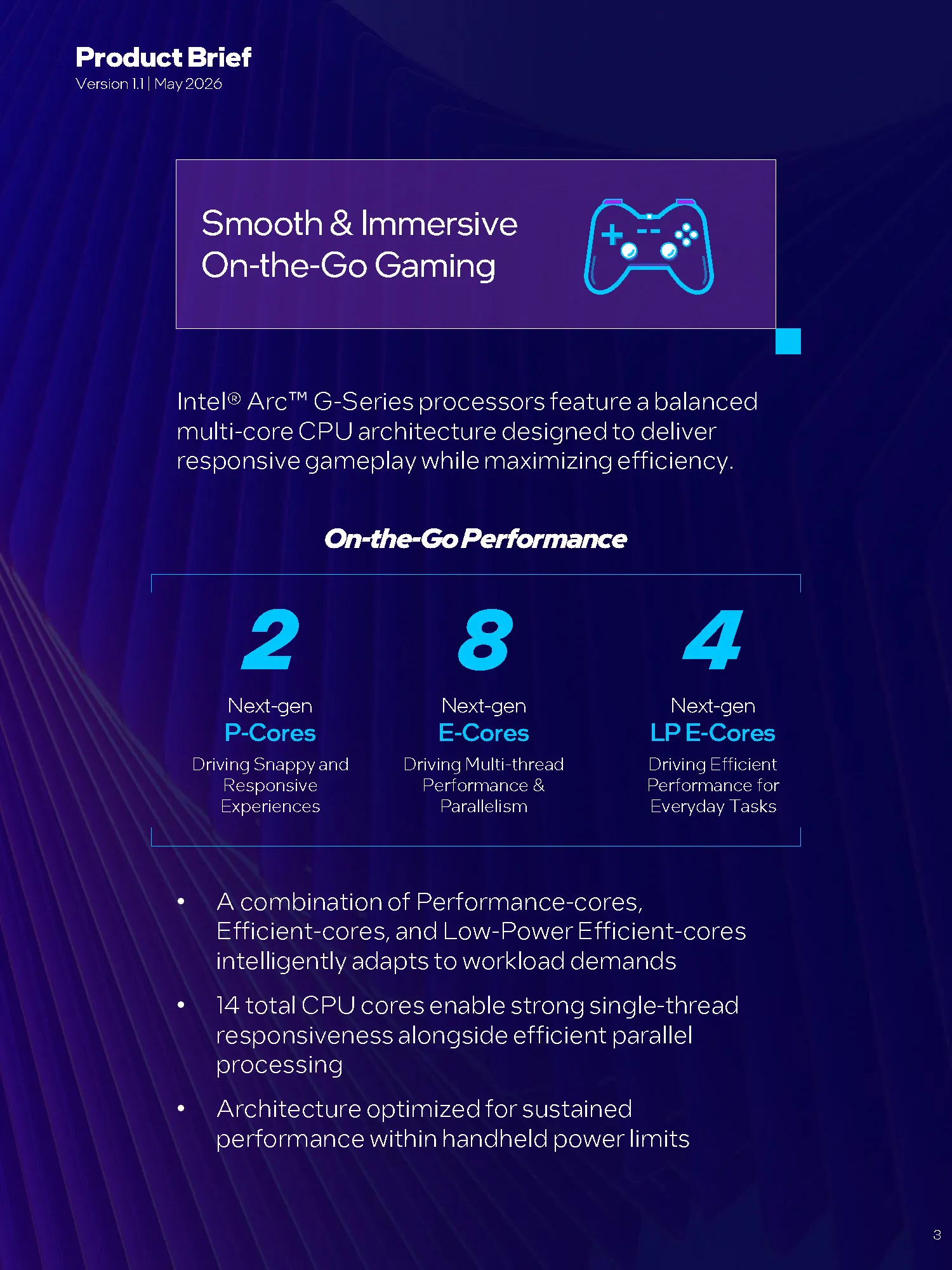
To combat thermal throttling on mobile devices, Intel has completely axed Hyper-Threading to simplify the silicon and reduce power consumption. The Arc G3 Extreme features a 14-core, 14-thread configuration distributed across three clusters, orchestrated by the Intel Thread Director:
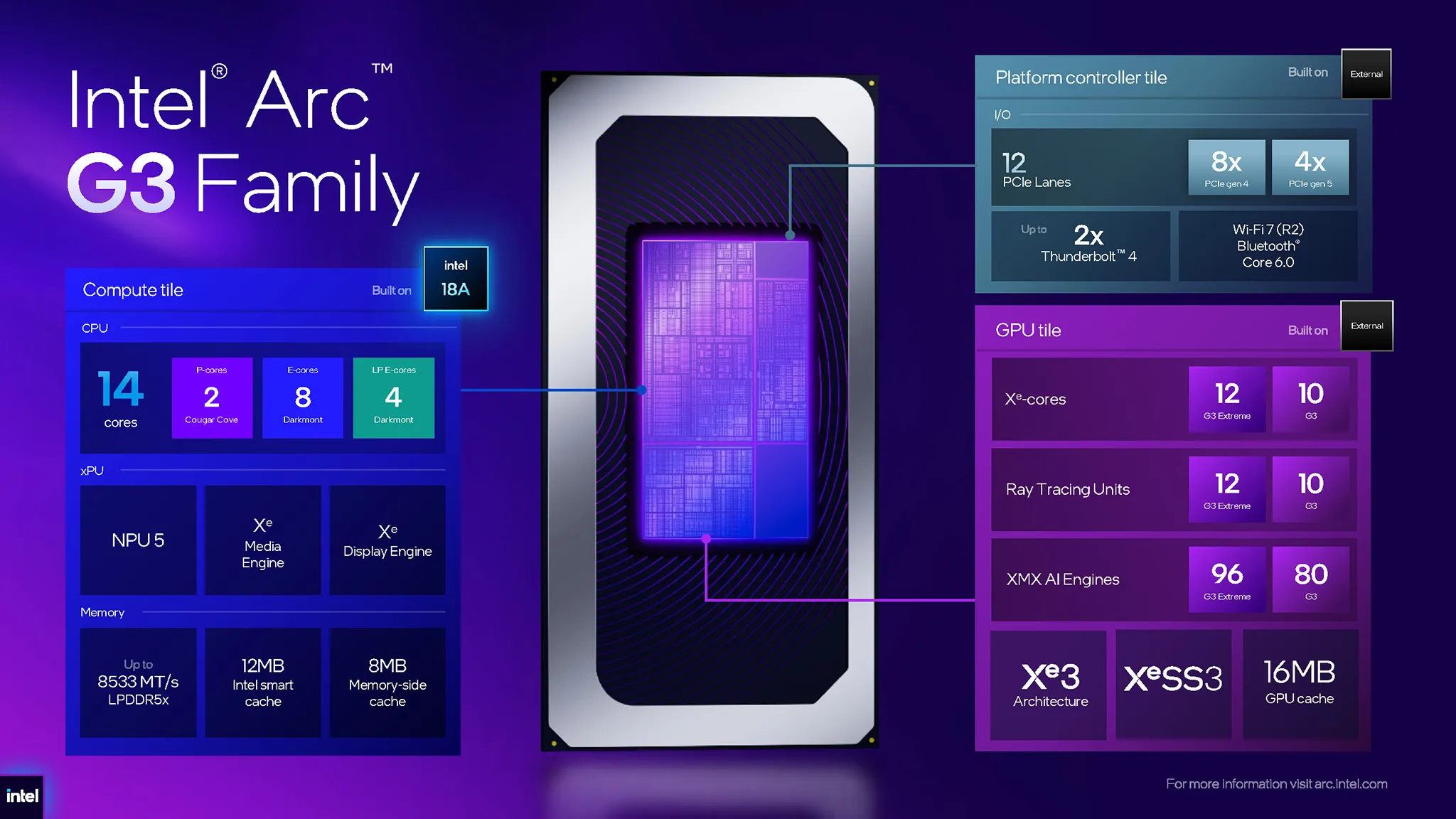
- 2 Performance Cores (P-Cores): Based on the Cougar Cove architecture; featuring a 1.9 GHz base clock and a maximum Turbo of 4.7 GHz. These are tasked with handling complex single-threaded calculations and real-time logic.
- 8 Efficient Cores (E-Cores): Based on the Darkmont architecture; clocking between 1.5 GHz and 3.4 GHz. These are tuned for parallel multi-threaded processing, such as managing in-game physics engines.
- 4 Low-Power Efficient Cores (LP E-Cores): Utilizing a low-voltage variant of the Darkmont architecture; with a maximum clock of 3.1 GHz. These handle Windows 11 background tasks, video decoding and idle state management to stretch battery life.
| Intel Arc G3 Extreme | Intel Arc G3 | |
|---|---|---|
| Process node | Panther Lake (Intel 18A + TSMC N3E) | Panther Lake (Intel 18A + TSMC N3E) |
| Core/Thread confirguration | 14 cores / 14 threads (no Hyper-Threading) | 14 cores / 14 threads (no Hyper-Threading) |
| Core clusters allocation | 2 P-Cores + 8 E-Cores + 4 LP E-Cores | 2 P-Cores + 8 E-Cores + 4 LP E-Cores |
| Maximum frequency (P/E/LP) | 4.7 GHz / 3.4 GHz / 3.1 GHz | 4.6 GHz / N/A / N/A |
| Last Level Cache (LLC) | 12 MB Intel Smart Cache | 12 MB Intel Smart Cache |
| iGPU | Intel Arc B390 (Xe3 - Battlemage) | Intel Arc B370 (Xe3 - Battlemage) |
| Xe-Cores count / Frequency | 12 cores / 2.3 GHz | 10 cores / 2.2 GHz |
| NPU (AI Engine) | NPU Gen 5 (46 TOPS INT8) | NPU Gen 5 (46 TOPS INT8) |
| Graphics computing power | 113 PTOPS | 90 PTOPS |
| RAM support | LPDDR5X-8533 (max bandwidth 136.5 GB/s) | LPDDR5X-8533 (max bandwidth 136.5 GB/s) |
| TDP | Flexible 8W - 35W (Basic 25W) | Flexible 8W - 30W (Basic 25W) |
| Network & I/O | Wi-Fi 7 R2 / BT 6.0 Dual / 2x Thunderbolt 4 | Wi-Fi 7 R2 / BT 6.0 Dual / 2x Thunderbolt 4 |
Compared to standard Panther Lake laptop variants (which typically feature 4 P-Cores), stepping the Arc G3 Extreme down to just 2 P-Cores frees up significantly more thermal headroom. Funneling that extra power budget directly into the iGPU allows for a highly flexible TDP envelope ranging from 8W to 35W (with a guaranteed minimum floor of 15W and short-burst Turbo limits reaching up to 80W).
Xe3 graphics architecture and AI acceleration
The integrated Arc B390 graphics tile is built on the Battlemage (Xe3) architecture, featuring 12 Xe-cores running at a 2.3 GHz clock speed. The Xe3 graphics architecture boasts up to 96 XMX (Xe Matrix eXtensions) engines arranged in a systolic array, enabling direct hardware-level matrix math calculations.
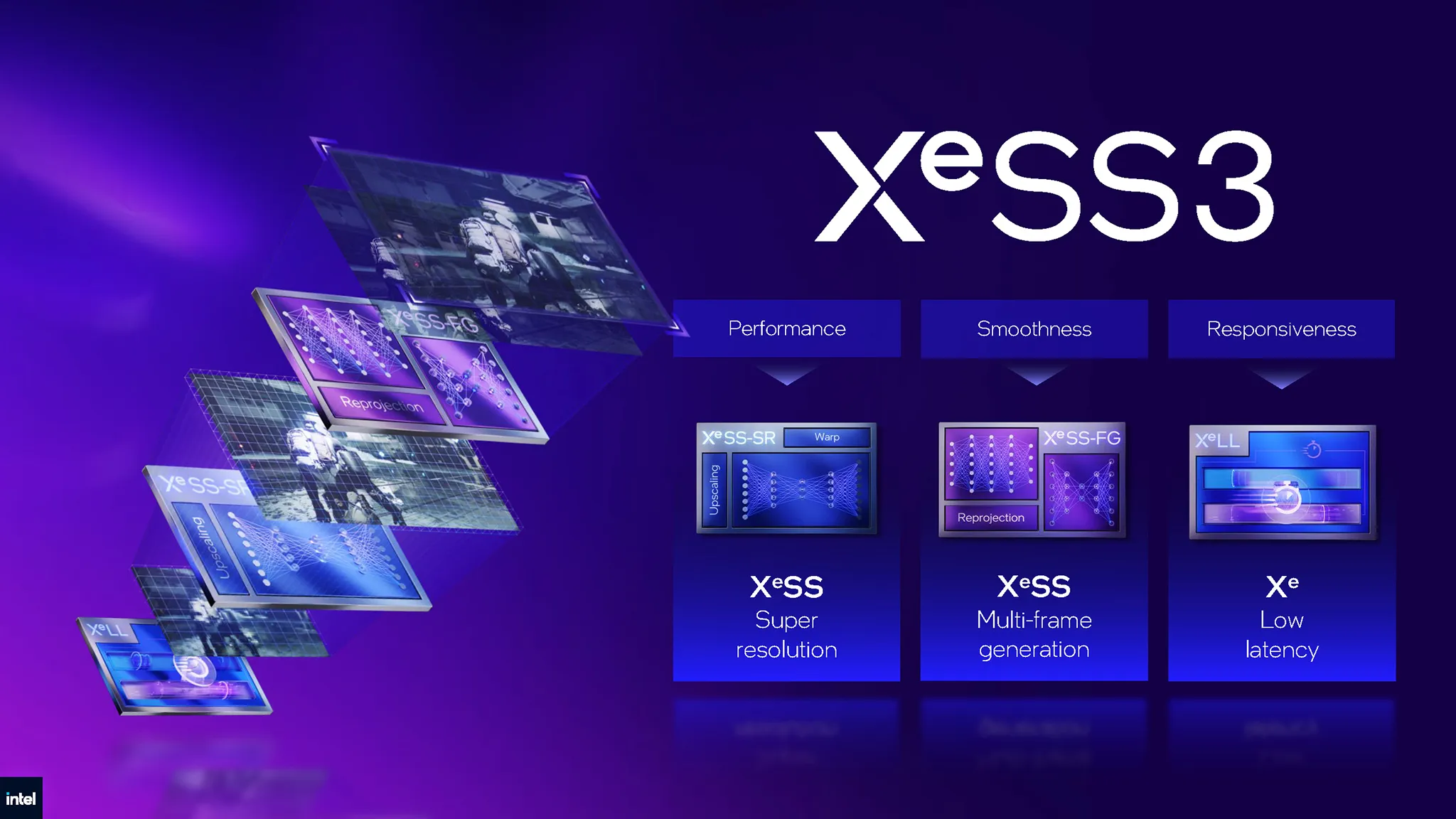
By combining the hardware muscle of the Gen 5 NPU (46 TOPS) and the GPU (113 PTOPS), the system forms a comprehensive AI compute platform delivering roughly 160 TOPS of total performance. This platform is perfectly positioned to drive the XeSS 3 upscaling suite:
- XeSS-SR (Super Resolution): Renders the scene at a lower native resolution (such as 720p) and leans on machine learning models running on the XMX cores to reconstruct the missing pixels. This scales the output to a sharper 1080p image while drastically minimizing the hardware resources required for native rendering.
- XeSS-MFG (Multi-Frame Generation): A frame generation technique that utilizes optical flow reprojection combined with motion vectors extracted directly from the game engine. An AI algorithm accurately interpolates the spatial changes between consecutive frames and inserts a newly generated frame, effectively pushing framerates from 30-40 FPS up to 70-80 FPS. This framerate territory delivers a vastly smoother gaming experience.
- XeLL (Xe Low Latency): To combat the inherent input lag introduced by the frame generator's queuing mechanism, XeLL hooks directly into the game engine's render pipeline. It synchronizes control signals to aggressively minimize the response time from a button press to the on-screen action.
Proprietary power management algorithms
Intelligent Bias Control - IBC v3.5

On legacy hardware architectures, power distribution was typically fixed between the CPU and GPU. The velocity-based algorithm in IBC v3.5 continuously monitors real-time loads, automatically shifting the lion's share of the package power headroom directly to the iGPU during gaming. IBC activates an "E-cores-first scheduling" mode and parks the high-performance P-cores. This approach feeds more power to the graphics tile, netting an average 13% uplift in framerates at highly constrained, ultra-low 12W power limits.
Endurance Gaming
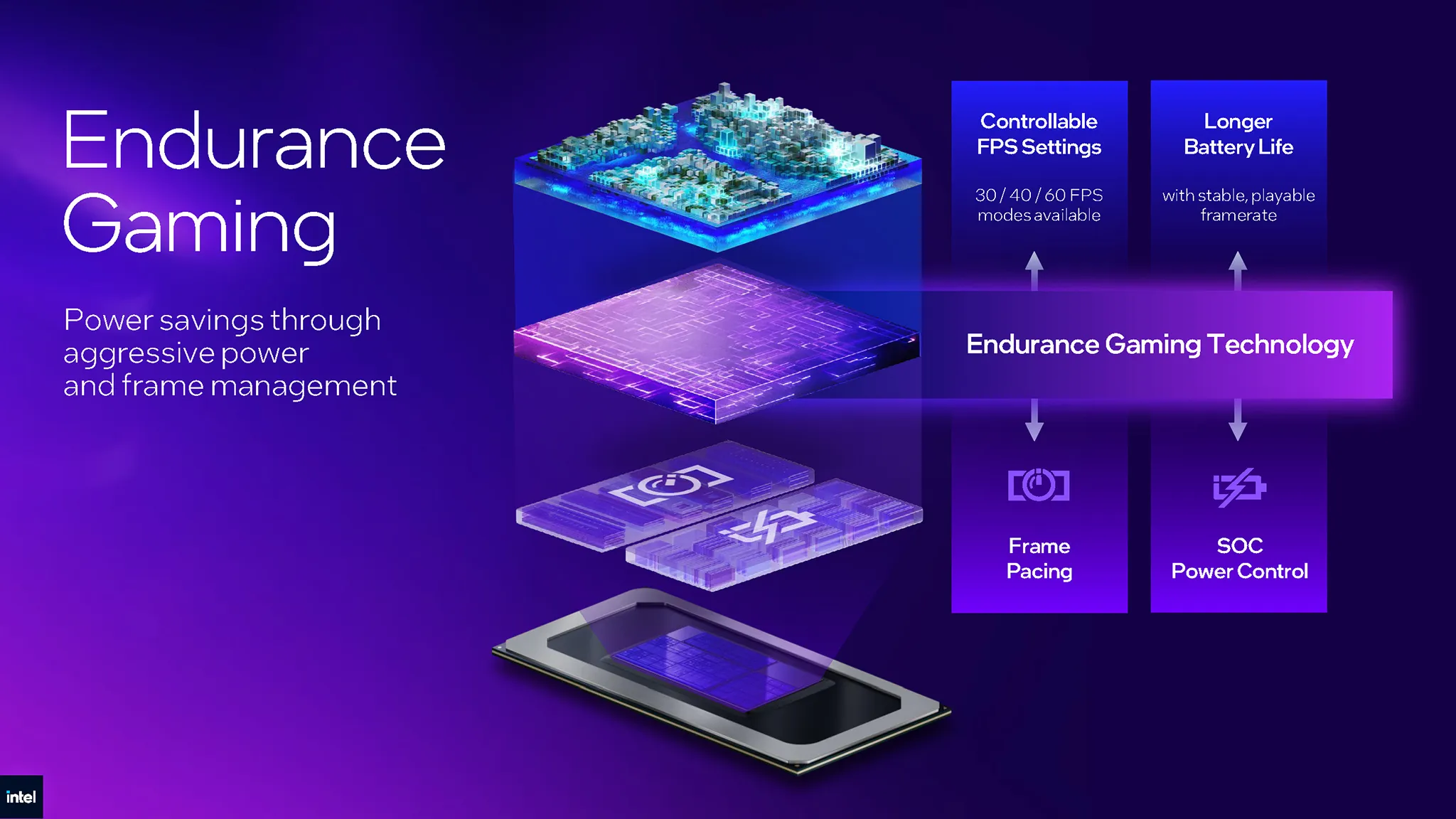
By pairing SoC Power Control with Frame Pacing, the Endurance Gaming feature allows users to lock in a target FPS threshold. Once the system hits that predefined framerate, the processor actively puts any underutilized silicon blocks into a rest state.
In real-world testing with Team Fortress 2, total SoC power draw plummeted from 22W down to just 4W (with the CPU sipping 13% of that power budget and the GPU pulling a mere 3%).
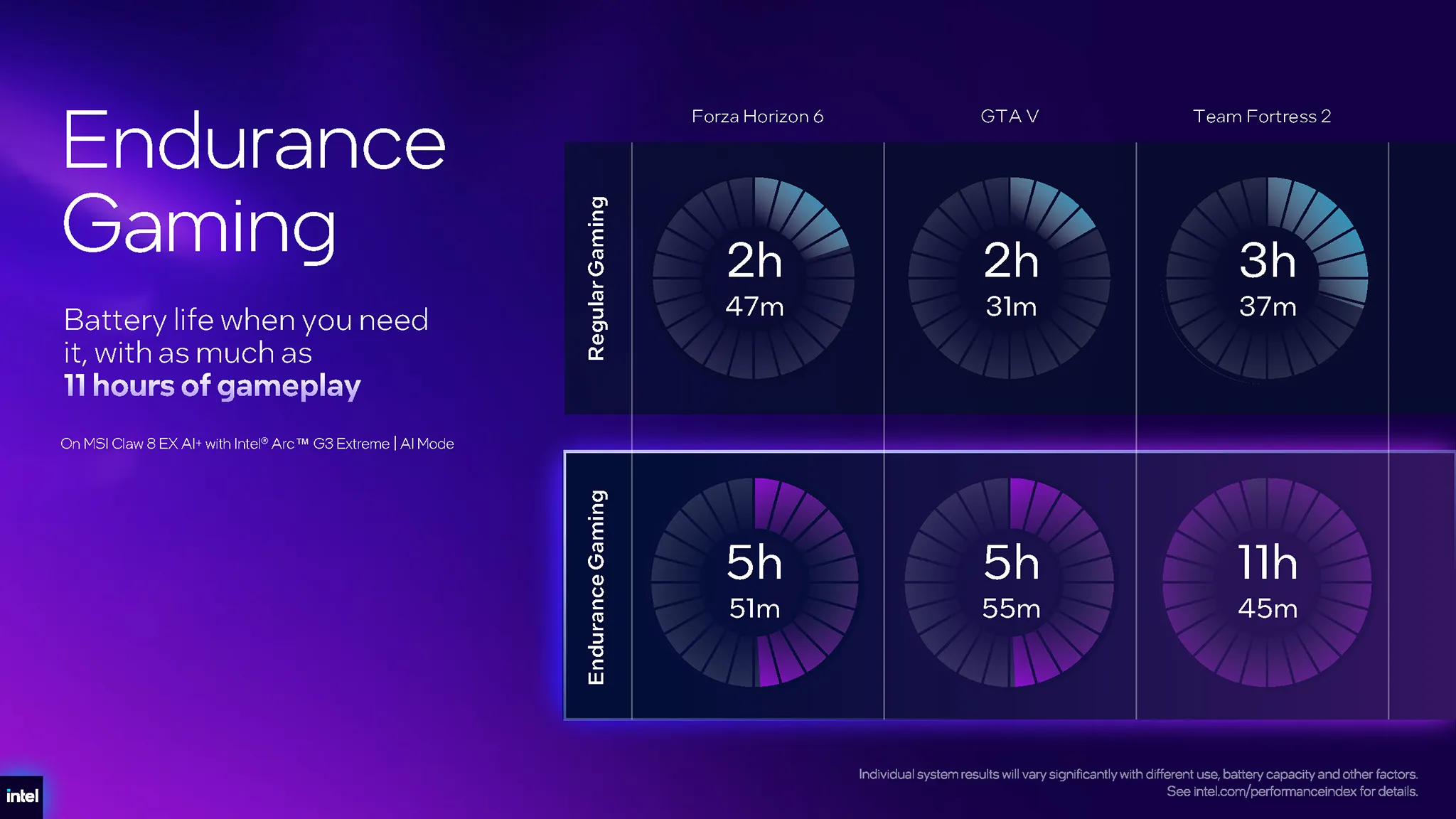
Real-world battery life benchmarks (using an 80Wh battery, running in AI Mode + Endurance Gaming Efficiency):
- Forza Horizon 6: Jumped from 2 hours 47 minutes to 5 hours 51 minutes.
- Grand Theft Auto V: Increased from 2 hours 31 minutes to 5 hours 45 minutes.
- Team Fortress 2: Skyrocketed from 3 hours 37 minutes to 11 hours 09 minutes.
Precompiled Shader Distribution
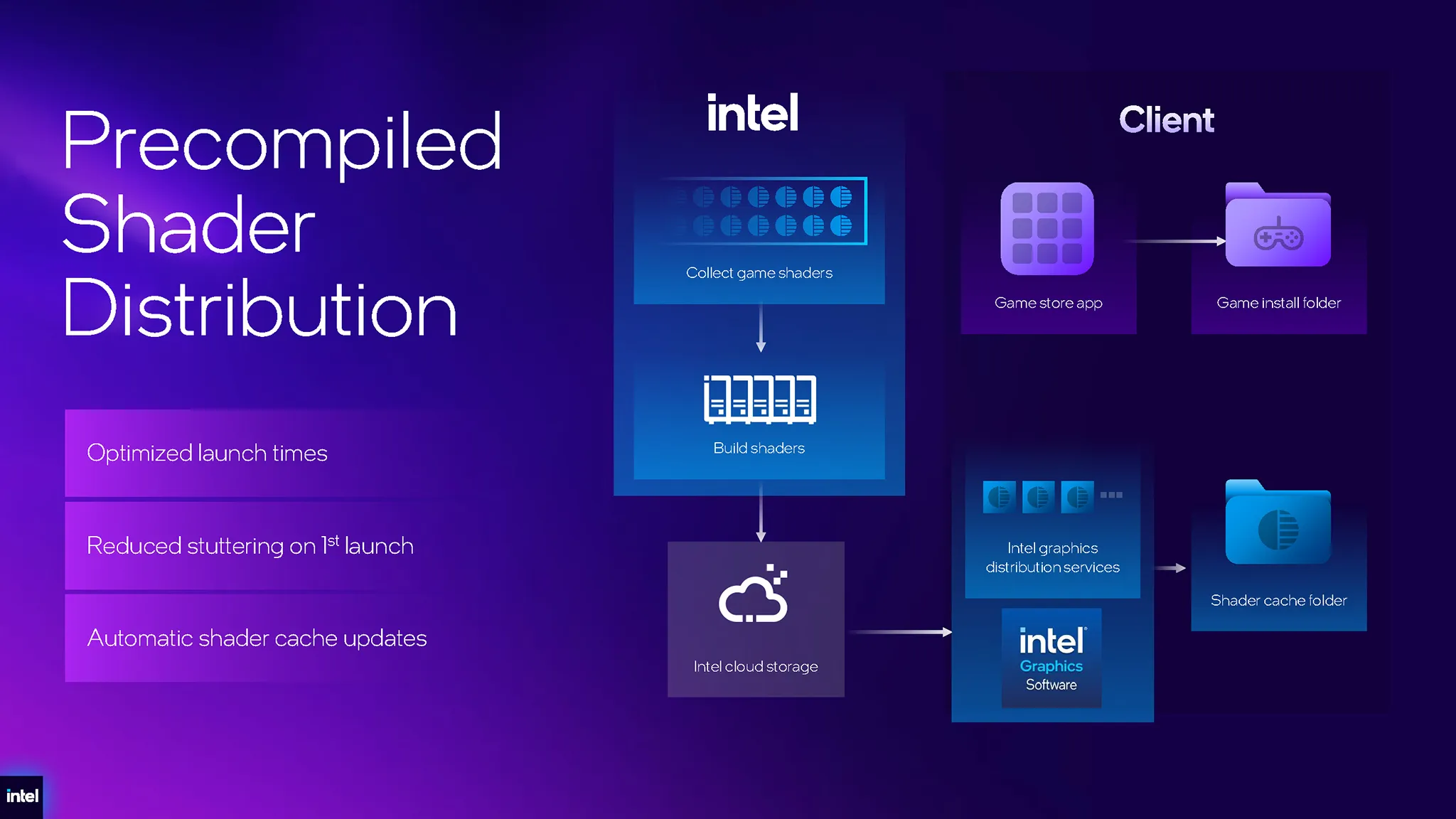
To completely eradicate the sudden stuttering caused by compiling new shader data on the fly, Intel is actively crowdsourcing and precompiling shaders for popular titles via the Intel Cloud. A complete shader cache package automatically syncs directly to the user's local installation directory. This solution slashes average game load times by more than 3x:
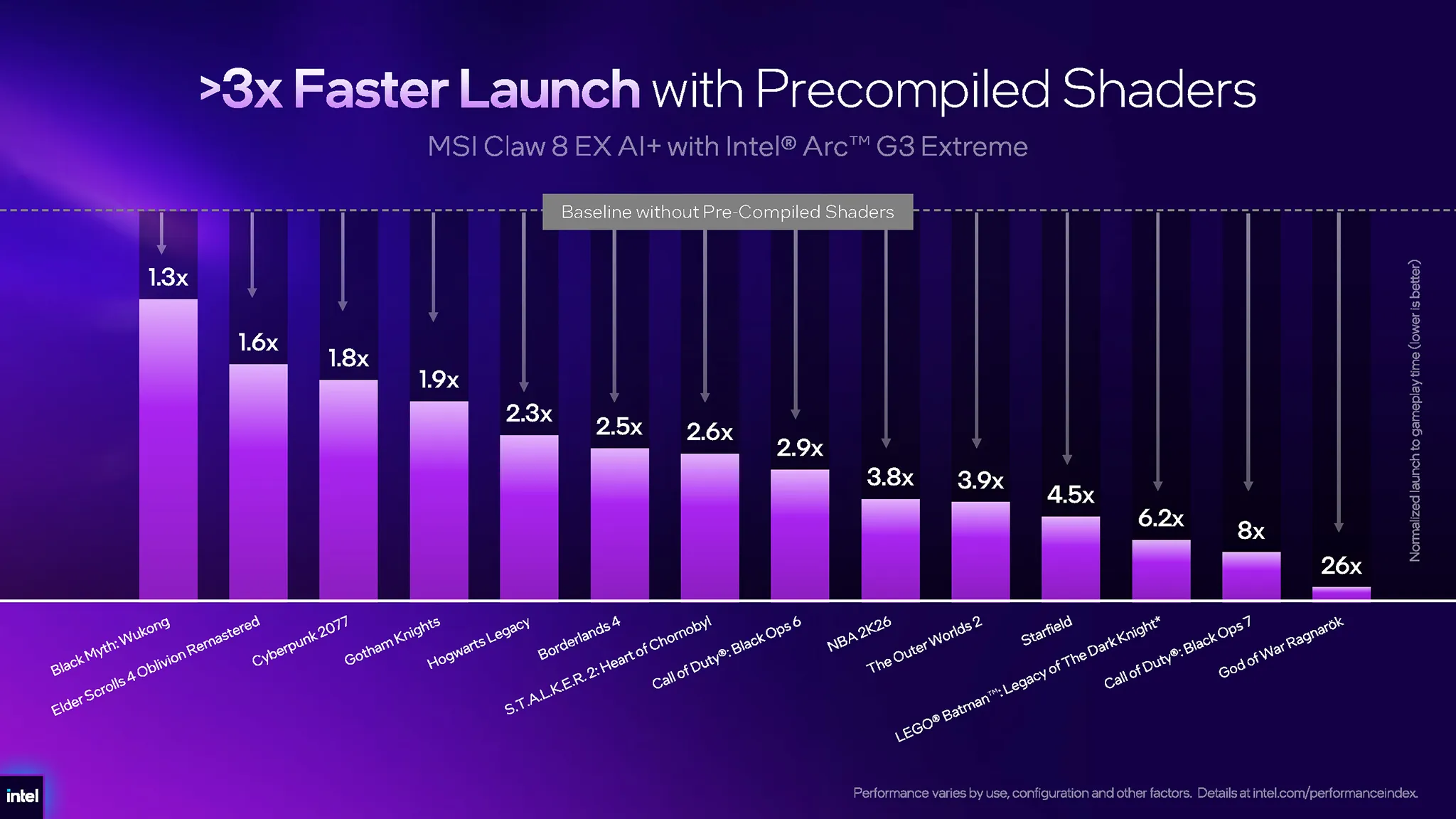
- Black Myth: Wukong: 1.3x faster.
- Cyberpunk 2077: 1.6x faster.
- Hogwarts Legacy: 2.3x faster.
- Starfield: 8.0x faster.
- God of War Ragnarok: 26.0x faster.
Performance: Gen-on-Gen and versus the competition
Intel benchmarked the Arc G3 Extreme on the MSI Claw 8 EX AI+ (32 GB LPDDR5X-8533, 4 TB SSD), squaring it up against the Intel Core Ultra 7 258V (Lunar Lake) and the AMD Ryzen Z2 Extreme (Zen 5 + Radeon 890M RDNA 3.5 GPU, 24 GB LPDDR5X-8000). All tests were run at a 1080p output resolution with 2x upscaling.
Versus Lunar Lake (Intel Core Ultra 7 258V)
Thanks to the bump up to 12 Xe3 cores, the Arc G3 Extreme demonstrates overwhelming dominance at higher power envelopes:
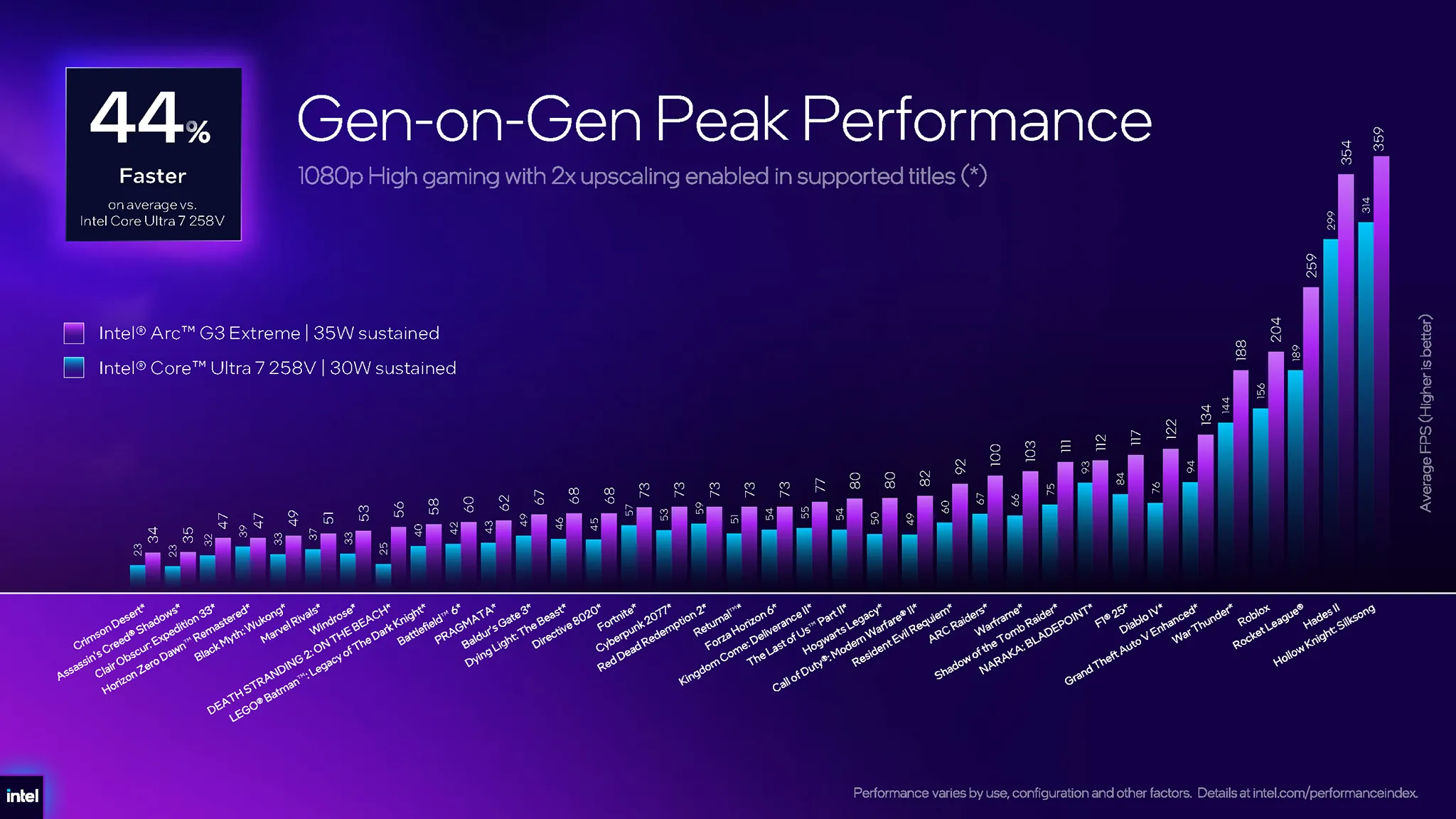
- At a 35W setting, across a 36-game average, the Arc G3 Extreme outperformed the Ultra 7 258V by 44%.
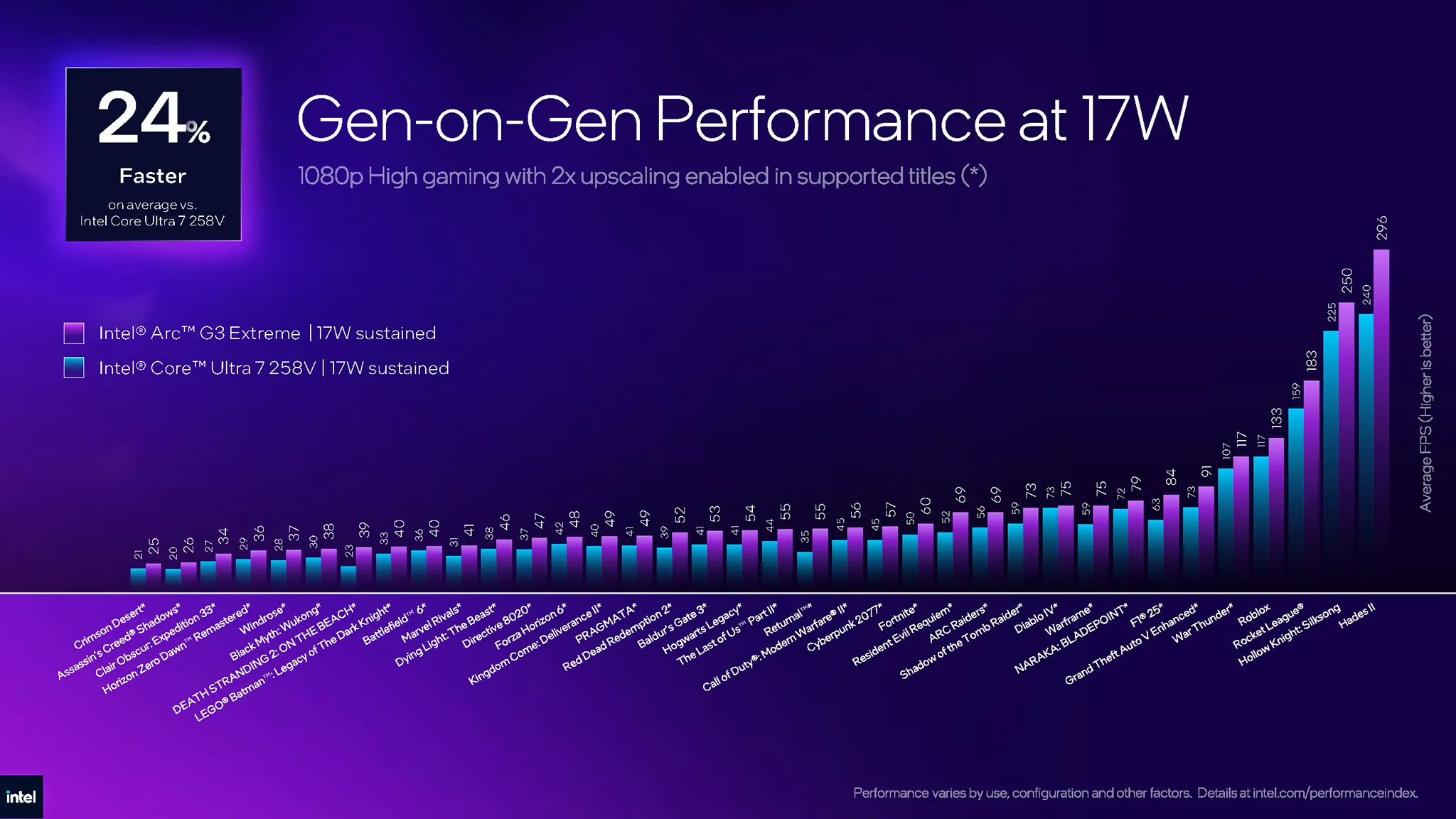
- Down at a restricted 17W limit, the chip still maintains a 24% lead, ensuring heavy-hitters like Hogwarts Legacy run stable in the 50-60 FPS range.
Versus AMD Ryzen Z2 Extreme
At 35W (High Graphics Preset): The Arc G3 Extreme leads by an average of 42%:
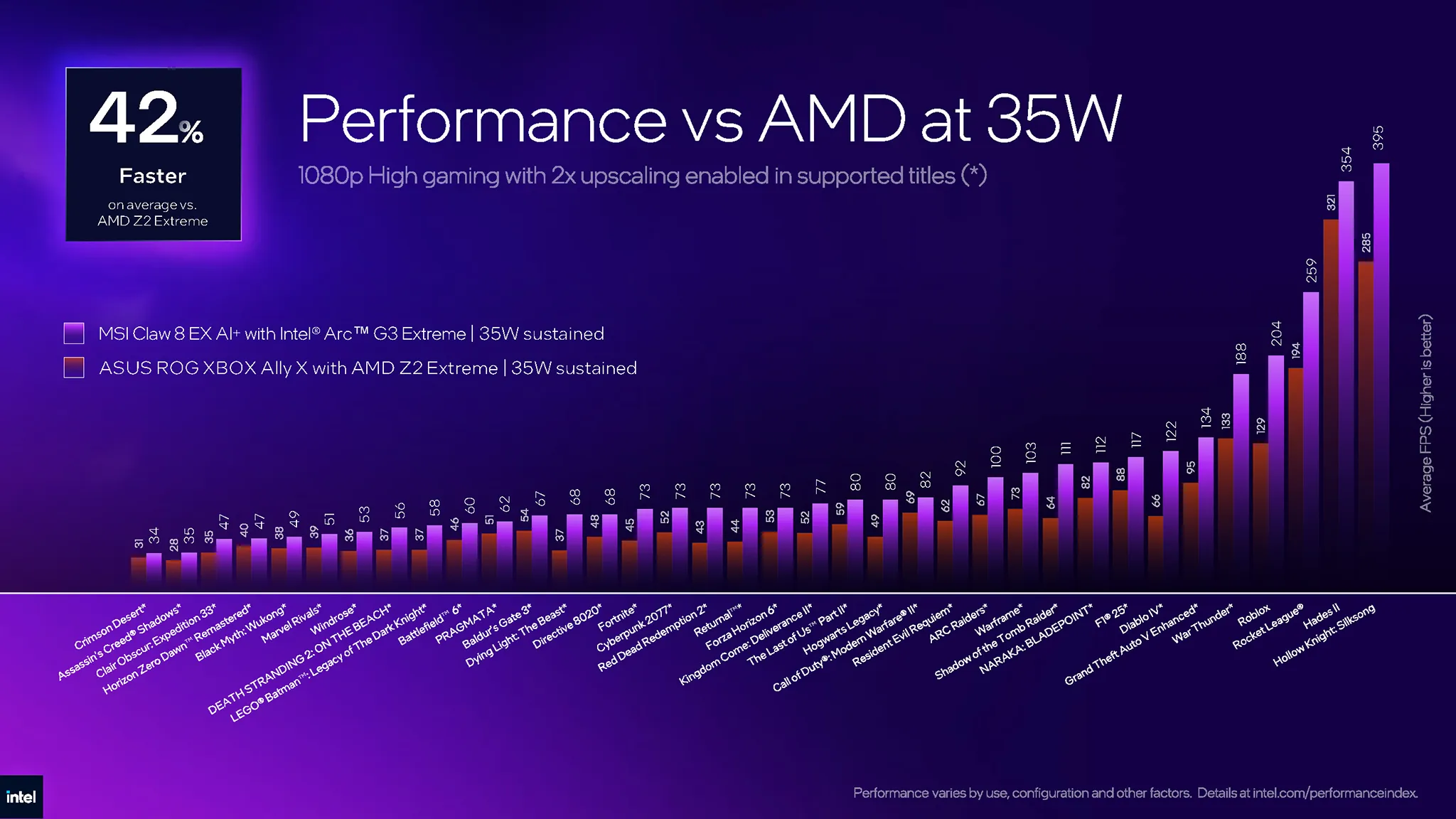
- Cyberpunk 2077: Intel hits 97 FPS | AMD hits 68 FPS.
- Hogwarts Legacy: Intel hits 117 FPS | AMD hits 64 FPS.
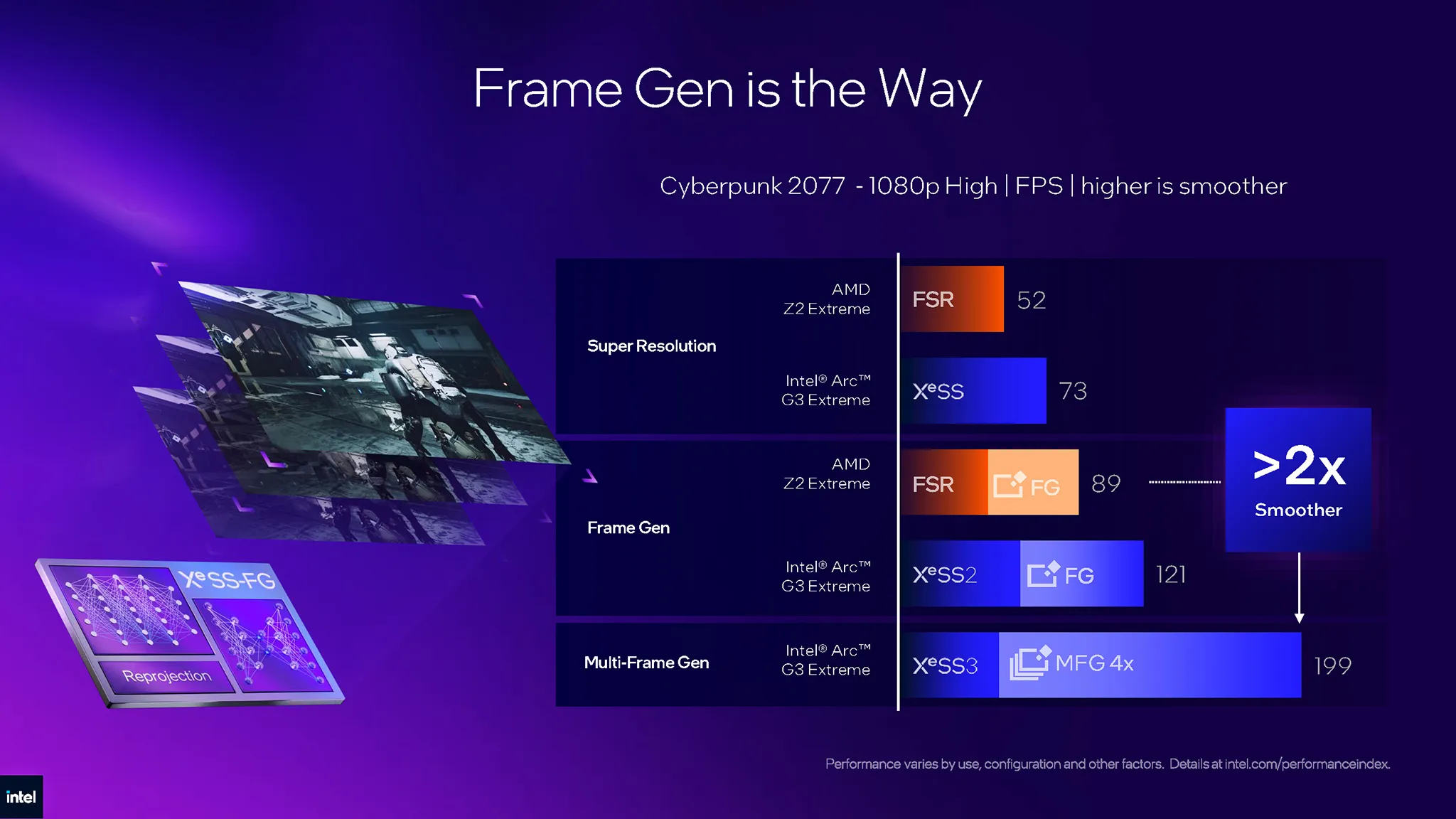
- Forza Horizon 6: Intel hits 134 FPS | AMD hits 95 FPS. (When enabling frame generation in Cyberpunk 2077 at 1080p High, XeSS 3 Multi-Frame Gen delivers a 2.5x smoother graphical experience, pushing 199 FPS compared to just 89 FPS on AMD FSR).
At 17W: Intel pulls ahead by an average of 20%.
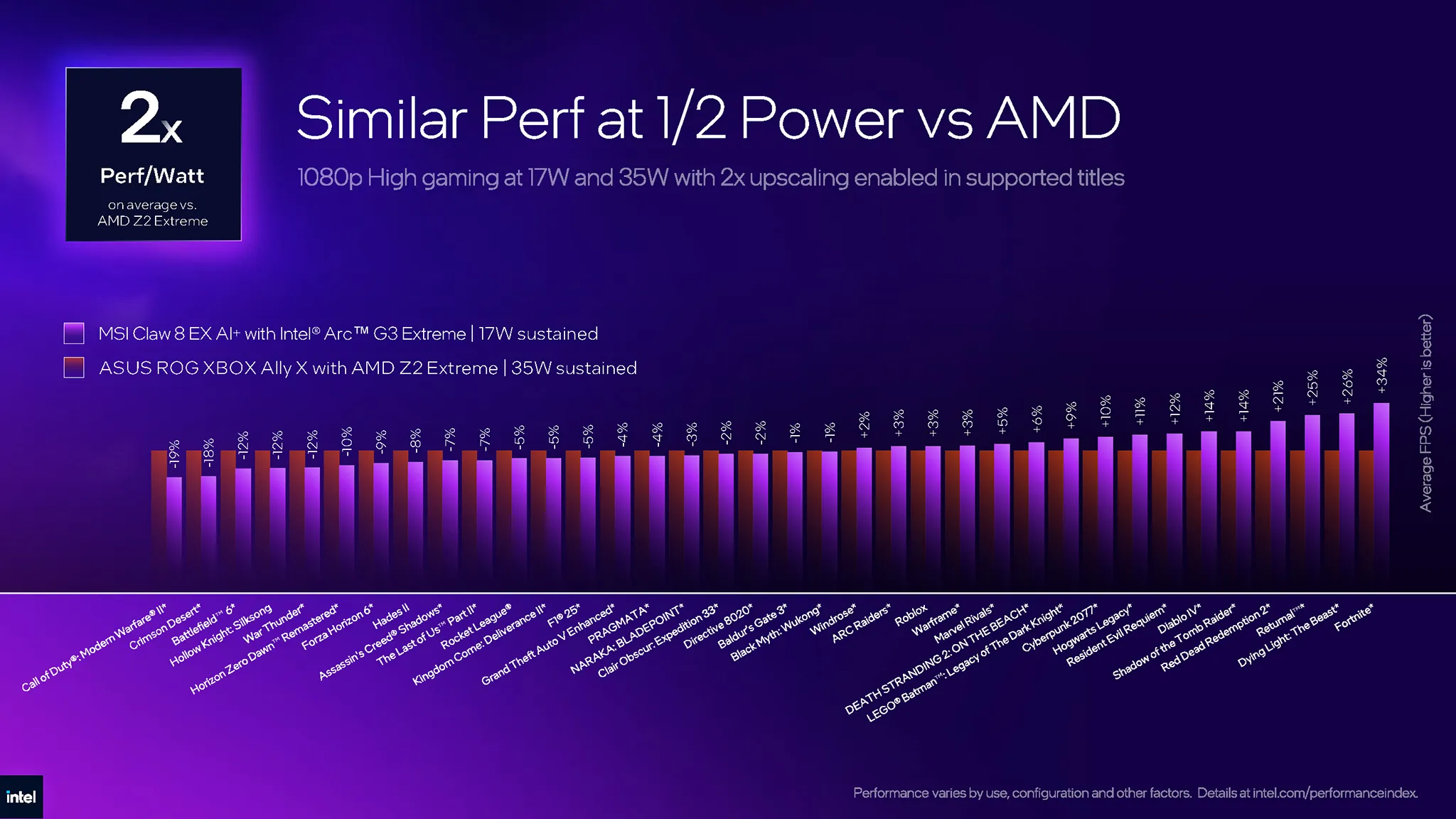
At 12W (Low Graphics Preset): Intel completely flips the script in the low-power segment - historically a major weakness for previous generations - beating the Zen 5 architecture by 37%.
- Cyberpunk 2077: Intel hits 54 FPS | AMD hits 39 FPS.
- Black Myth: Wukong: Intel hits 51 FPS | AMD hits 41 FPS.
- Grand Theft Auto V Enhanced: Intel hits 99 FPS | AMD hits 71 FPS.
Performance-per-watt: Configured at a lean 17W, the Arc G3 Extreme delivers framerates equivalent to and sometimes 2% to 5% higher in lighter titles, than the AMD Ryzen Z2 Extreme chugging at its full 35W limit. Intel's architecture effectively delivers double the performance-per-watt of its competitor.
The commercial product lineup
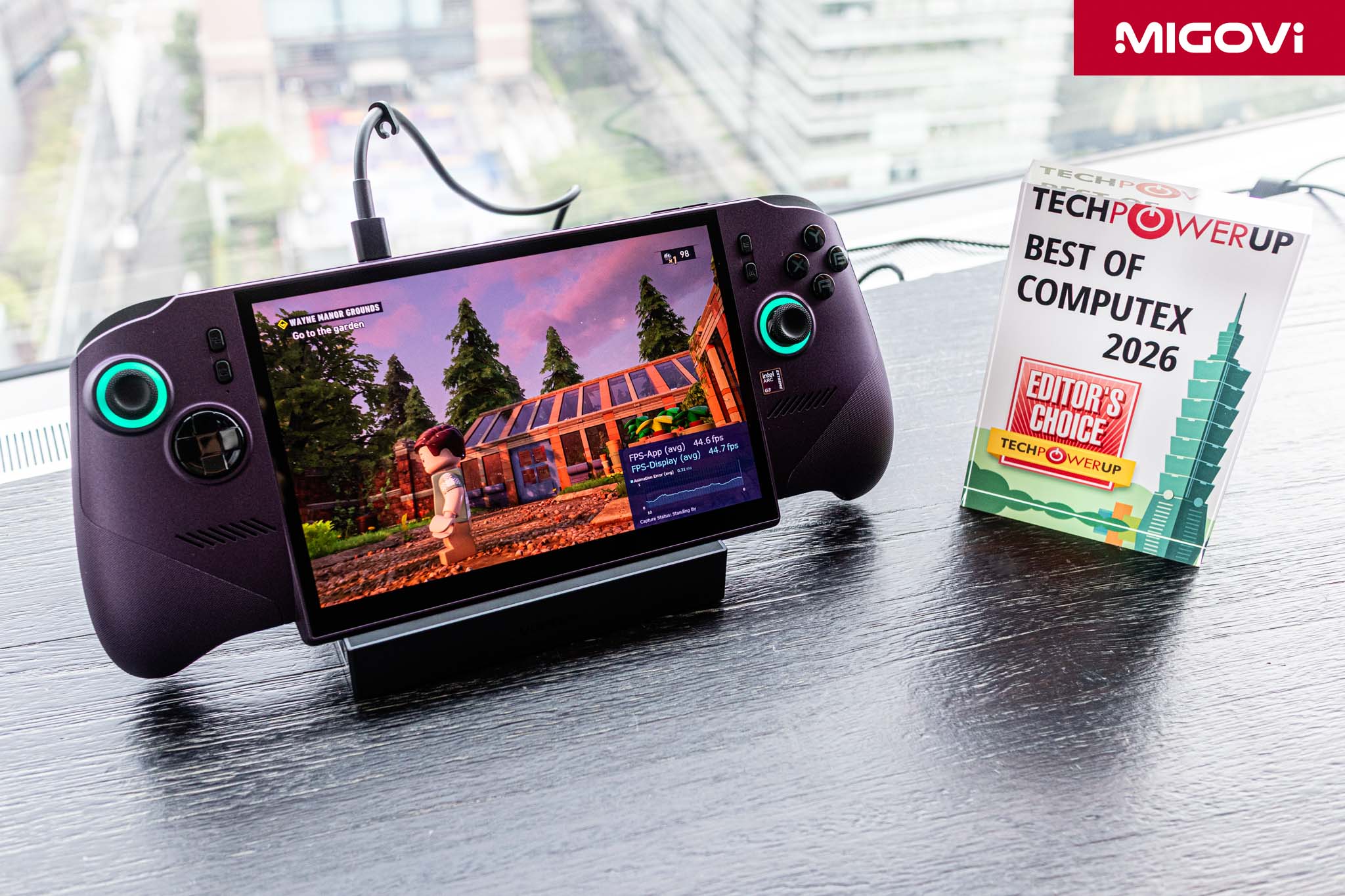
MSI Claw 8 EX AI+: The flagship handheld contender. It features an 8-inch IPS display (1920 x 1200), a 16:10 aspect ratio and a 120 Hz refresh rate with VRR. The control scheme utilizes Hall-effect magnetic sensors for both the joysticks and triggers to permanently eliminate stick drift. A 6-axis IMU rumble motor array paired with software algorithms produces an impressive HD Haptics response. The unit packs a massive 80Wh battery, Cooler Boost Hyperflow thermals and runs MSI Center M 2.0. The MSI Claw 8 EX AI+ is projected to retail for $1500, launching on June 23rd.
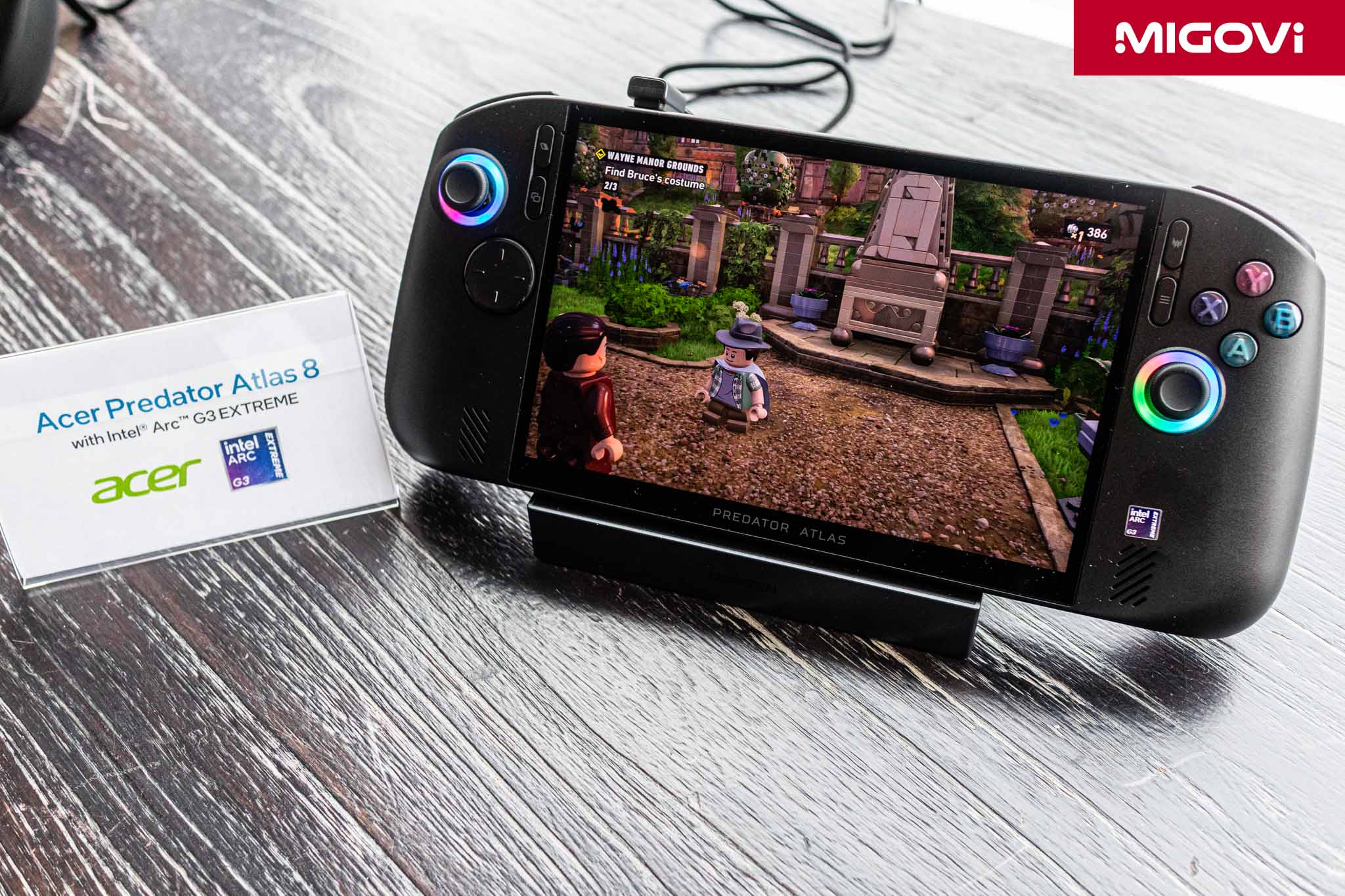
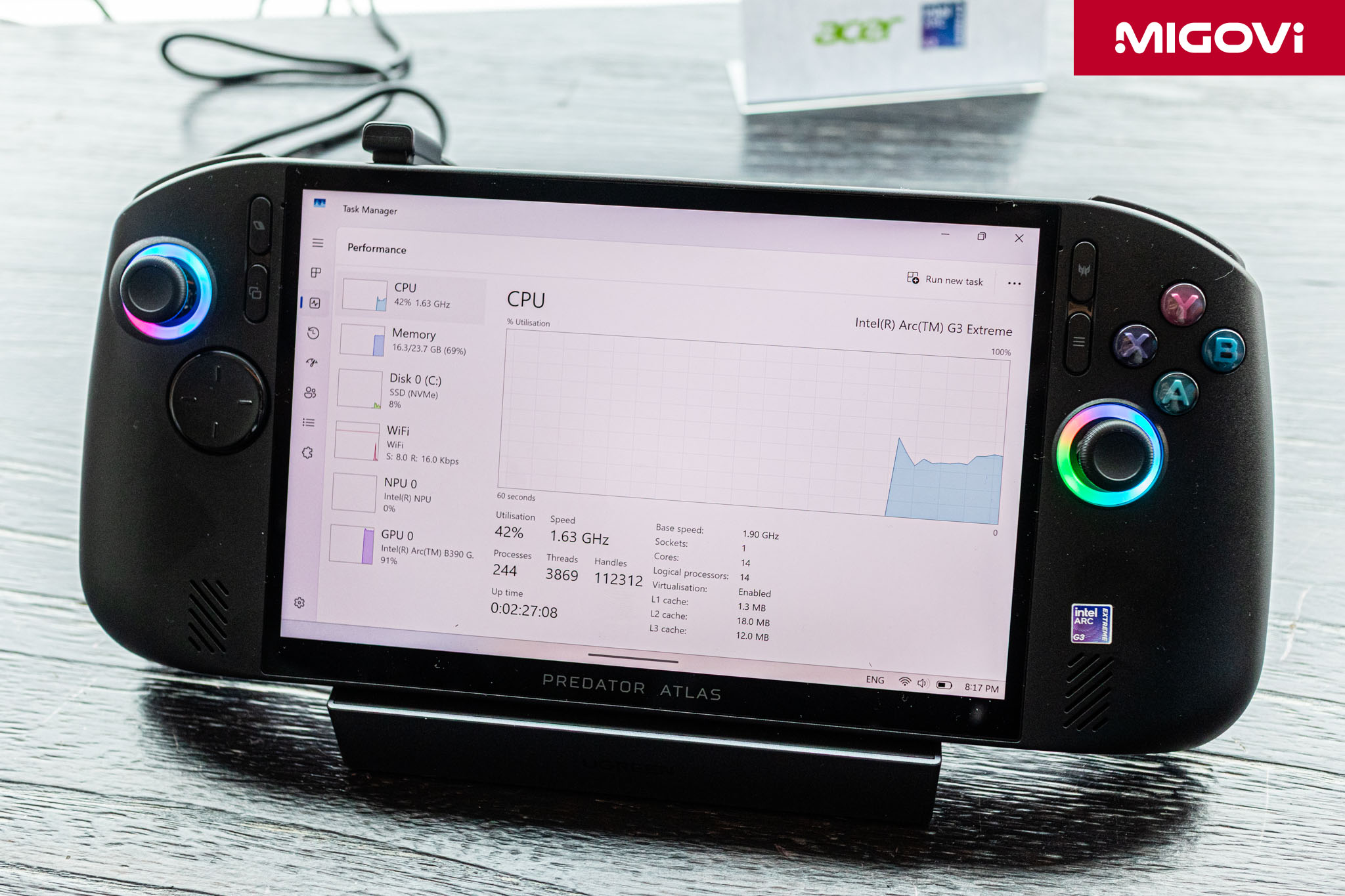
Acer Predator Atlas 8: Slated for an October 2026 launch. It sports an 8-inch WUXGA 120 Hz VRR display hitting 500 nits of brightness with 100% sRGB coverage. This handheld packs dual Predator AeroBlade fans with ultra-thin metal blades and a Vortex Flow design, boosting airflow by over 10% to sustain the chip's Turbo state for longer durations. The Acer Predator Atlas 8 integrates an 80Wh battery and PredatorSense software.
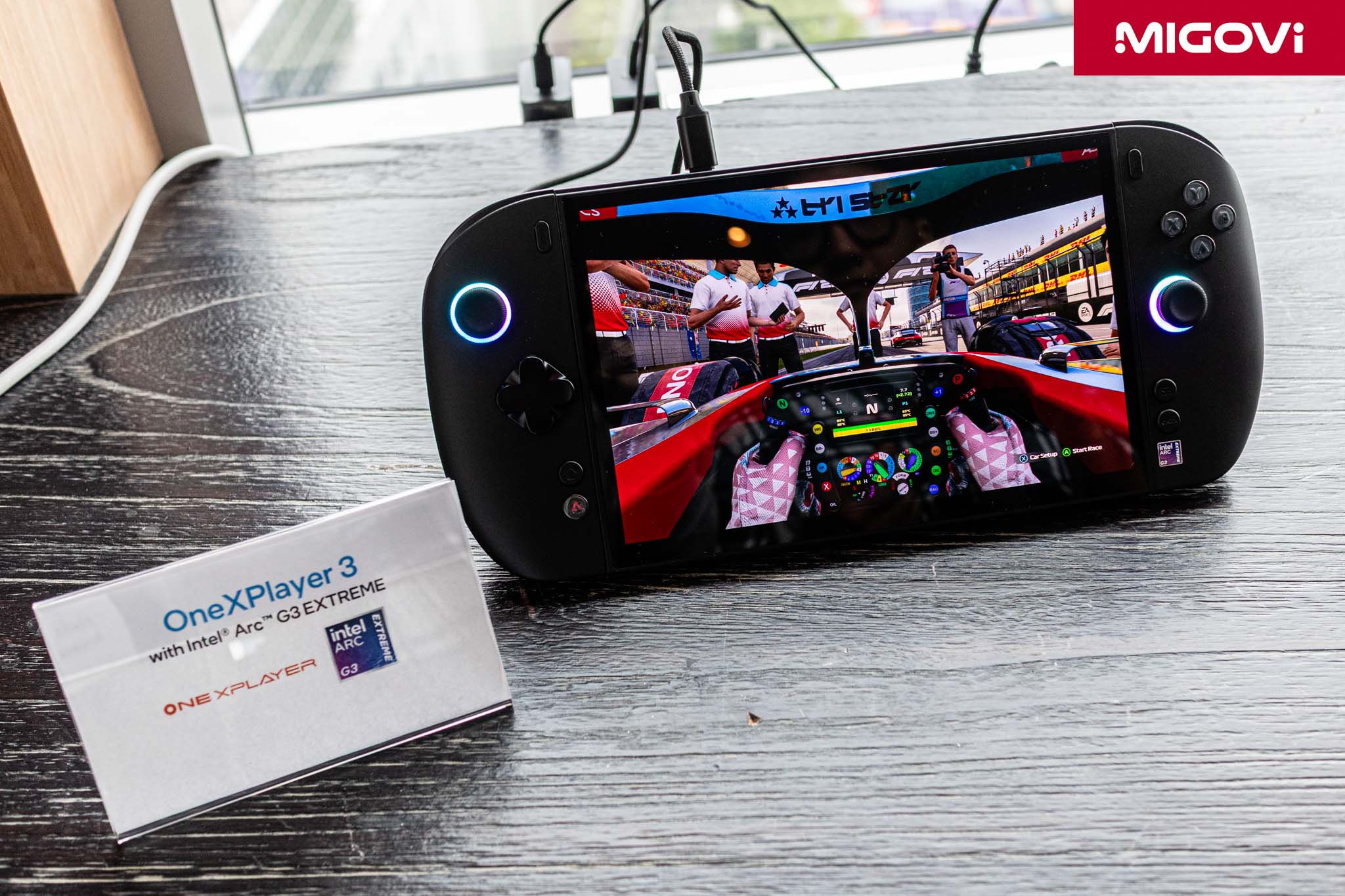
OneXPlayer 3: A premium-tier model focused on high-end visuals, featuring a massive 8.8-inch OLED display and a detachable controller design similar to the Lenovo Legion GO.
The bottom line
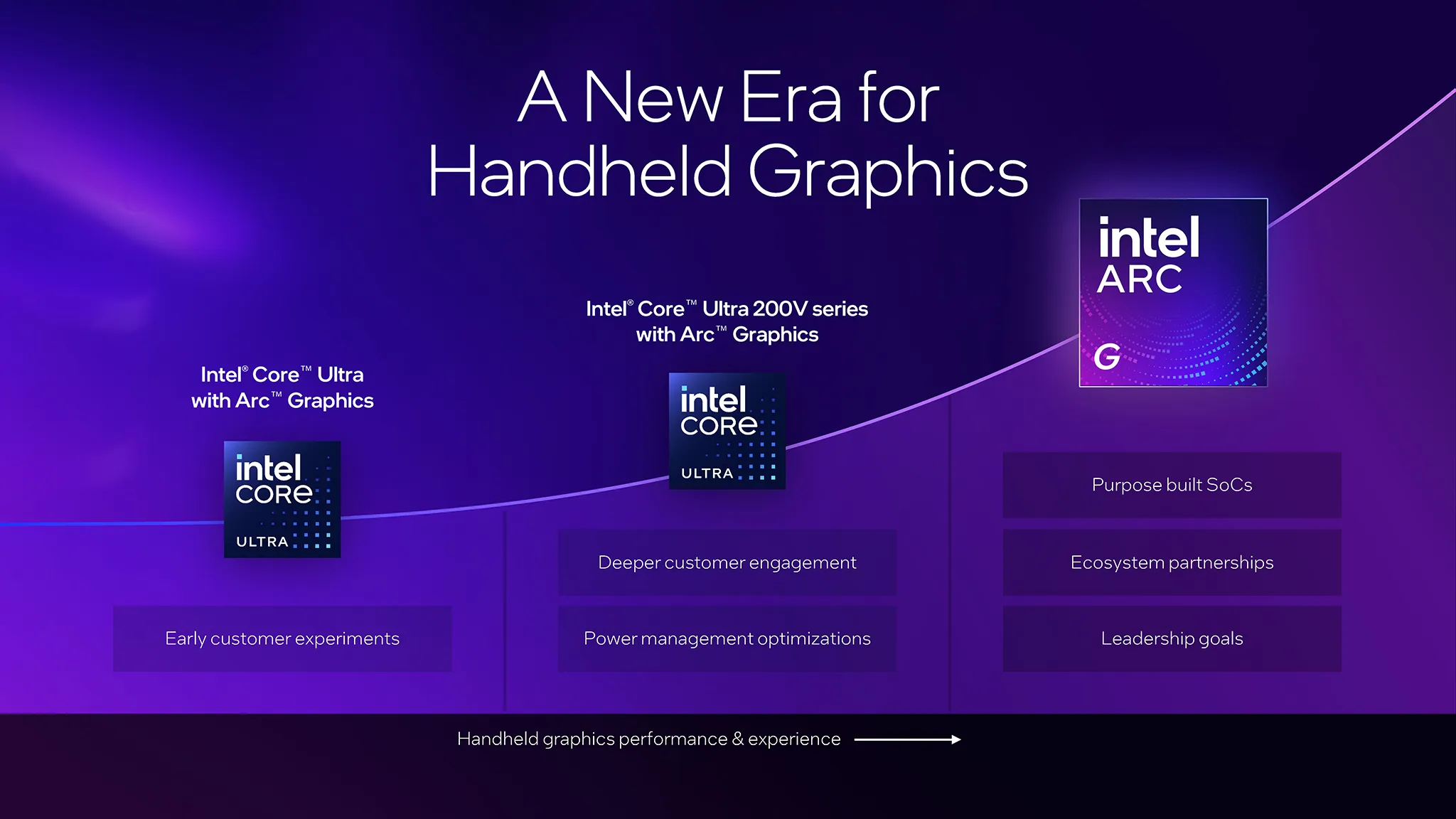
The Intel Arc G3 Extreme wields serious competitive advantages, setting a new benchmark for mobile devices and handheld PCs. The Battlemage Xe3 graphics architecture (12 cores) delivers optimal raw compute, backed to the hilt by the XeSS 3 AI ecosystem (integrating Multi-Frame Generation and XeLL latency reduction) to crank up framerates while preserving image quality. At the same time, the power consumption puzzle has been fundamentally solved thanks to smart power management from the Intel 18A node paired with the IBC v3.5 algorithm. Furthermore, the Arc G-Series ensures top-tier connectivity with Wi-Fi 7 R2 networking and Thunderbolt 4 (40 Gbps) ports featuring Thunderbolt Share support.
Intel has laid out a clear roadmap for the Handheld PC sector, stretching from Panther Lake (2026) through Nova Lake Edge (2026 - 2027) and onto Razor Lake (2027). The most notable highlight in this mid-cycle is Nova Lake Edge with its highly specialized design: completely dropping P-Cores to go all-in on an 8-core cluster of next-gen E-Cores (Arctic Wolf) paired with a 12-core Xe3 iGPU. By shifting the CPU portion to TSMC's 2 nm (N2) node, this variant promises a 20-25% bump in iGPU performance over the Arc G3 Extreme. Heading into late 2027, the Razor Lake generation (leveraging Griffin Cove and Golden Eagle cores) will further cement Intel's open reference design ecosystem. This trajectory not only paves the way for potential hardware partnerships with Microsoft - such as an Xbox Surface Handheld - but also aligns with the horsepower of the Clearwater Forest server platform to serve future Cloud Gaming infrastructure.