Tesla says FSD v15 improves its critical intervention rate by 25x, but it has not published the actual figure, so the gain is still very hard to verify.
- FSD v15 has started rolling out. Tesla has not said which cars get it first, and the AI4 (HW4) computer is reportedly enough to run it
- Tesla claims a 25x improvement in critical intervention rate but has not published the real number
- Improvements target road signs, potholes, school zones, and speed cameras, with Reality View and Bike Rack Mode added
- Driver monitoring is relaxed in high-speed driving profiles, running against the tightening trend in Europe
- Fleet-learned navigation currently applies only to the start and end of a trip
Table of Contents
What's in FSD v15
Tesla has just started rolling out "Full Self-Driving" v15. It was announced on X, and the Tesla Super Intelligence account then posted the full release notes. The company has not said which cars are updated first, but it previously told investors that the AI4 (HW4) computer is capable of running v15. Notably, the list of improvements reads like a list of FSD's biggest weaknesses today: sign recognition, pothole avoidance, and speed handling in school zones.
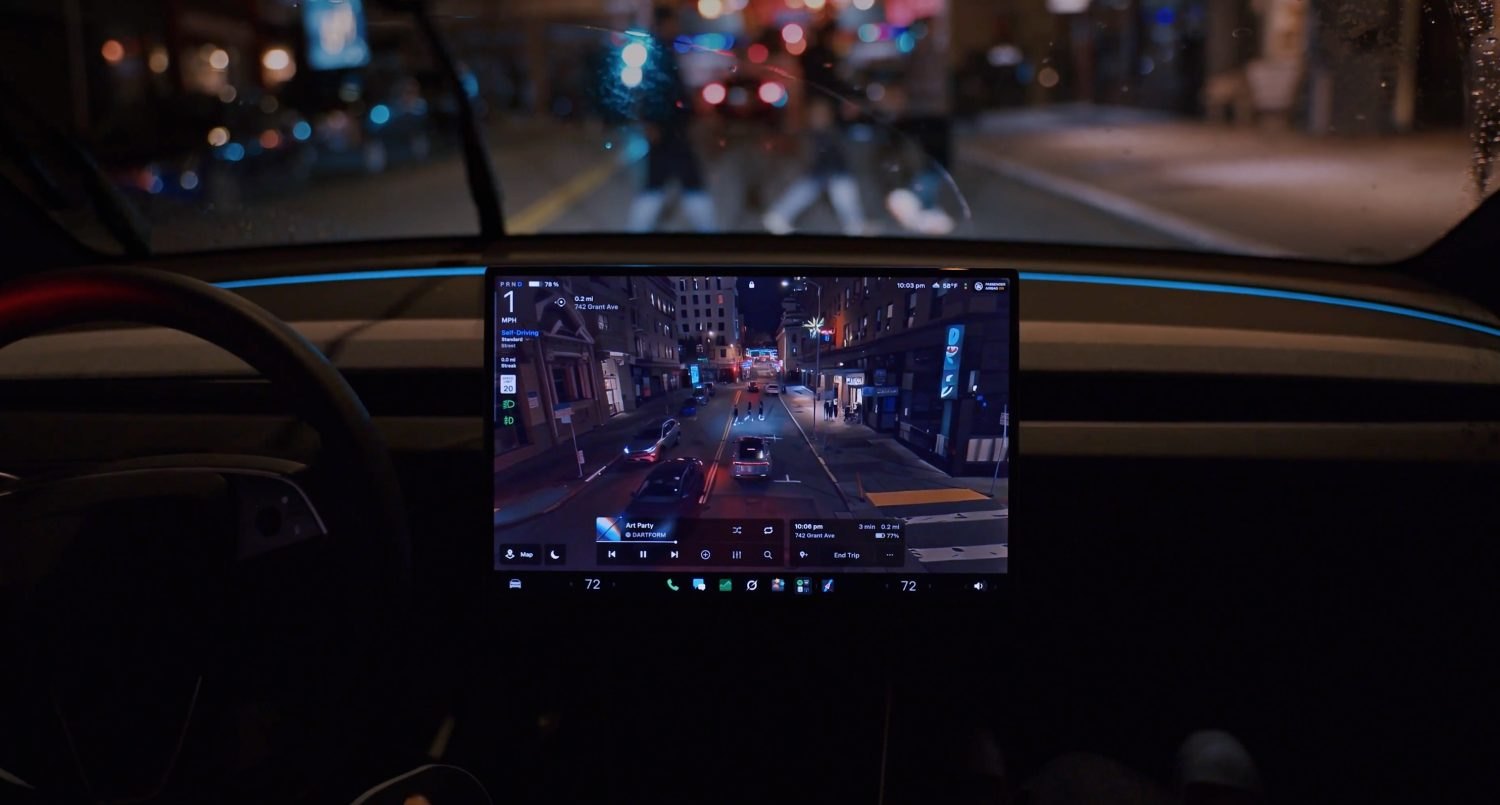
At the core is an upgraded vision encoder shared across FSD, Robotaxi, and Optimus, trained on millions of videos from the internet to generalize better and use data more efficiently. Tesla says this makes the critical intervention rate 25 times better. Alongside it are a number of smaller changes: navigation that learns from the preferred routes of the entire fleet, parking spot suggestions based on each person's history, better driver monitoring when the driver wears a hat or sunglasses, slowing down for speed cameras, and a Bike Rack Mode for cars carrying a bike rack. The new navigation only learns for the start and end of a trip, and Tesla promises later v15 releases will extend it to the whole route.
Reality View looks impressive
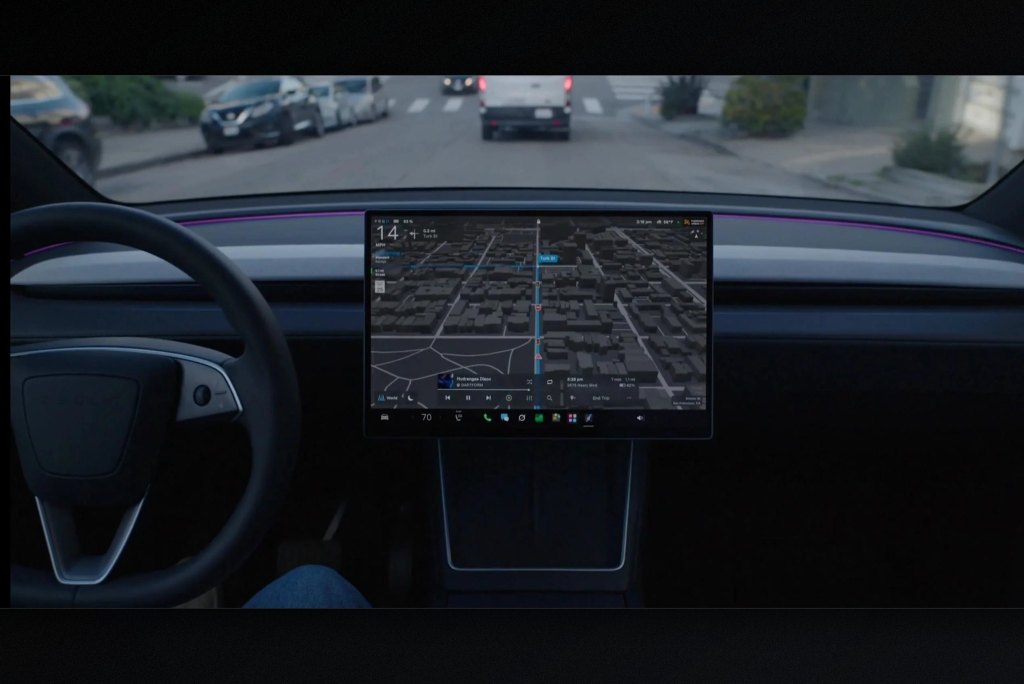
The most eye-catching piece is the new display that Tesla calls "Reality View" in its announcement and "Tesla Augmented Reality" in the release notes. In the video Tesla shared, the center screen redraws the road around the car in far more detail than FSD's current visualization. According to the notes, it replaces a set of discrete model signals with a single seamless display layer that uses less compute, and the company says drivers can "see and control what FSD intends to do." If it works as advertised, supervising the system gets much easier, since the person behind the wheel can tell at a glance how the car understands the road.
Targeting long-standing weak spots
Almost every driving improvement in the notes touches a spot where FSD has stumbled. Road signs are the clearest example: in a test published in September, the Brussels-based nonprofit Johanna.be found that FSD exceeded the limit in 55% of the 30 km/h zones the car passed through, at an average speed of 44 km/h. In most of those zones, the car's display showed a 50 km/h limit, meaning the car failed to read the sign. Potholes are the same story: in August, Elon Musk said pothole avoidance was "coming soon," though he has promised the same thing since 2019, and FSD currently still drives straight through them.
School zones are also on the list, and this is where regulators are watching. NHTSA is reviewing a petition claiming that Tesla's Robotaxi drives too fast through active school zones, on top of an investigation opened in October 2025 into FSD violating traffic laws such as running red lights. Slowing for speed cameras falls along the same lines, though it also suggests Tesla is willing to let FSD speed when no camera is present. One change runs the other way: Tesla is "reducing the strictness" of driver monitoring in high-speed driving profiles, just as stories of drivers falling asleep on FSD keep making headlines and Tesla is being forced to tighten monitoring in Europe at regulators' request.
The 25x figure is still an open question
The release notes say the "25x" refers to the critical intervention rate, and that is indeed the right measure for judging how close FSD is to unsupervised driving. The problem is that Tesla gives only the multiplier, not the underlying number. According to tracking data from earlier this year, FSD v14 went roughly a few thousand miles between critical interventions, so multiplying by 25 would put v15 around 50,000 miles, far above the roughly 10,000 miles reportedly needed for Tesla to run a limited unsupervised service. If that holds across the whole fleet, it would be Tesla's biggest boost in autonomous driving in years.
Expectations for v15 were already very high. In April, Elon Musk wrote that v15 "will far exceed human safety, even in complex and fully unsupervised situations," though he has said similar things about v12 and v14. In August, Tesla told JPMorgan that v15 is a "leap forward" built on seven "core technologies," about 40% of which are already running on the Robotaxi fleet in Austin. FSD's history also shows that progress has never been a straight line: v14 launched in October 2025 with plenty of hallucinations, jerky braking, and speeding, and early community data recorded only about 732 miles between serious disengagements. It then improved considerably, after which the v14.2 releases went backward before Musk promoted v14.3 as the version where "the last big piece finally falls into place." Seven months and many patches later, owners still have to supervise the car themselves, so Tesla now needs v15 to deliver what v14.3 was expected to.
Migovi sees Reality View as the most credible part of this update, since it is already visible in the video and is immediately useful for supervision. The driving side is harder to call. Tesla is targeting exactly the flaws that owners and regulators complain about most, but "improved recognition" does not say how much better, and a 25x multiplier without the underlying number cannot be checked by anyone. FSD has also regressed several times in patches where the previous release handled things fine, and relaxing driver monitoring suggests the company is leaning more on trust than on data. For Vietnamese users following Tesla, a sensible approach is to treat v15 as a promise and wait for real-world intervention figures from independent users or from Tesla itself, rather than rushing to conclusions from a promo video.
Source: Electrek (EVs)
Reviewed by: Hero Association