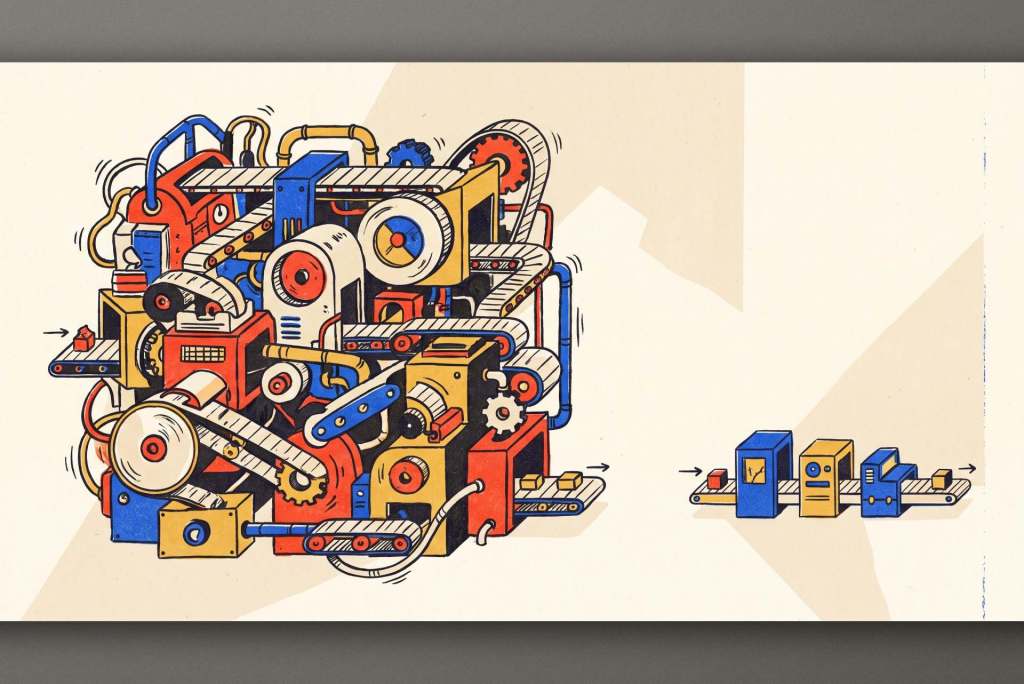
As AI agent training pipelines keep piling on stages, ByteDance wants to show that cutting steps can still produce a competitive open model.
- ByteDance and several US universities argue that training an AI agent takes only three steps, not a long chain of stacked stages
- The problem the team points to: the more nested a pipeline gets, the harder it is to tell which step actually helps, and the more expensive it becomes to reproduce
- The supporting evidence is a competitive open model
- The three specific steps and the model's benchmark results still need independent verification
Table of Contents
Why agent training pipelines keep getting messier
AI agents are now expected to search the web on their own, run code, and handle tasks made up of many consecutive steps. To get there, many developers line up a series of training stages one after another, each building on the results of the one before. This makes the pipeline increasingly nested and complex, to the point that outsiders struggle to picture how it works.
A new research paper points to two consequences. First, when stages are tightly coupled, the final result is the sum of all of them, so it is nearly impossible to know which step actually contributes and which only makes the pipeline longer. Second, reproducing someone else's work also gets more expensive, because anyone who wants to check it has to rebuild the entire chain.
ByteDance's leaner approach
The authors come from ByteDance, TikTok's parent company, and several universities in the US. They frame the problem in the opposite way from the trend of adding more steps. In their view, three steps are enough to train an AI agent that performs impressively. An argument like that is easy to dismiss as idle talk without something to back it up, so the team offers a competitive open model as evidence.
The fact that the model is open also matters for the team's own argument. If the pipeline really is lean, other research groups have a chance to rebuild and measure it themselves instead of taking the publisher's word for it. In a field where reproduction cost is a central worry, this is the most direct way a paper can make its case.
What to look at next
Still, what the three steps actually are and where the model stands against its rivals are details to read in the full paper before drawing conclusions. A model that is competitive on some benchmarks does not necessarily represent every task an agent has to handle in the real world. So the next thing to watch is whether independent groups can replicate these results at lower cost.
Migovi finds ByteDance's approach notable because it hits the sore spot of the agent field: when training pipelines get so tangled that nobody can say which step helps, progress can easily come down to who has more money and more stages. If three steps really are enough, smaller teams, including those without massive infrastructure, would have a chance to join in and check each other's work. For now, though, this is only the authors' own argument, so users in Vietnam should not rush to expect better or cheaper agents right away. A more sensible move is to wait and see whether independent groups rebuild it and get similar results, since that is the real test of this claim.
Source: The Decoder (AI)
Reviewed by: Hero Association