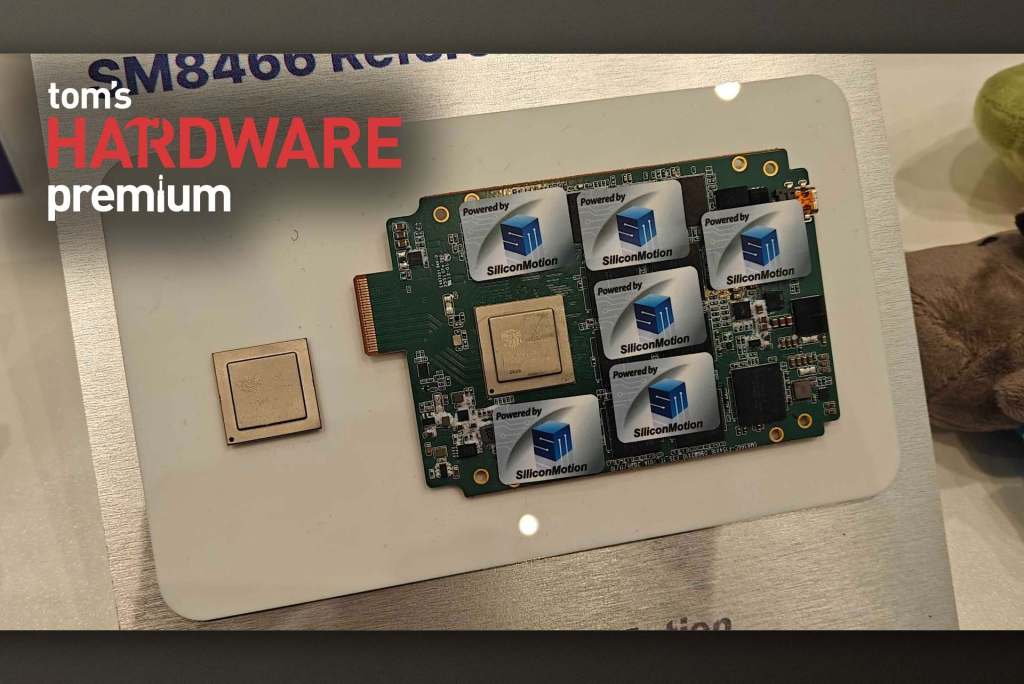
The SM8466 is Silicon Motion's taped-out PCIe 6.0 SSD controller, paired with PerformaShape 2 technology that keeps performance consistent when multiple workloads run at once.
- The SM8466 has taped out and samples are coming soon; SSDs built on the chip are expected to launch in late 2027 or early 2028
- PCIe 6.x x4 interface, 16 NAND channels, sequential read and write speeds of up to 28 GB/s, and 7 million 4K random IOPS
- The key differentiator is PerformaShape 2: QoS groups double from 256 to 512, with support for NVMe TP4176
- Aimed at data centers and hyperscale, with no direct relevance to mainstream users yet
Table of Contents
A controller built for data centers
Silicon Motion showed its SM8466 PCIe 6.0 SSD controller for the first time at the SC26 conference in Chicago. The production version of the chip has just taped out, and SSDs using it are expected to appear in late 2027 or early 2028. The MonTitan SM8466 line was previously introduced at FMS 2025 and targets data centers and hyperscale storage systems.
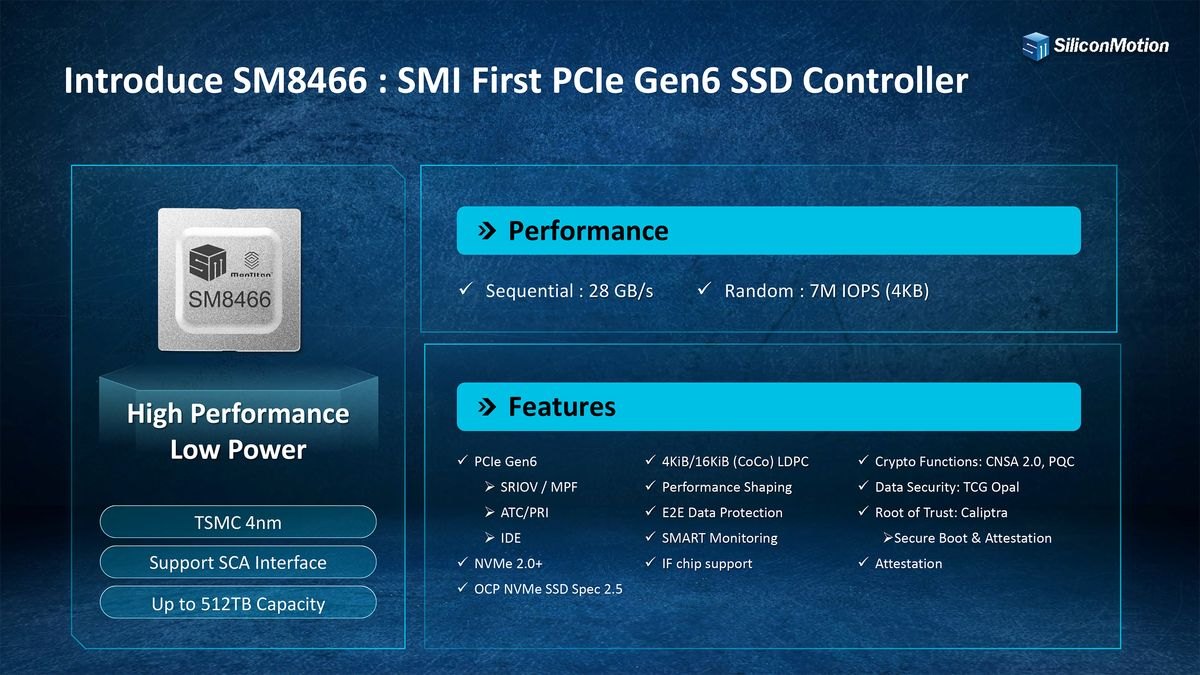
On specs, the chip uses a PCIe 6.x x4 interface with 16 NAND channels, delivering sequential speeds of up to 28 GB/s and random performance of up to 7 million IOPS at 4K block size. It supports capacities of up to 512 TB, and potentially more as new 3D NAND types arrive. Like the high-end data center controllers that have launched over the past few years, the SM8466 complies with NVMe 2.0 and OCP NVMe 2.5.
To cut latency and boost performance, Silicon Motion developed the Separate Command Architecture (SCA), which separates command and address paths in the NAND interface so parallel operations run more efficiently. The chip also offers a fairly complete set of error correction, virtualization, and data protection features: LDPC with 4KiB codewords, 16KiB Collaborative Codeword (CoCo) technology to maintain reliability with newer NAND, plus SR-IOV, MPF, and SMART diagnostics. On the security side, it supports Secure Boot, AES-256 encryption, TCG Opal, and firmware attestation, making it a fit for high-capacity drives that need consistent latency.
PerformaShape 2 keeps performance steady
The most notable piece is probably the second generation of PerformaShape, which builds on the first version found in the PCIe 5.0 SM8366 controller. The original used a dedicated hardware accelerator and two-tier leaky-bucket throttles to cap IOPS and read/write bandwidth, both per workload and for the whole drive. That lets data center operators stop one workload from hogging resources from the others. According to the source article, this is also the most important differentiator against rivals, which guarantee performance through other methods.
The second version keeps those capabilities but raises the number of supported quality of service (QoS) groups from 256 to 512, along with finer-grained control mechanisms for many concurrent workloads with different requirements. One key addition is Multi-Dimensional Shaping, which lets the controller coordinate performance limits across multiple I/O characteristics instead of applying each limit independently, giving operators more flexibility when dividing drive resources among applications.
The other major improvement is support for NVMe TP4176, a proposed extension to the NVMe standard that aims to standardize performance and QoS management. The first PerformaShape had to rely on Silicon Motion's proprietary NVMe commands and a driver running on the host, whereas with TP4176, compatible software can later configure performance policies through a common mechanism. According to the company, the technology is especially useful in cloud environments, where SSDs serve many virtual machines, containers, and applications whose storage demands vary considerably over time.
The SM8466 shows that the enterprise PCIe 6.0 SSD race is not just about sequential speed, because keeping performance steady when many workloads compete for resources is what cloud operators actually need. This view rests on Silicon Motion's choice to upgrade PerformaShape to 512 QoS groups and to pursue standardization through NVMe TP4176, rather than simply touting 28 GB/s. That said, TP4176 is still a proposal and real drives won't launch before late 2027, so real-world testing will be needed to know how big this advantage really is. For users in Vietnam, the chip mainly has an indirect effect through the quality of cloud services down the line, and consumer PC SSDs don't need to wait for it.
Source: Tom's Hardware
Reviewed by: Hero Association