Intel didn't show off Diamond Rapids at SC26, but two partners did it for the company, and their demos hint that Xeon 7 could launch earlier than expected.
- Diamond Rapids (Xeon 7) ran live for the first time at SC26, at Montage's CXL booth, while Intel's own booth had no demo
- Bull showed off its 2P Bullsquana XH31600 server with two sample chips, support for 32 channels of DDR5, and a liquid-cooled design
- Intel has said Xeon 7 will launch in 2027, but the partner servers suggest the date could be Q2
- Supports 16 memory channels, RDIMM up to 8000 MT/s, MRDIMM up to 12,800 MT/s, and up to 256 P-cores on the 18A-P process
- No performance figures yet, and the maximum RAM capacity hasn't been announced
Table of Contents
Two partner booths stand in for Intel
At Supercomputing 2026 (SC26), Intel's Xeon Diamond Rapids chip appeared at two booths, but both belonged to partners rather than Intel. The most notable was a live server at the CXL booth, which only ran on the first day of the show before it was shut off following noise complaints. Intel's own booth, meanwhile, was mostly given over to Xeon 6+ and the D270 GPU, also known as Crescent Island, so visitors didn't see Diamond Rapids there.
The other server was part of a Montage demo built around its CXL MXC (Memory eXpander Controller) memory expansion controller. Memory expansion over CXL is becoming a fairly common way to let multiple servers share one large pool of RAM, so capacity is no longer capped by each individual machine. In the demo, Montage had a Xeon 6 system and a Diamond Rapids system share the same memory pool. CXL is an open standard built on top of PCIe.

Sample chips and what remains undisclosed
To be clear, the demo reveals nothing about Diamond Rapids performance. Its value is that this is the first time anyone has seen the chip running in the real world. The 256 GB of memory shown in the demo isn't a hint at the chip's limits either, since Intel has already said Diamond Rapids supports 16 memory channels, RDIMM up to 8000 MT/s, and MRDIMM up to 12,800 MT/s, on par with AMD's new EPYC Venice line. The company hasn't stated a maximum capacity, but expect it to go well beyond 256 GB, especially as the previous generation, Granite Rapids-AP, already supported up to 3 TB per socket.
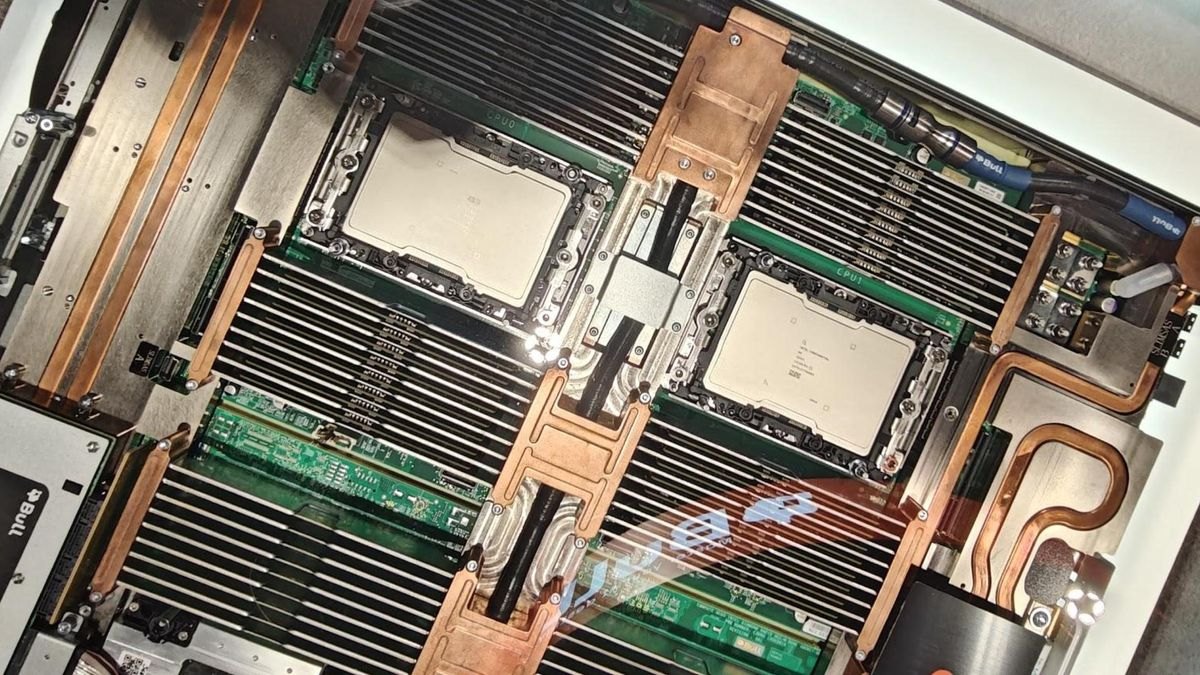
At Bull's booth, a Diamond Rapids chip sat inside a server behind glass. Bull is a French server maker focused on HPC and AI infrastructure, and it fitted two Xeon 7 chips into its Bullsquana XH31600. In that 2P configuration, the machine supports 32 channels of DDR5 memory and is designed for liquid-cooled deployments.
Launch timing and the new design
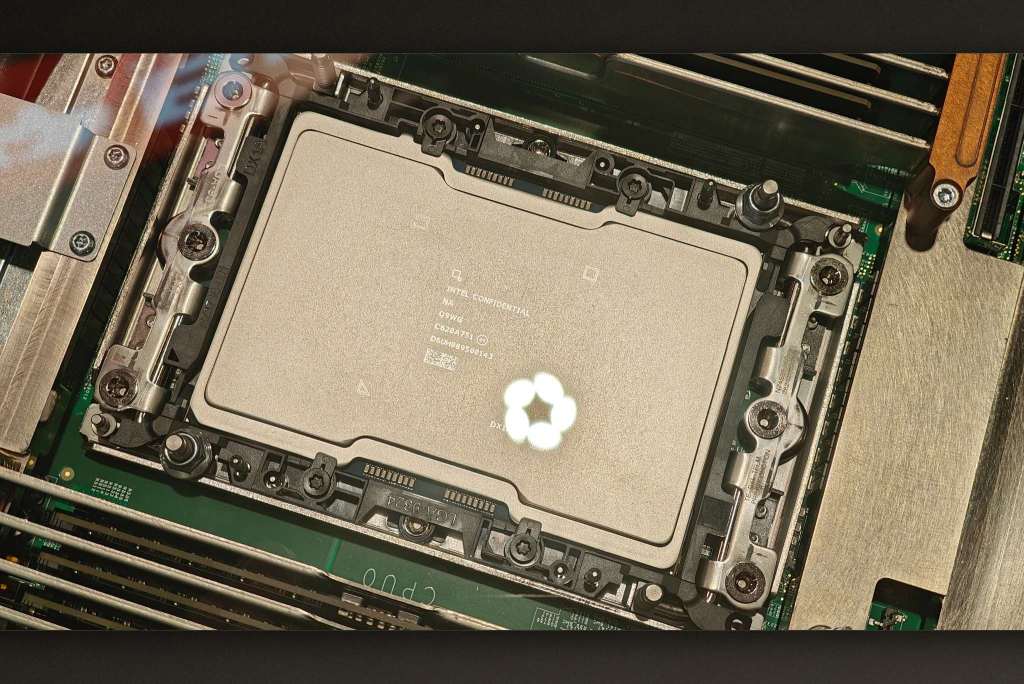
A closer look shows this isn't a retail chip: it carries an "Intel confidential" marking and a code starting with the letter Q, a sign of a sample part. Diamond Rapids was previously expected in the second half of this year, but in August Intel said Xeon 7 would launch in 2027. Based on the servers and demos seen so far, Intel appears to be targeting an earlier point in that year, most likely Q2. Further delays are still possible, but unlikely, since the chip has already slipped once and demand for CPUs in AI data centers shows no sign of cooling.
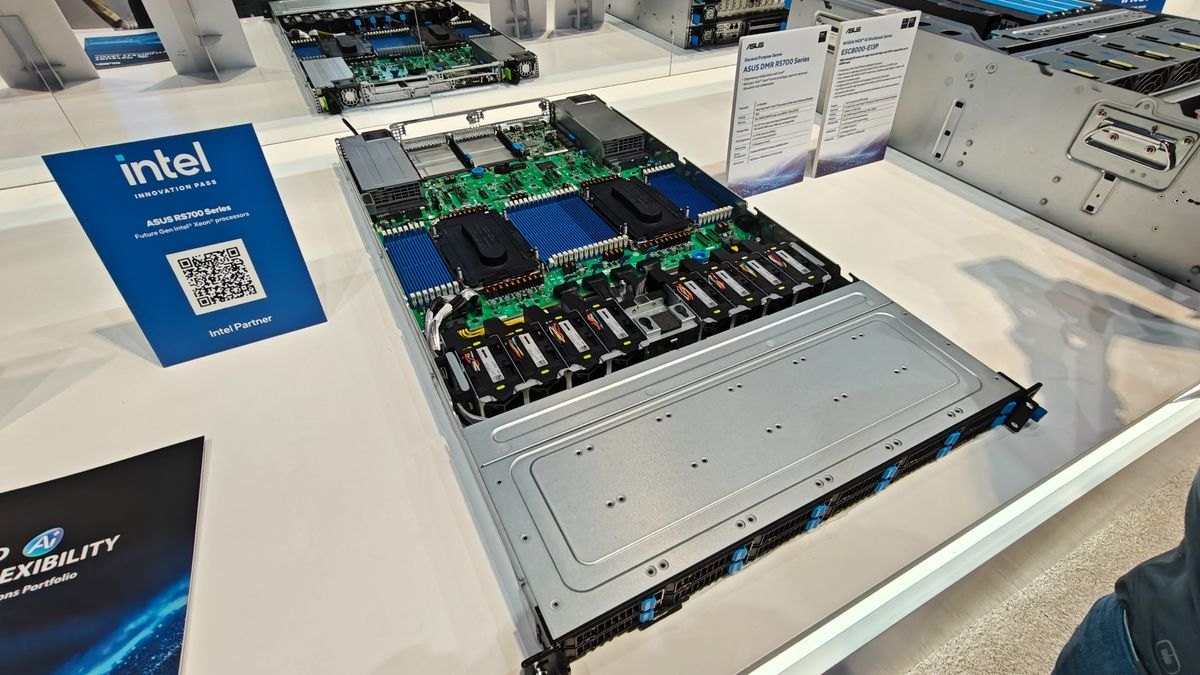
Another sign that the launch isn't far off is that several partners, including Dell and Asus, brought next-generation Diamond Rapids servers to the show, using the LGA 9324 socket. Still, Bull was the only one to display a real chip.
Diamond Rapids is Intel's true next-generation CPU line, following the E-core-only Xeon 6+ that launched earlier this year. The chip has up to 256 P-cores and is built on the 18A-P process, a performance-focused refinement of 18A. The most interesting part is the internal layout: Intel is moving away from its old design to build something closer to AMD's EPYC CPUs, with memory and I/O gathered at the center of the package, whereas on Granite Rapids they were pushed out to the edges.
Intel's decision not to show Diamond Rapids itself, while partners displayed both sample chips and complete servers, suggests the product is close enough for the ecosystem to prepare, but not yet mature enough for Intel to speak confidently about performance. Migovi therefore considers a Q2 launch next year reasonable, but there is no basis yet for judging whether the chip is actually worth waiting for, since there are no benchmarks, no maximum RAM capacity, and no pricing. For Vietnamese businesses planning a server or AI infrastructure upgrade, if there's no urgency, it's better to wait a few months for independent test results before choosing between Xeon 6 and Xeon 7, rather than locking in a configuration based on what Intel has announced on paper.
Source: Tom's Hardware
Reviewed by: Hero Association