GENTO unveils 21-DoF robotic hand as NVIDIA debuts GR00T 2
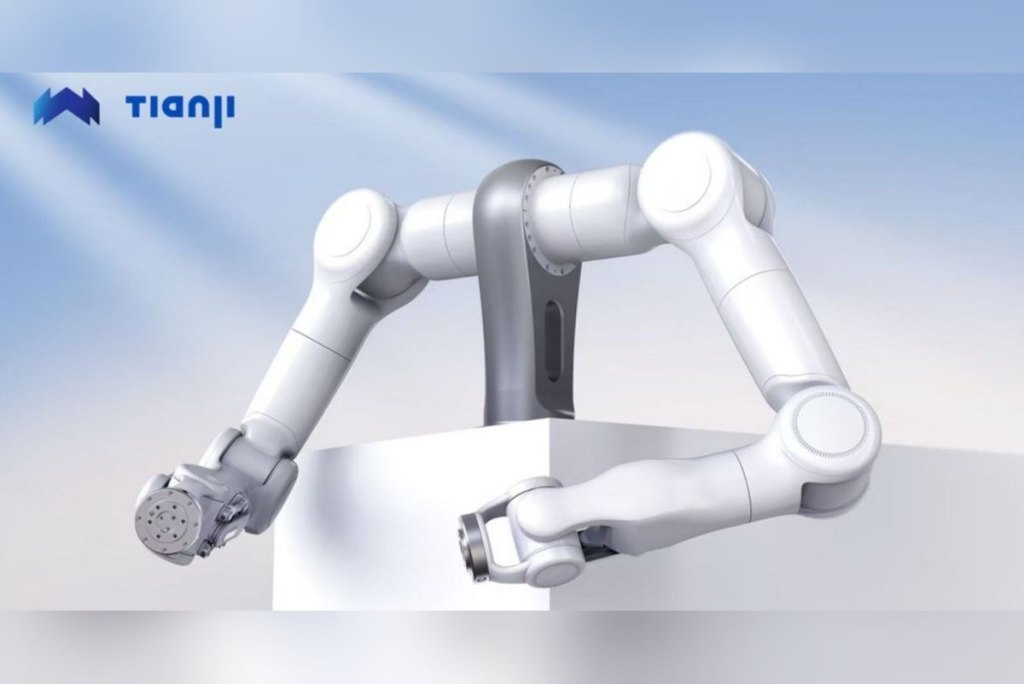
GENTO unveiled a 21-degree-of-freedom robotic hand at CoRL 2026, while NVIDIA showcased its GR00T 2 model running on Tianji Intelligence's TIANJI Marvin Pro platform.
- GENTO introduced a 21-degree-of-freedom (21-DoF) dexterous hand prototype at the CoRL 2026 conference in Austin, Texas.
- The linkage-driven transmission design targets four longstanding issues: backlash, durability, joint backdrivability, and fingertip force.
- Tianji Intelligence combines MEMS torque sensors with compliant impedance control to enable robots to sense force during contact.
- NVIDIA unveiled GR00T 2, an action model built on NVIDIA Cosmos, using the TIANJI Marvin Pro platform as its demonstration robot.
Table of Contents
The tactile challenge in robotics
When handing an object to someone, wiping a table, or positioning a machine component, humans constantly adjust their grip force without even thinking about it. For robots, this seemingly mundane interaction remains an immensely difficult engineering challenge. While AI models have made massive strides in "thinking," physical execution lags behind because robots lack subtle tactile perception.
GENTO, an embodied robotics brand under Tianji Intelligence, is tackling this exact challenge. The company's 21-degree-of-freedom dexterous hand made its global debut at CoRL 2026 (Conference on Robot Learning), held from November 9 to 12 in Austin, Texas. Booth 602 (3rd floor, JW Marriott Austin) showcased the GENTO hand alongside TIANJI force-controlled arms, the TIANJI Marvin Pro platform, and GENTO Luna. The exhibition area remained open until 1:00 PM on November 11 local time.
One mechanical design for four persistent challenges
According to the company, this hand prototype employs a linkage-driven transmission design to tackle four longstanding issues simultaneously: high backlash, fragile transmission mechanisms, non-backdrivable joints, and rated fingertip force constrained by finger size. The demonstration robots on site were also equipped with hands developed in-house by GENTO.
Specifically, a high-precision linkage mechanism with minimal clearance reduces backlash, which typically causes inconsistent finger movement. A shock- and overload-resistant transmission structure mitigates situations where an accidental collision leads to costly repairs. Every joint is backdrivable, meaning external forces can push the fingers rather than encountering rigid resistance. Combined with MIT force/position hybrid control, this design enables softer physical interactions. Finally, the linkage mechanism transmits force efficiently, delivering a higher rated fingertip force within the same finger size.
Notably, the company emphasizes the synergy of these four elements within a single architecture, rather than optimizing each factor in isolation.
Torque sensors and hardware platforms
The current robotics landscape also features NVIDIA's Isaac development platform and Tesla's Optimus humanoid robot. A movement may look flawless in simulation yet fail in the real world. In precision assembly, a discrepancy of just a fraction of a millimeter can cause resistance to spike. When wiping a table, success hinges on maintaining continuous, adaptive contact pressure, not simply moving to a set coordinate.
Tianji Intelligence couples torque sensors with compliant impedance control. The robot measures torque at each joint in real time and adjusts its stiffness accordingly. For heavy-duty tasks, it can lock rigid. When soft, human-safe feedback is required, it immediately yields. This also embodies GENTO's slogan, "Touching the World Gently." For AI researchers, force data addresses a crucial bottleneck: cameras capture what moved, while force data captures how the physical interaction felt.
Tianji Intelligence's hardware traces its roots to the industrial sector. Co-incubated by Yaskawa Electric and Everwin Precision, the company has deployed more than 30,000 industrial robots globally. Its current product lineup is built around proprietary MEMS joint torque sensors capable of detecting torque down to 0.02 N·m, featuring a 160 Hz torque-loop bandwidth and a repeatability of ±0.03 mm. These sensors are integrated into TIANJI arms, including the M6-Lite, M6, and M20, which support payloads of up to 20 kg per arm. According to the company, the joint module integrates the motor, reducer, driver, encoder, and brake into a single unit, making it roughly 25% lighter than its main competitors.
To back up its claims, Tianji Intelligence released trajectory-tracking benchmark code on GitHub (May 2026) for third-party verification. According to the benchmarks, trajectory-tracking error dropped from 10.56 mm to 1.89 mm, while latency was reduced from 45 ms to 5 ms.
GENTO Luna, Skye, and TIANJI Marvin Pro
Moving beyond stationary arms, GENTO is expanding whole-body force control to mobile platforms. GENTO Luna is a foldable, wheeled humanoid platform featuring an omnidirectional mobile base, dual arms, and a torso. At CoRL 2026, Luna was fitted with GENTO's proprietary hands to run teleoperation demos - mimicking attendees' movements while handing over items in real time. GENTO Skye is a wheeled configuration equipped with a lifting column, designed for reinforcement learning and real-world deployment validation.
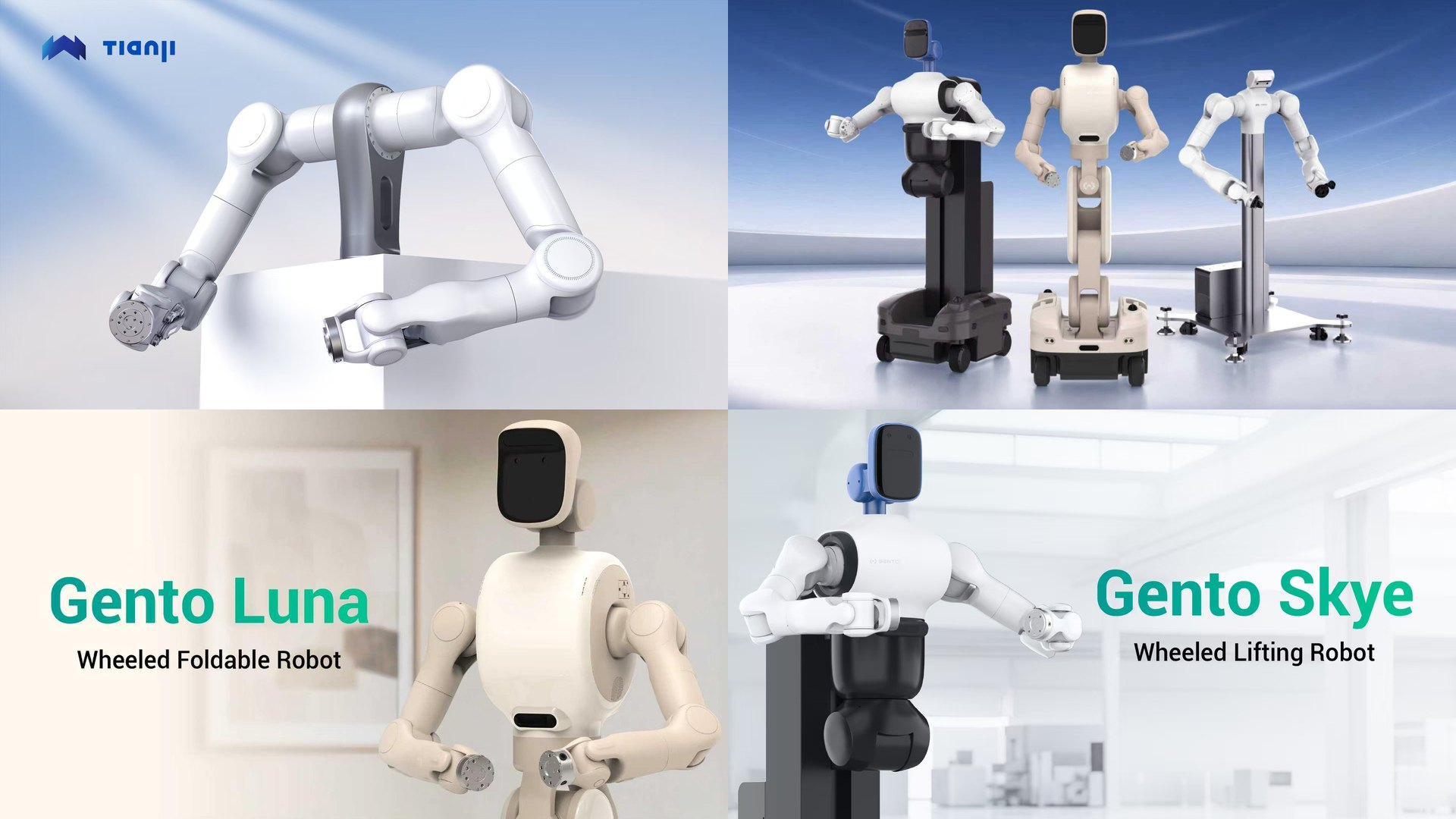
TIANJI Marvin Pro is a fixed-base, dual-arm platform designed for teleoperation and real-robot data collection. At Booth 602, visitors could test a voice-command grasping demo, where Marvin Pro parsed natural language instructions to identify and retrieve the correct item from a cluster of objects.
NVIDIA launches GR00T 2 alongside TIANJI Marvin Pro
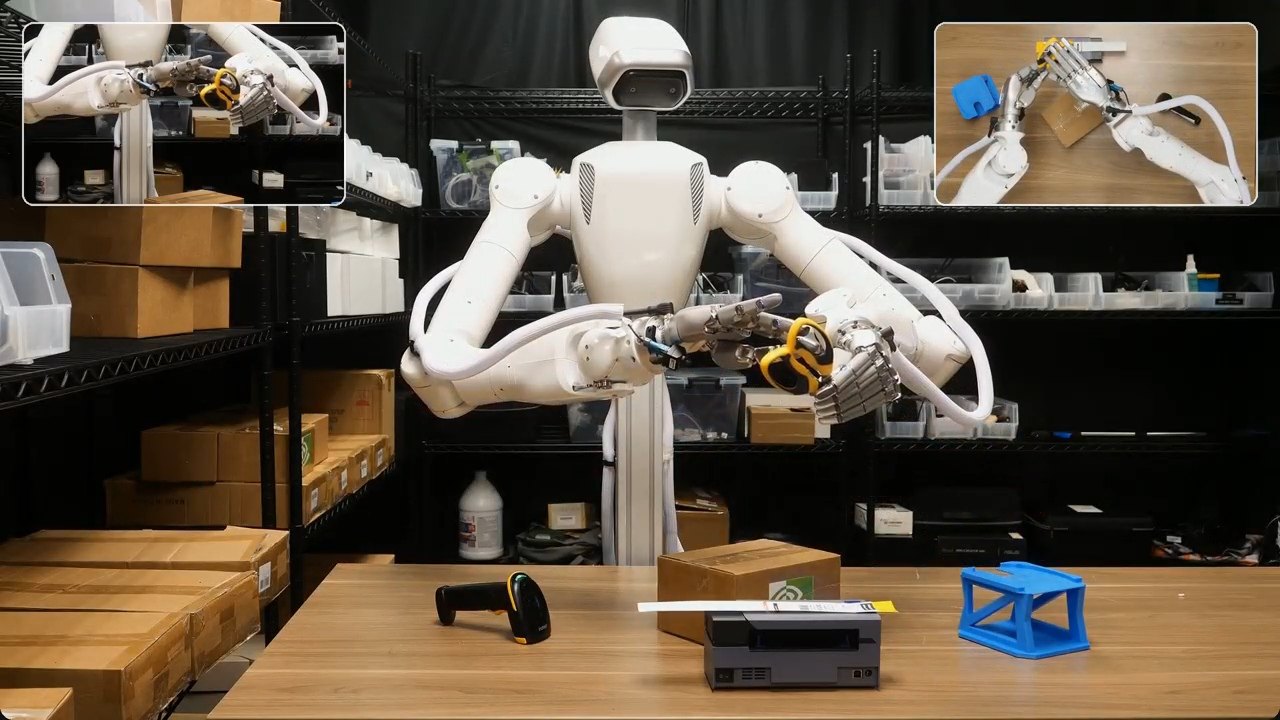
At CoRL 2026, NVIDIA introduced GR00T 2, an open-world action model built on NVIDIA Cosmos that concurrently predicts future video and robot actions. The launch demos utilized the TIANJI Marvin Pro platform, customized with a bespoke head and torso developed specifically for NVIDIA by Tianji Intelligence.
Fitted with dual dexterous hands, the robot performed tasks demanding coordinated manipulation. In one skill-transfer demonstration, researchers recorded human hand motions using a wearable exoskeleton. They then leveraged GR00T 2 to have the robot perform tasks such as making banana yogurt. The demo highlighted Marvin Pro's role as the physical platform for executing learned robot behaviors.
From human manipulation to AI data pipelines
Hardware is only half the battle; data is where robot learning truly thrives. Tianji Intelligence built a data pipeline connecting VR headsets, data gloves, and a bimanual leader-follower teleoperation system to an annotation and format conversion platform. As an operator guides the robot through contact-rich tasks, the system accurately records resistance forces alongside synchronized vision and motion data.
The company estimates that 100 TIANJI Marvin Pro platforms could capture more than 600,000 real-robot demonstration datasets annually. This data pipeline also serves as a physical proving ground for AI models, such as Shengshu Tech's Motus2 world model.
The quiet infrastructure behind embodied AI
While headlines obsess over who is building the next humanoid robot, Tianji Intelligence is quietly serving as the foundational execution layer for the entire sector. In mid-2025 alone, the company shipped more than 2,000 pairs of force-controlled arms for humanoid robots in just four months, capturing a leading market share in this segment. It currently supplies over 45 embodied AI and robotics partners worldwide.
This rapid expansion is backed by substantial funding, including a 1 billion RMB Series B/B+ round led by Hillhouse Venture Capital and Meituan, followed by a strategic B++ round led by Ant Group and Sofina. CoRL 2026 attendees can visit Booth 602 until 1:00 PM on November 11 local time.
What makes GENTO worth watching isn't just the degree-of-freedom count, but how the company ties force sensing, compliant control, and force data into a unified training pipeline. If contact data becomes the norm, humanoid robots will rely less heavily on pure simulation. That said, figures regarding weight savings, accuracy, and market share are all self-reported by the company. Only the open benchmark suite on GitHub allows for third-party verification, so readers should await further independent evaluations.
Source: Digital Trends
Reviewed by: Hero Association