Intel has started adding Razor Lake and Coral Rapids support to the Linux kernel, a sign that its next-generation chip roadmap is being prepared well ahead of time, through to 2028.
- Intel has begun upstreaming support for Razor Lake (the mainstream CPU line succeeding Nova Lake) and Coral Rapids (the next-generation Xeon line) into the Linux kernel.
- The first patch, submitted by Intel engineer Tony Luck on November 13, only declares the Family and Model IDs.
- Razor Lake is expected to launch in 2028 in L, U, and S variants, with the desktop version reportedly reusing the LGA 1954 socket of Nova Lake-S.
- Both Razor Lake and Coral Rapids will use the Griffin Cove P-core.
- GCC patches for Coral Rapids have already referenced AVX10.2, APX, and AMX-FP8.
Table of Contents
The first Linux kernel patch
According to Phoronix, Intel has started submitting upstream kernel code for two upcoming chip lines, Coral Rapids and Razor Lake. The first patch is fairly basic and only sets up the CPU Family and Model identifiers. Still, it marks the start of the full enablement work to come.
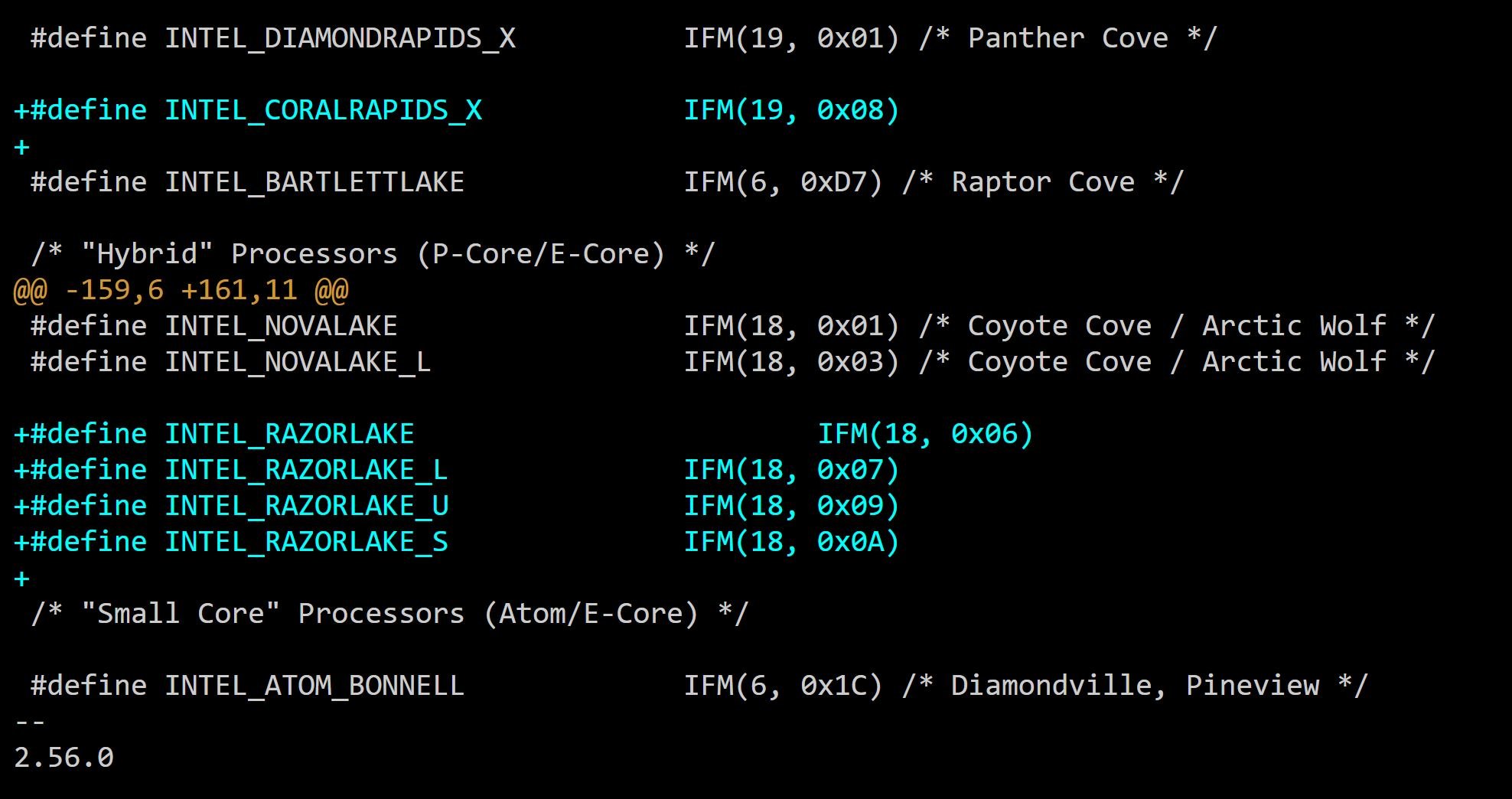
The patch was submitted by Intel engineer Tony Luck on November 13. Coral Rapids carries Family 19, Model 8, while Razor Lake uses several Model IDs under Family 18. Coral Rapids is the next-generation Xeon for servers, and Razor Lake will follow Nova Lake in the mainstream consumer segment.
Razor Lake targets 2028
Razor Lake is declared with separate identifiers for the L, U, and S variants. More complete patches will likely appear over the coming weeks and months. Earlier reports put Razor Lake's launch in 2028, with the desktop version reusing the LGA 1954 socket of Nova Lake-S.
On the architecture side, Razor Lake is said to introduce the Griffin Cove P-core, and Coral Rapids will use the same core. High-end Razor Lake models are expected to deliver a significant upgrade over Nova Lake. However, the launch is still a long way off, so concrete specifications are almost nonexistent.
GCC compiler support is also being prepared
Intel previously submitted the first GCC patches for Coral Rapids. They mention instruction sets such as AVX10.2, APX, AMX-FP8, and AMX-AVX512, along with several other advanced instructions. There is also a new instruction, AVX10_VPMLDSABFLYDQ, aimed at accelerating ML-DSA operations.
The current patch is only a platform declaration, so it should not be treated as an official Razor Lake spec or launch schedule. The socket is the detail worth watching: if the desktop version really reuses LGA 1954, Nova Lake-S platform owners will have more reason to consider an upgrade later on. On the server side, the early GCC and Linux kernel groundwork for Coral Rapids shows that Intel wants the software ecosystem ready before the chips reach the market.
Source: Wccftech
Reviewed by: Hero Association