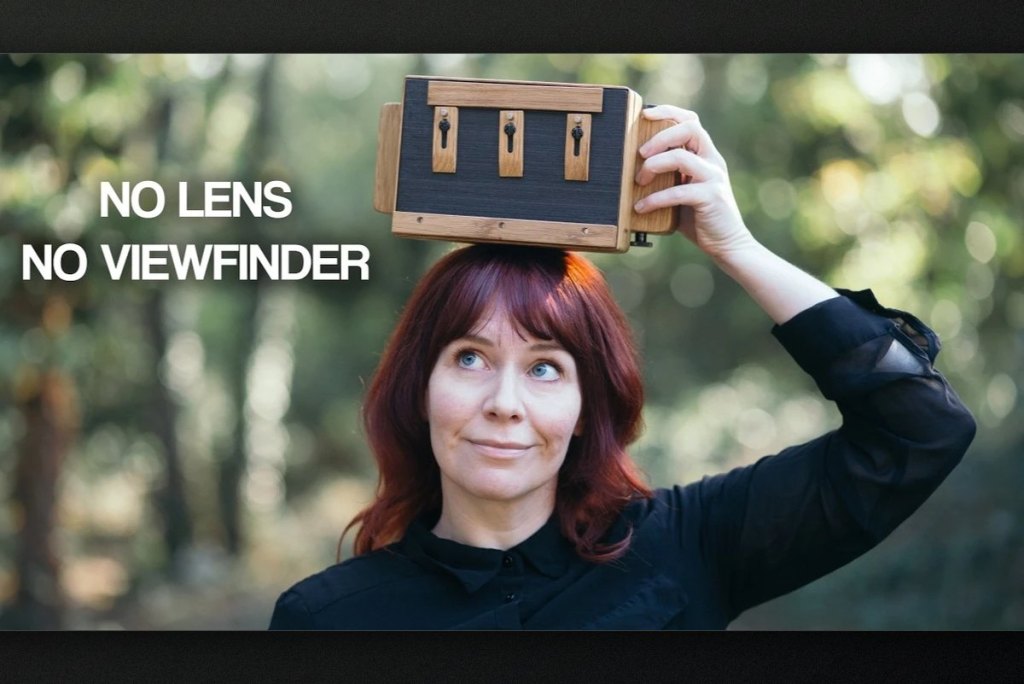
The Mania MFZ is a handmade oak pinhole camera with no lens and no viewfinder, forcing the photographer to picture the frame in their head before sliding the cover open for an exposure.
- The Mania MFZ is a handmade pinhole camera built from oak and magnets, and it shoots 120 film in several formats.
- It has no lens, viewfinder, or shutter button. You slide a wooden cover to start and end the exposure.
- The included wooden strip is used to frame the shot, and it also helps convert a meter reading at f/11 into a pinhole exposure time.
- Exposures longer than about 1 second cause reciprocity failure in film, so you need to add time using the film maker's formula.
- Logging every frame in a notebook will teach you faster than any lookup chart.
Table of Contents
A camera with no lens and no viewfinder
The Mania MFZ is a pinhole camera made from solid oak and magnets. It has no lens, viewfinder, or shutter button, yet it still works with 120 film in a range of formats and focal lengths. With every automated aid stripped away, the photographer has to see the picture in their head before it exists.
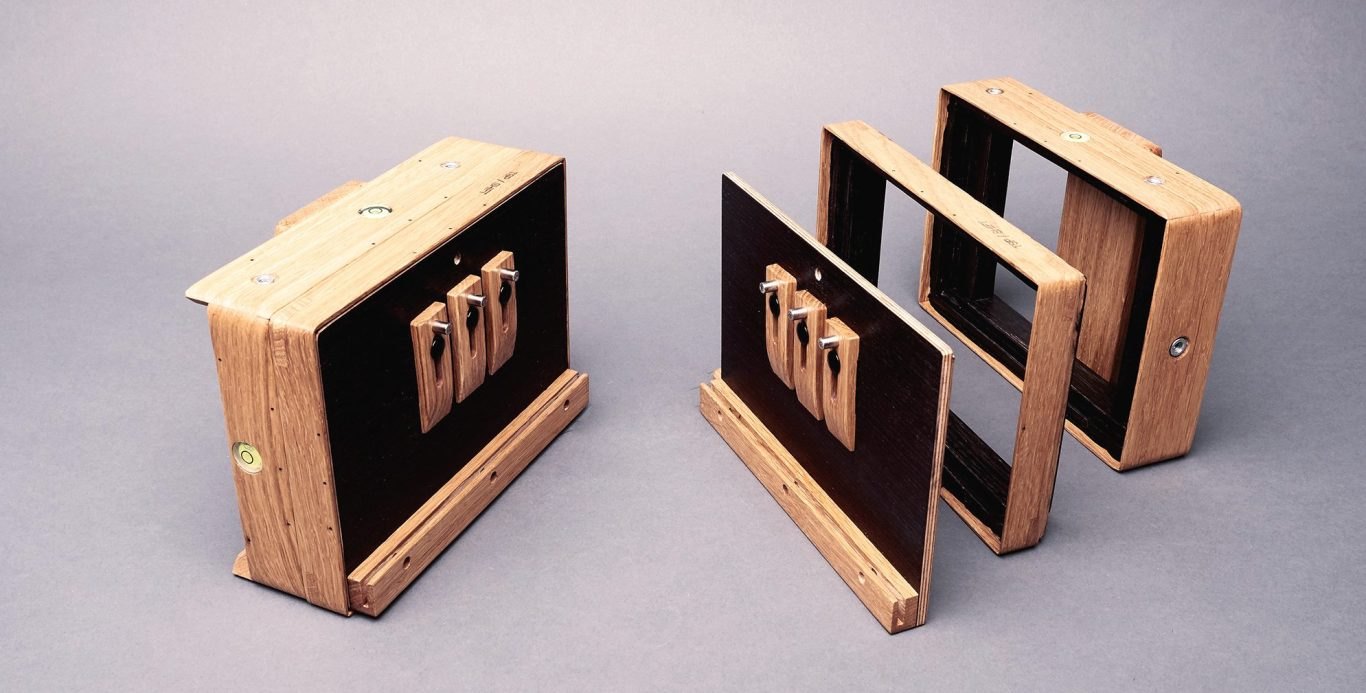
To expose a frame, you slide the wooden cover away from the pinhole, then slide it back when you're done. Photographer Els Vanopstal used the camera for several months along the French coast. Ralph Mann makes the camera by hand in Germany. He sent her one, but she says he had no influence over the content of her video. Light has to squeeze through a tiny hole, so almost every frame is a long exposure: a few seconds in sun, more than a minute in fog.
Formats, framing, and metering
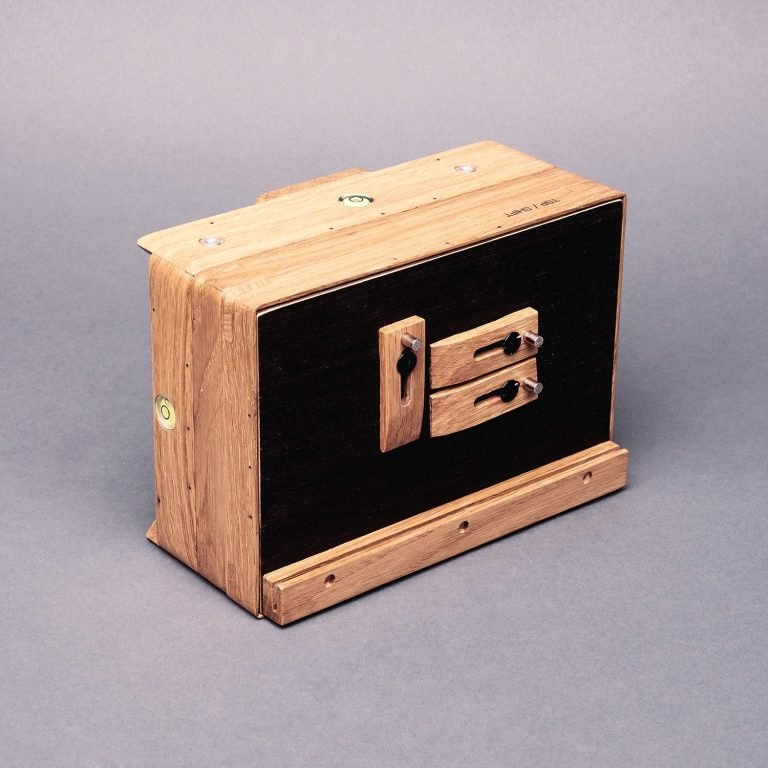
Small wooden pieces change the frame format on the roll, from square 6x6 to long panorama strips. Vanopstal was drawn to the camera for its square format, then fell for the wide frames. Her first test was on a replica of Christopher Columbus's ship moored on the coast. If you're used to composing on a screen, the biggest challenge is that most of the picture has to already exist in your head.
With no viewfinder, framing relies on a flat wooden strip that the maker calls speculation wood. You line the strip up with the marks on the body and sight along the line between two dots to get a rough idea of where the edges of the frame fall. The same strip is used for metering. A handheld light meter can't read at an aperture as small as a pinhole, so you meter at f/11 and use the strip to convert the reading into an exposure time. In one case, an f/11 reading converted to 6 seconds.

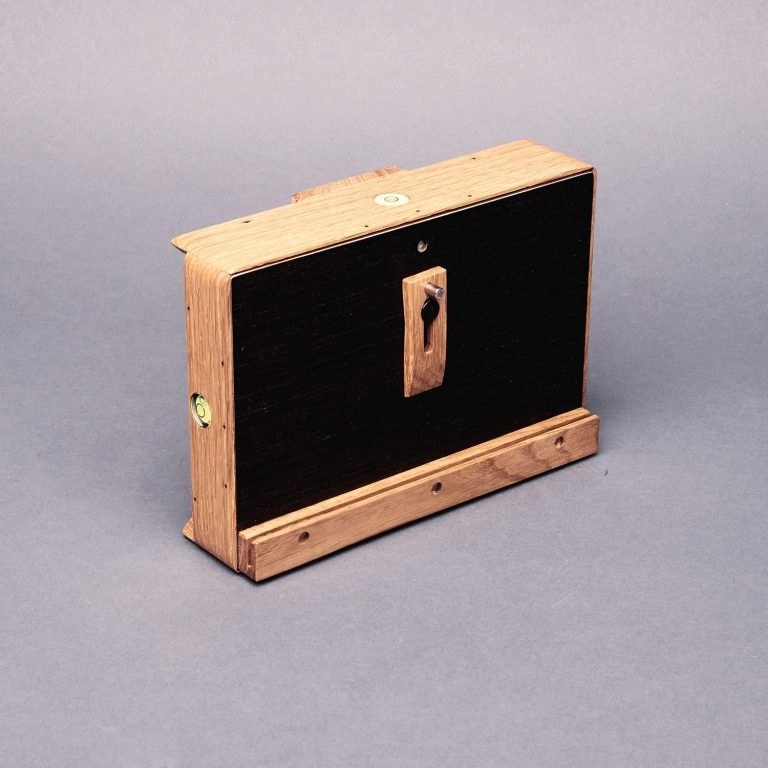
The camera also has add-on modules that extend the focal length from roughly 35 mm equivalent to 55 mm and 75 mm. The body has a mount for filters, a wooden piece that keeps the cover from sliding open in a bag, three tripod sockets, and two built-in spirit levels. Everything you need is already on the camera, which is rare for pinhole models.
Reciprocity failure in long exposures
Once exposure time goes past about 1 second, film no longer responds linearly. This is called reciprocity failure, and pinhole photography lives almost entirely in that range. Ilford publishes a simple formula for black-and-white film: take the metered time (in seconds) and raise it to a fixed exponent, 1.26 for FP4 Plus and 1.31 for HP5 Plus. A 10-second reading on FP4 Plus becomes about 18 seconds, and a metered 1 minute stretches to nearly 3 minutes. Kodak and other manufacturers have their own tables, and free phone apps can do the math in the field.
Pinhole images have nearly infinite depth of field, so focus doesn't decide whether a shot works. The whole picture depends on exposure and composition. This kind of camera suits people who already shoot landscapes on a tripod, or who want to slow down as young photographers rediscover analog film. A notebook with the meter reading for each frame and the time you actually used will teach you faster than any chart.
Failed shots and how to handle them
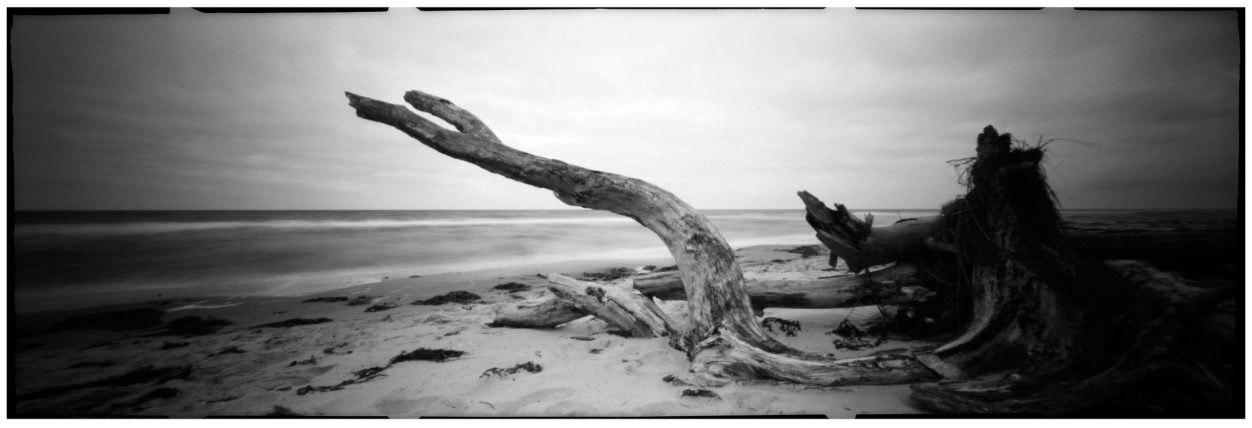
Portraits come with their own difficulties. The subject has to hold still for 6 seconds while Vanopstal stands beside a box she can't see through. She found herself composing more cautiously because she wasn't sure how the frame would turn out. A surprise foggy morning posed a different problem. With only Ilford FP4 Plus (ISO 125) on hand, she set a much higher ISO than the box speed to cut a 4-minute calculation down to 1 minute 35 seconds while the fog was still around. In her rush, she didn't advance the film far enough between 6x12 frames, so the first two exposures overlapped. She sees such accidents as a creative tool if used deliberately. The camera also has three pinholes instead of one, and the two outer ones allow two separate exposures to be combined into a single wide panorama.
The camera lets you rewind the film at any point. She once rewound mid-roll, removed one focal-length plate to switch from 55 mm back to 35 mm, then advanced to an unused frame. Not every idea worked. In a self-portrait with a train passing by, she used a red filter instead of an ND filter, which stretched the exposure to 15 seconds. The train was in view for only about 3 seconds, so it left no trace. She still plans to keep shooting until she gets the image she wants. In her view, the camera pushes her out of her comfort zone, but it also makes her willing to try things without knowing the result, and the element of surprise is a big part of the fun.
For film shooters in Vietnam, harsh sun shortens exposure times, but adding time using the film maker's formula is still a step you shouldn't skip. The original article doesn't mention the camera's price, so if you just want to try pinhole shooting, start with a few rolls of 120 film and a notebook before thinking about investing. Hot, humid weather is also a reason to store your film somewhere dry and well ventilated. The most valuable thing about this camera is that it forces you to shoot slowly and think carefully. Don't expect speed or sharpness.
Source: Fstoppers
Reviewed by: Hero Association