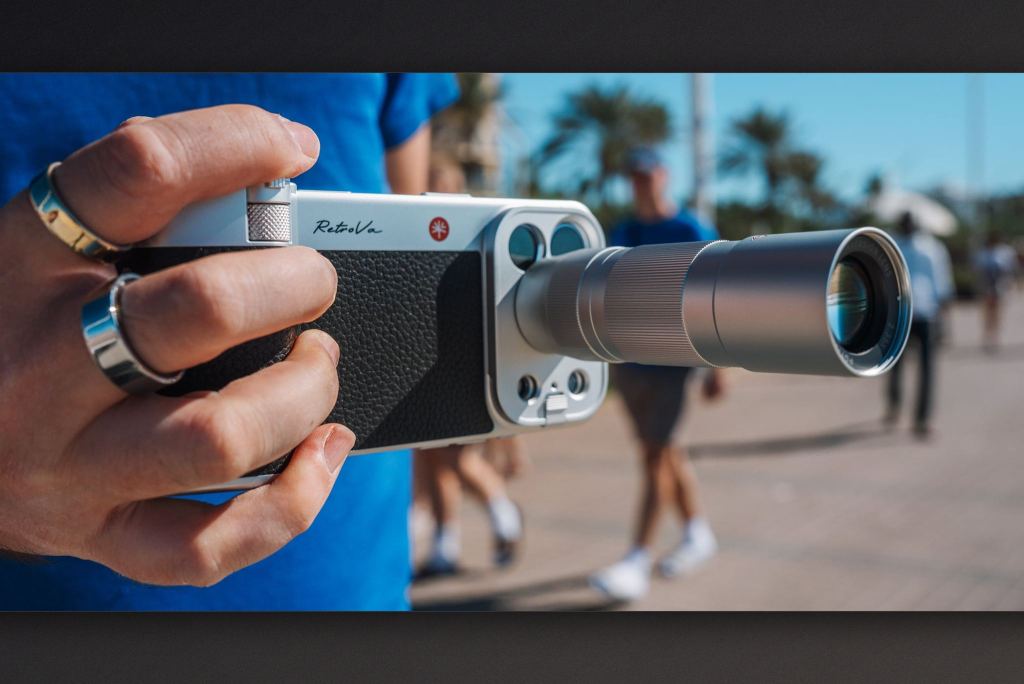
With the PGYTECH RetroVa, the 4X telephoto lens on an iPhone Pro's telephoto camera can only focus from 16.2 meters away, a detail few people think about before buying.
- RetroVa includes a MagSafe case, a Bluetooth grip with a microSD slot, and a 2X or 4X telephoto lens, for the iPhone 17 Pro/Pro Max and 18 Pro/Pro Max
- The 4X lens delivers a 400 mm equivalent focal length, extendable to 1200 mm with digital crop
- The lens doesn't communicate electronically with the app, so you have to select the attached lens manually
- The 4X lens's minimum focus distance is 16.2 meters on the telephoto camera, and it has no optical stabilization
- The grip and case come in separate Pro and Pro Max sizes and aren't interchangeable
Table of Contents
From camera accessories to the iPhone
PGYTECH has long been known for camera bags, tripods, and straps, and in the phone space it makes detachable telephoto lenses for Vivo and Oppo flagships. RetroVa brings that approach to the iPhone: the kit first appeared on Kickstarter in January for the iPhone 16 Pro and 17 Pro, with a camera-style Bluetooth grip, a retro-looking case, and a 2.35x telephoto adapter. The new version for the iPhone 17 Pro/Pro Max and 18 Pro/Pro Max adds a smaller, lighter 2X lens along with a 4X lens as an alternative, giving the iPhone equivalent focal lengths of 200 mm, 235 mm, and 400 mm with sharper images than zooming on the phone alone.
The All-in-One Ultimate Gift Set in Graphite Black includes the 4X telephoto lens, a lens mount, a lens pouch, the RetroVa case, the grip, a strap, and an Arca-Swiss compatible tripod ring for the lens. The 4X lens, grip, and case are also sold individually or in smaller bundles, so you can put together a kit that suits your needs. The case is made of polycarbonate, supports MagSafe, and still works with a screen protector already applied. You need to pick the right size, since the grip and case are made separately for Pro and Pro Max, while the lens mount is the same for both. Fortunately, the iPhone 17 Pro and 18 Pro share the same dimensions, so the accessories are interchangeable between them.
The grip and microSD slot
The grip weighs 63 grams for the Pro and 65.4 grams for the Pro Max. It slides onto the USB-C port and is held firmly by a locking switch, though it actually connects to the phone over Bluetooth. The base has a 1/4-inch tripod thread, and the top has familiar physical controls: a shutter button that focuses on a half-press, shoots on a full press, or fires continuously when held; a zoom lever just below it that jumps between focal lengths in Vintage mode or zooms freely in Standard mode; and a dial for adjusting exposure, ISO, white balance, or shutter speed. The multifunction button underneath handles power, mode switching, and Bluetooth pairing, with a small LED indicating connection status.
The microSD slot (UHS-I or UHS-II) lets you offload photos and video from the phone's storage, with a few limitations: RAW photos and 4K video can both be saved, but video is limited to HEVC at up to 120 fps. When you shoot with Apple's Camera app, video goes to the card automatically if the format is supported. PGYTECH's app supports more formats, and third-party apps that can write to external storage will also recognize the card. To copy files, plug the grip into a laptop. PGYTECH also sells 62 mm and 67 mm filter adapter rings separately, not included in any bundle, but you can't share filters across the telephoto lenses because the ring covers the entire rear camera module.
The companion app
The kit works with the PGYTECH app, Pro Camera & Editor, which is free to download and requires iOS 17 or later. Keep the app up to date: if it's outdated, it may lock manual controls behind a prompt asking for a paid subscription, which isn't actually required, and the prompt disappears after updating. Manual mode lets you adjust exposure, shutter speed, ISO, white balance, tint, and filters, and you can assign those parameters to the grip's dial under Settings > Hardware Settings after connecting over Bluetooth and selecting RetroVa. If you don't adjust anything yourself, all parameters adapt automatically to the frame, and Focus Assist (similar to focus peaking) highlights the in-focus area after you tap to focus.
The film simulation is the app's most fun feature, with about 15 standard filters plus styles such as Classic Negative, Kodak Gold 200, Fujifilm PRO Neg Std, Velvia 100, Classic Chrome, FujiColor C200, Tungsten 500, and Bleach Bypass. Intensity is adjustable from 0 to 100 and applies to both photos and video. Retro Film mode uses the same simulations but changes the hybrid zoom steps to 35 mm and 50 mm equivalents, mimicking a traditional fixed lens, while Dive Mode shifts controls to the physical buttons for underwater shooting. The editing section includes HSL for color adjustments, beauty tools, and social media sharing templates, plus an on-device AI tool (HD or AI HD) that must be downloaded first and can be skipped if you don't like AI. For ordinary shooting without a lens attached, the grip still works with Apple's Camera app once you turn on Full Screen Zoom under Accessibility in Settings, and PGYTECH says it is working on integration with other apps.
Three lenses and their limits
The 4X lens is the newest and the highlight of the trio, with an 11-element design in 3 groups using low-dispersion fluorite glass. It weighs about 137 grams and feels solid in the hand, so for long exposures or timelapse you should add the tripod ring. The lens provides a 400 mm equivalent optical focal length, up to 1200 mm with digital crop. The included lens mount also has a position for the main camera, giving a 240 mm equivalent optical focal length or 400 mm when cropping within the sensor, with stronger subject separation that PGYTECH aims at portraits. The 2X lens weighs about 104 grams and gives 200 mm optical and 400 mm cropped on the telephoto camera, or 105 mm and 200 mm on the main camera. However, it doesn't come with a pouch and has a mount only for the telephoto camera, so anyone who wants to use both cameras should keep that in mind.
The biggest consideration is that the minimum focus distance increases significantly with a lens attached: according to PGYTECH, the 4X lens is 16.2 meters on the telephoto camera and 3 meters on the main camera, while the 2X lens is 5.22 meters and 60 cm. None of the three lenses has optical stabilization, so the company relies on the app's stabilization algorithm to keep handheld shots steadier, and according to the author, the kit handles better handheld now than it did a few months ago. The lenses also don't communicate electronically with the app, so each time you attach or swap a lens you must select the right one in the app so that focal length, focus, and image processing match reality, which is easy to forget when shooting outdoors but very important. On the iPhone 18 Pro and 18 Pro Max, the PGYTECH app can't yet control the main camera's mechanical aperture, so you can't stop down to f/4.
Using the lenses with Apple's Camera app isn't supported in theory, and in practice the author found it worked at times and not at others. The cause is how Apple builds the camera array as a virtual system, so the software may pick the camera it considers best even after you've chosen one, whereas the PGYTECH app shoots only with the camera the lens is attached to. If you're lucky enough to get it working, you also gain manual controls on the 18 Pro and 18 Pro Max and the ability to adjust the main camera's variable aperture, but results are hit or miss each time.
RetroVa is appealing because it makes an iPhone Pro feel closer to a camera: real buttons, a memory card, and a long focal reach that ordinary zoom struggles to match in quality. But the 4X lens's long minimum focus distance, the lack of optical stabilization, and the need to select the lens manually in the app show this is a kit for people who like shooting distant subjects such as birds, stage performances, or architecture, not for general everyday use. If you're in Vietnam and interested, ask yourself whether you often shoot from far enough away, because if you mostly shoot up close, the 2X lens will be less of a hassle. PGYTECH hasn't said anything about pricing or official retailers in Vietnam, so it's also worth waiting for more information before deciding.
Source: PetaPixel
Reviewed by: Hero Association