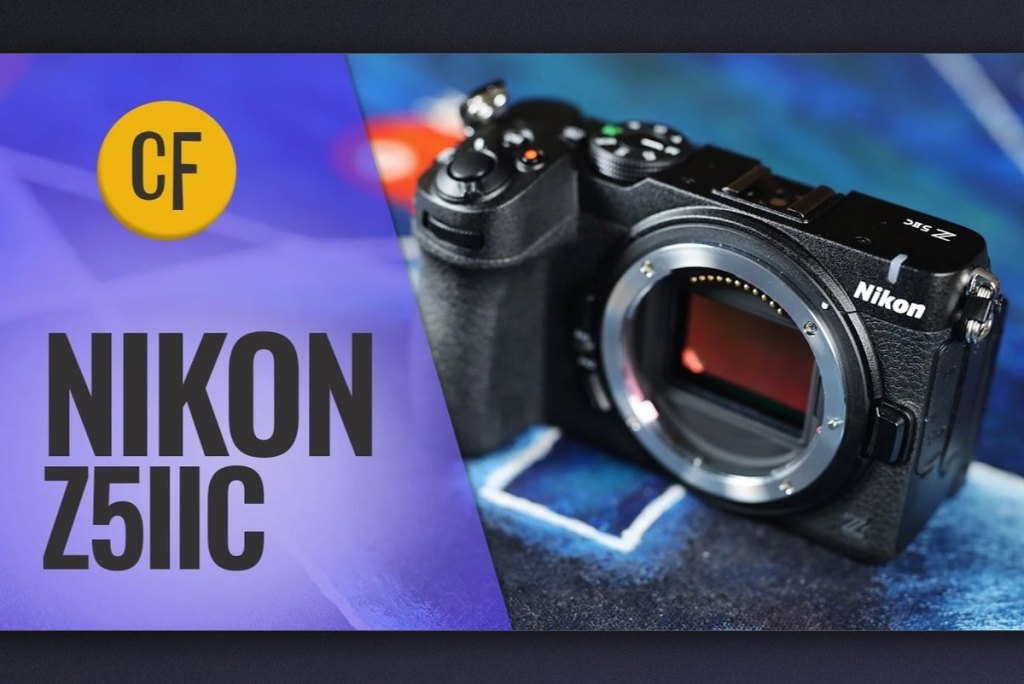
The Nikon Z5IIC keeps the Z5II's sensor, 7.5-stop stabilization, and image quality, cutting only the viewfinder and a few small details, which makes it noticeably cheaper.
- The Z5IIC costs $1,396 USD, while the Z5II is $1,847 USD; the biggest difference is the missing electronic viewfinder
- 24-megapixel sensor, up to 7.5 stops of stabilization, and photo and video quality identical to the Z5II
- You get a single SD card slot, and there is no focus lever or AF assist lamp
- The battery is good for about 400 shots, and a full charge with a 65 W charger still takes about 1.5 hours
- Anyone who needs a viewfinder or two card slots should choose the Z5II
Table of Contents
What the camera leaves out
The Nikon Z5IIC is essentially a Z5II with the electronic viewfinder removed, selling the rest for $1,396 USD. For anyone saving up for an affordable full-frame body, the question is whether composing only on the rear screen is worth trading for a smaller camera and a few hundred dollars left in your pocket. The missing viewfinder has stirred up more debate online than you might expect, so photographer Christopher Frost borrowed a unit from Nikon UK and spent about a week finding out how much of the $1,847 USD Z5II survives the cuts.
Most of it does. The 24-megapixel BSI sensor is retained, along with in-body stabilization rated up to 7.5 stops, a top mechanical shutter speed of 1/8,000 s, and continuous shooting at 11 fps with the mechanical shutter or 30 fps with the electronic shutter, though 30 fps is available only in JPEG. The Z5II's pre-release capture mode and astrophotography modes are still here. The large battery gave Frost about 400 shots, a fairly good figure for a body this small.
The specific cuts
The cuts are quite clear, so you can weigh each one against the way you shoot. The screen is fully articulating, touch-enabled, and bright enough in sunlight, but its resolution is lower than that of the Z5II's screen; even so, it still has more than 1 million dots, and Frost found it sharp in real use. The camera has just one SD card slot, and the focus lever is gone, so you move the focus point with the directional pad or by tapping the screen. The dedicated AF-ON button is also missing, but the AE-L button can be reassigned to do the same job, while the AF assist lamp has been dropped entirely. Interestingly, the cheaper camera adds something the Z5II doesn't have: a fish subject detection mode.
Handling and everyday use
The older-generation sensor reads out somewhat slowly in silent electronic shutter mode, so Frost recommends keeping the camera very still when using it. The microphone, headphone, mini HDMI, and USB-C ports sit behind a rubber cover, and USB-C is used for charging the battery, but even with a 65 W charger a full charge takes about an hour and a half. The body comes in two finishes, all black or with a silver top plate, and Frost thinks the silver version looks slightly better.
In the hand, the camera works better than its compact size suggests. The deep rubberized grip makes the body feel a little chunky in your palm, but it is solid, with plenty of customizable buttons and front and rear command dials. One of the three custom positions on the mode dial has been replaced by a scene mode, where choosing sunset or sports makes the camera set the corresponding aperture, white balance, and shutter speed on its own. A dedicated button next to the mode dial opens the picture styles quickly, and Frost found that a few of the more unusual looks were genuinely inspiring. The menus take some getting used to; for example, silent shooting now lives in the settings menu rather than the photo shooting menu, which left Frost fumbling for a while.
Image and video quality
Image quality is identical to the Z5II. Raw files hold up very well in detail with the 24-megapixel sensor, and the JPEGs have pleasing color and contrast, although the sharpening is a bit heavy-handed for Frost's taste. Images are clean from ISO 100 to 800, the finest details start to soften past ISO 1600, ISO 3200 is still fairly good, ISO 6400 shows more obvious detail smearing, and ISO 12,800 should be used only as a last resort. The camera also has a sensor-shift mode that produces 96-megapixel images, which Frost found most effective at 32 frames on a very stable tripod.
For video, the camera records 4K 60 fps with a 1.5x crop, internal 12-bit raw, 16-bit log, and 1080p 120 fps. Quality is again on par with the Z5II: at 4K 60p detail is middling, noise starts to show from ISO 1600, and Frost avoided ISO 6400 and 12,800, while 4K 25p is cleaner and slightly more detailed. 1080p 120 fps footage looks great at HD resolution, but rolling shutter at 4K is quite heavy at both frame rates, so for moving subjects Frost switched to 1080p, where the artifact is minimized at every frame rate. When raw files are pushed up from -7 EV with the mechanical shutter, dynamic range is decent for a full-frame sensor, though a few pricier cameras do better.
Which camera to choose
Frost doesn't find anything controversial about this camera. He sees it as a very worthwhile option if you want the most value from a full-frame purchase, a solid choice for those still learning, and a good fit for anyone who doesn't like carrying a camera that looks big and expensive. Anyone who needs a viewfinder or two card slots should choose the Z5II, which is occasionally discounted and can narrow the price gap. But at current prices, he still wholeheartedly recommends the Z5IIC.
Migovi sees the Z5IIC as a camera that sells exactly what it can do: everything that matters for photo and video quality is intact, while what was cut is mostly stuff that landscape, everyday, and tripod-based vlog shooters rarely touch. If you often shoot in harsh sun or chase fast-moving subjects, the missing viewfinder will be a real cost, because no screen, however bright, easily replaces pressing your eye to the camera. A single card slot is also a risk worth weighing for event shooters or anyone whose work can't tolerate lost files. So the sensible approach is to ask yourself whether you truly need a viewfinder and a second card slot. If not, the Z5IIC delivers the same images for less money, and if so, the premium for the Z5II is a cost worth paying.
Source: Fstoppers
Reviewed by: Hero Association