Microsoft says MAI Code 2 delivers 98% of GPT-6.1 Sol's performance at 40% of the cost, while MAI Cyber 2 Flash costs less than 2% per task compared with GPT-6 Astra.
- Microsoft AI released seven MAI models at once at Ignite, targeting always-on AI agents and the problem of token costs
- MAI Code 2: by Microsoft's own figures, nearly on par with GPT-6.1 Sol and Claude Opus 5.5, but at just 40% and 5% of the cost
- MAI Cyber 2 Flash edges out GPT-6 Astra on CyberGym-E2E (92.3% vs. 91.5%) and is available only in Microsoft's security products
- Decision 1.1 is built on Google's Gemma 4, while MAI Image 2.7 tops Artificial Analysis' image editing leaderboard
- Almost every figure was published by Microsoft itself, and MAI Licensed Weights has neither a release date nor pricing yet
Table of Contents
Seven MAI models at Ignite
Microsoft AI (MAI) has unveiled seven new models at its Ignite conference, covering code, security, images, speech, and workflow orchestration. As at Build in June, Microsoft launched the whole batch at once rather than spreading releases across the year. The main selling point is price-to-performance, since the company sees enterprise customers' token spending climbing fast as they try to keep AI agents running around the clock. MAI chose the model lineup of its partner OpenAI as its yardstick, and Anthropic is also on the comparison list. Microsoft also states plainly that its code models target everyday enterprise programming, and are not yet optimized for heavier work such as foundational research or long multistep agent workflows.
Code models and office work
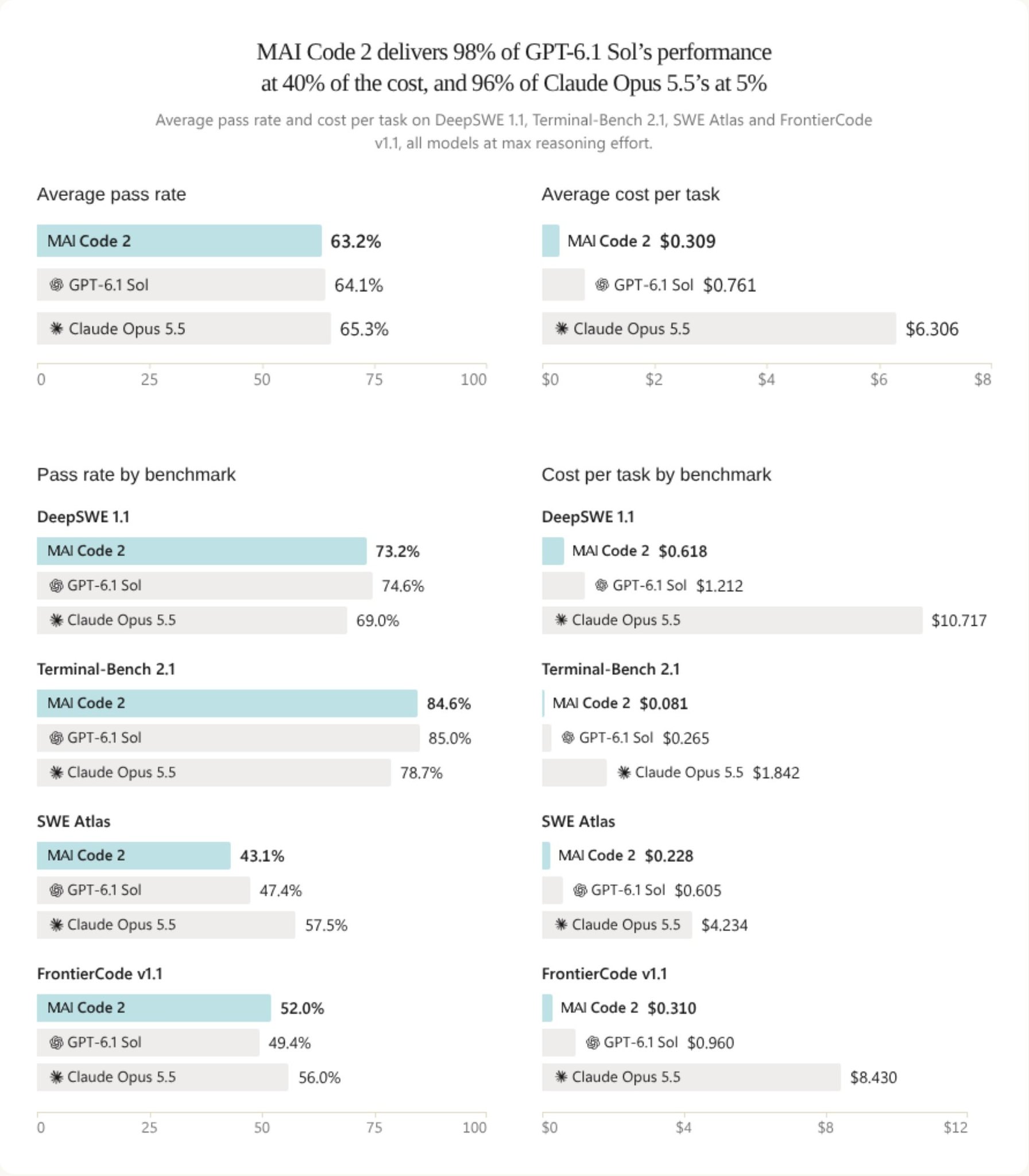
According to figures Microsoft published, MAI Code 2 averages 98% of GPT-6.1 Sol's performance across four benchmarks at only 40% of the cost. Against Claude Opus 5.5, it reaches 96% of the performance at 5% of the cost. The four tests are DeepSWE 1.1, Terminal Bench 2.1, SWE-Atlas, and FrontierCode v1.1. Three of them ran on Microsoft's internal MSBench platform with GitHub Copilot CLI and no sub-agents. Note that these cost figures are calculated after Microsoft's 50% promotional discount on its own model, so the numbers will not stay this low once the offer ends. On interface tasks such as UI, games, data visualization, and SVG graphics, human raters picked MAI Code 2's output in 64% of blind comparisons against GPT-6 Sol.
The lightweight MAI Code 2 Flash, the successor to MAI-Code-1.1-Flash, is aimed at explaining code, making targeted fixes, and handling common bugs. It is said to match GPT-6 Luna and Claude Haiku 5.5 at 65% and 20% of their cost, respectively. From this Flash model, Microsoft built MAI Work Flash to run inside Microsoft 365 and Fabric IQ. In internal tests, it matches GPT-6 Luna in Excel and PowerPoint, and in Word it is on par with GPT-6.1 Sol while using about 42% fewer input tokens. When writing DAX queries for Power BI, it beats GPT-5.6 Sol, GPT-6 Astra, and Opus 5.5. In GitHub Copilot, MAI Code 2 carries a promotional price of 0.50 USD per 1 million input tokens and 2.50 USD per 1 million output tokens through May 17, 2027, after which it rises to 1 USD and 5 USD. MAI Code 2 Flash costs 0.05 USD and 0.25 USD, rising to 0.10 USD and 0.50 USD.
MAI Cyber 2 Flash for security
On the security side, MAI Cyber 2 Flash solved 92.3% of tasks in the CyberGym-E2E vulnerability discovery benchmark, edging out GPT-6 Astra's 91.5%, even though GPT-6 Astra needed twice the reasoning budget. Per task, Microsoft's model costs less than 2% of what GPT-6 Astra does, and its per-token price is just one percent. On WebExploitBench, it scored 40.4%, ahead of GPT-5.6 Cyber at 38.4%. By list price, the model charges 0.10 USD and 0.50 USD per 1 million input and output tokens, versus 10 USD and 50 USD for GPT-6 Astra, so each CyberGym-E2E task costs 0.45 USD instead of 34.38 USD.
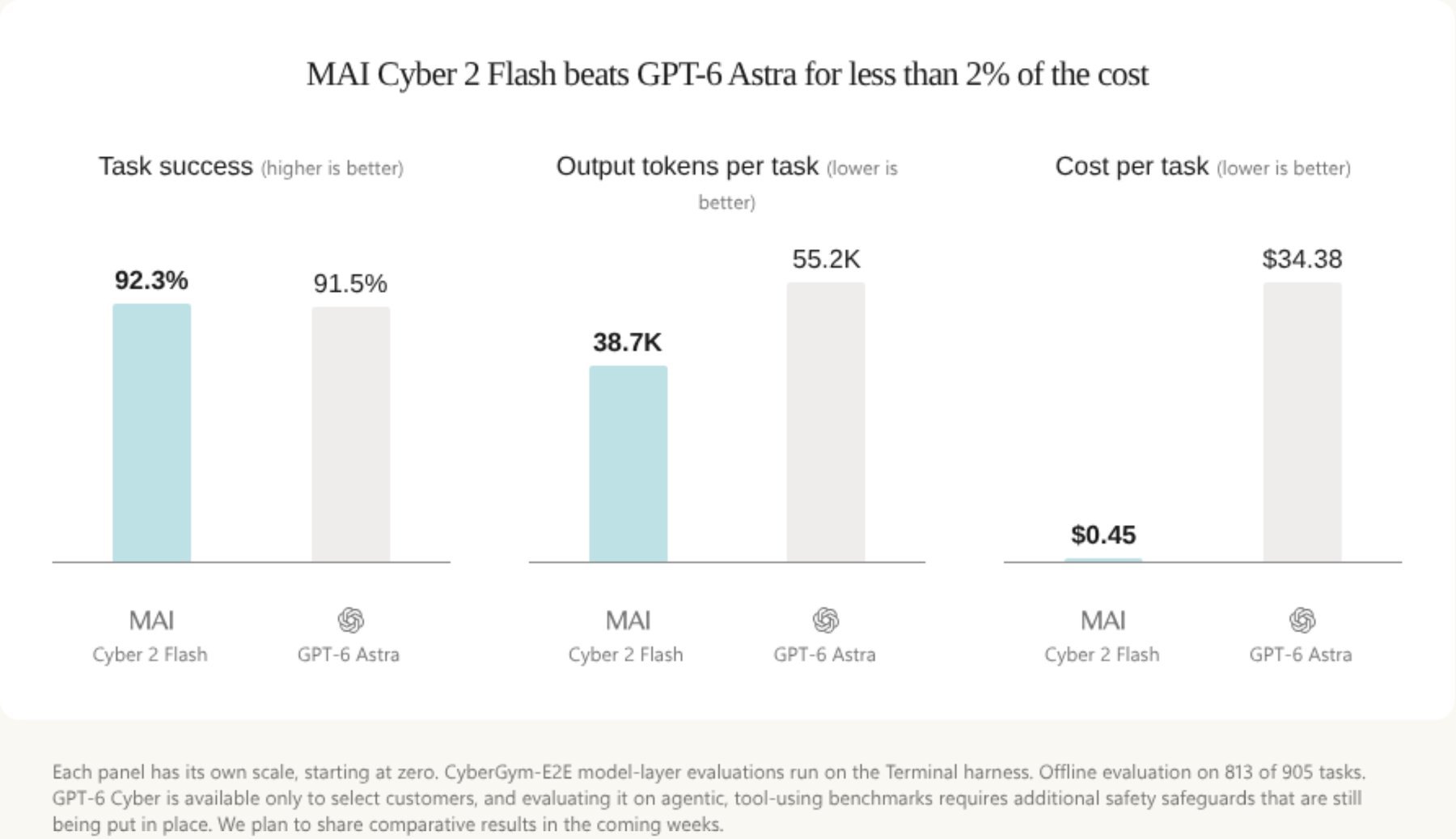
During evaluation, Microsoft found that 10% of roughly 900 CyberGym tasks used open-source projects and vulnerability reports that overlapped with some of its own training data. The company says the reference solutions never entered training, but it still excluded those tasks for every model and scored only the rest, so the 92.3% figure is a result on the cleaned subset. One gap remains: there is no comparison with GPT-6 Cyber, which is available only to selected customers. Agentic tests that use tools require extra safeguards, so Microsoft promises to publish those results in the coming weeks. On specs, the context window reaches 1 million tokens, four times that of MAI Cyber 1.1 Flash, and output tokens are 86% cheaper than in the previous version. MAI Cyber models have already handled nearly 40% of scans on Microsoft's MDASH security platform. MAI Cyber 2 Flash is available only in the company's security products, and Microsoft plans to automatically swap it in for the existing model in MDASH's MAI profile for eligible customers starting in mid-December.
Orchestration and retrieval models
Microsoft-Decision-1.1 handles routing, classification, prioritization, and workflow control. The model picks from actions pre-approved by developers and returns a calibrated confidence score, so when uncertainty is high, an app can escalate to a higher tier of handling instead of acting on a wrong decision. When information is insufficient, the model is designed to decline to decide. It is built on Google's Gemma 4 26B A4B mixture-of-experts model, whereas the previous version was based on Qwen3.5-9B. Microsoft trained it with supervised fine-tuning and reinforcement learning on hundreds of synthetic and licensed datasets, then runs it on a proprietary inference engine.
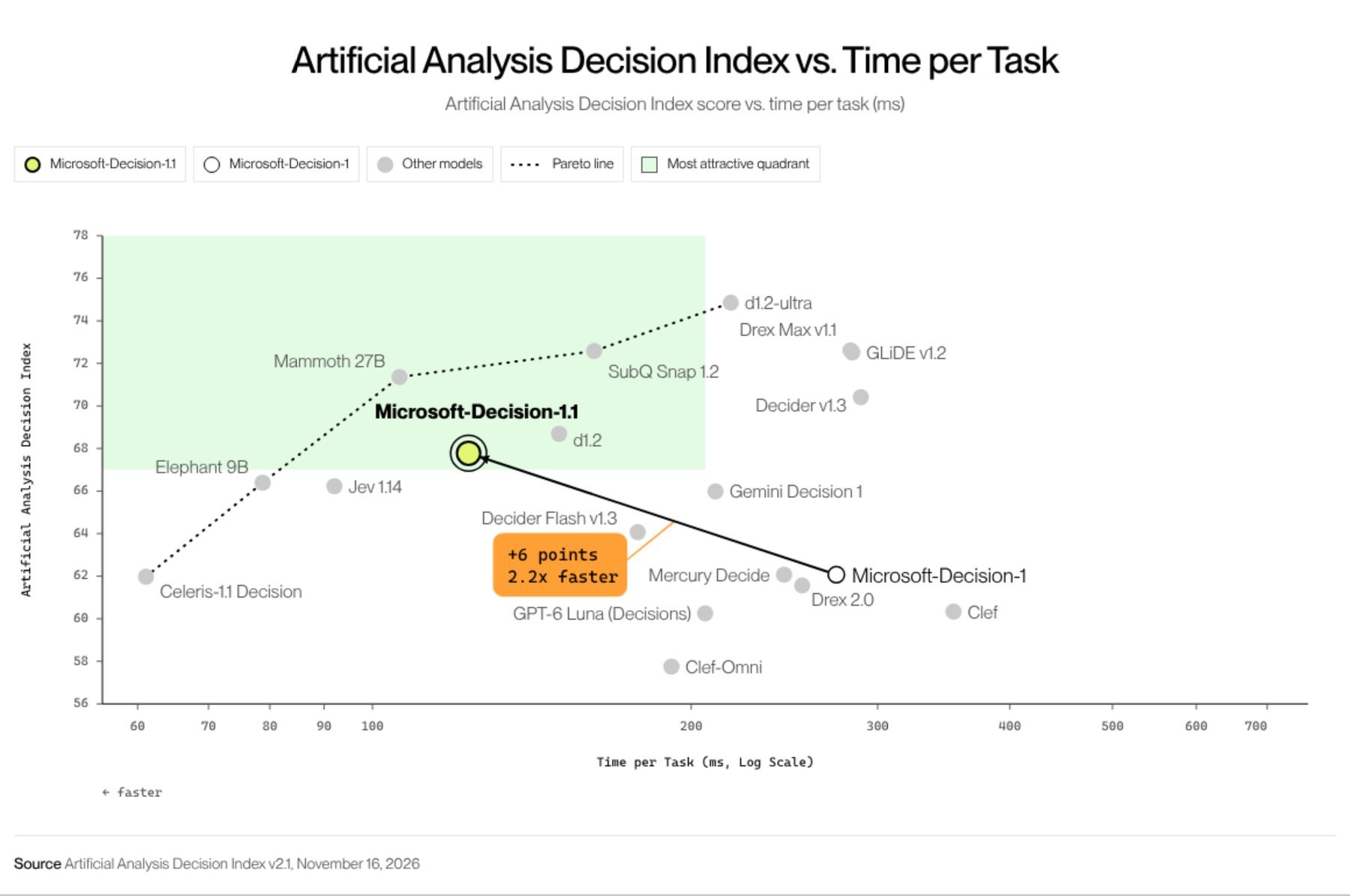
On Artificial Analysis' Decision Index v2.1, Decision 1.1 scores 68, six points above the previous version and higher than Jev 1.14, Gemini Decision 1, and GPT-6 Luna (Decisions). In 102 internal tests with more than 385,000 questions, Microsoft says it had the highest average accuracy among the eight decision models tested. The model now accepts images, including screenshots. In Copilot, it decides whether a user's request goes to Copilot or Cowork, with accuracy on par with a large language model but 2.2 times faster and 4.4 times cheaper. In Cowork, the Auto feature relies on it to set the reasoning effort for each task. Pricing is 0.042 USD per 1 million input tokens (0.05 USD in the EU data region), and output tokens are free.
Ignite's Book of News also lists Microsoft-Retriever-1, a model that specializes in gathering relevant information from enterprise documents for agents in Foundry IQ. Instead of searching just once, it plans queries, evaluates the results, and keeps asking until it has enough material for a grounded answer, an approach Microsoft says is faster and more effective than earlier methods. Retriever-1 launches in preview, while Model Router in Foundry can now also choose from a wider pool of models.
Images, speech, and healthcare
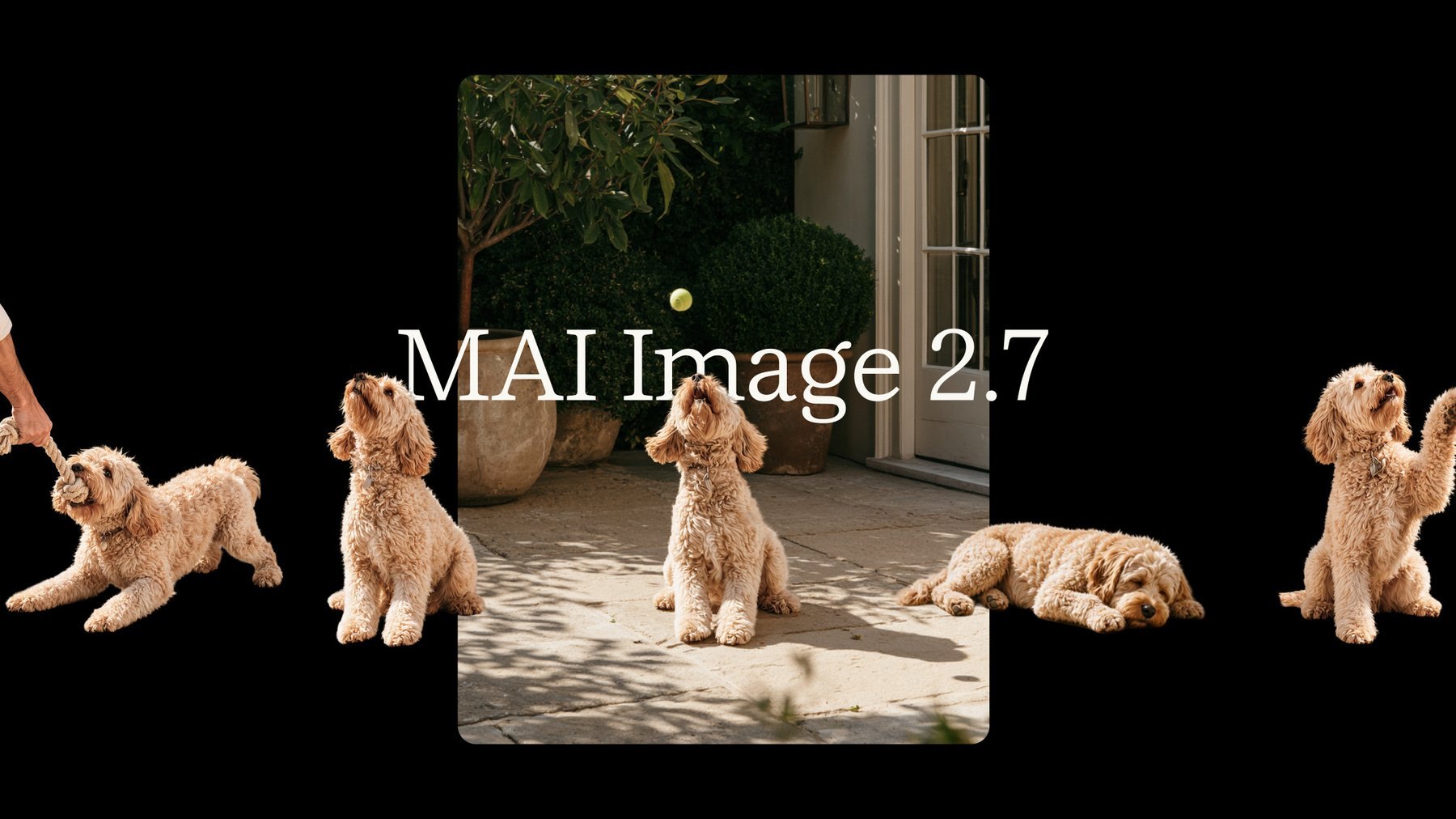
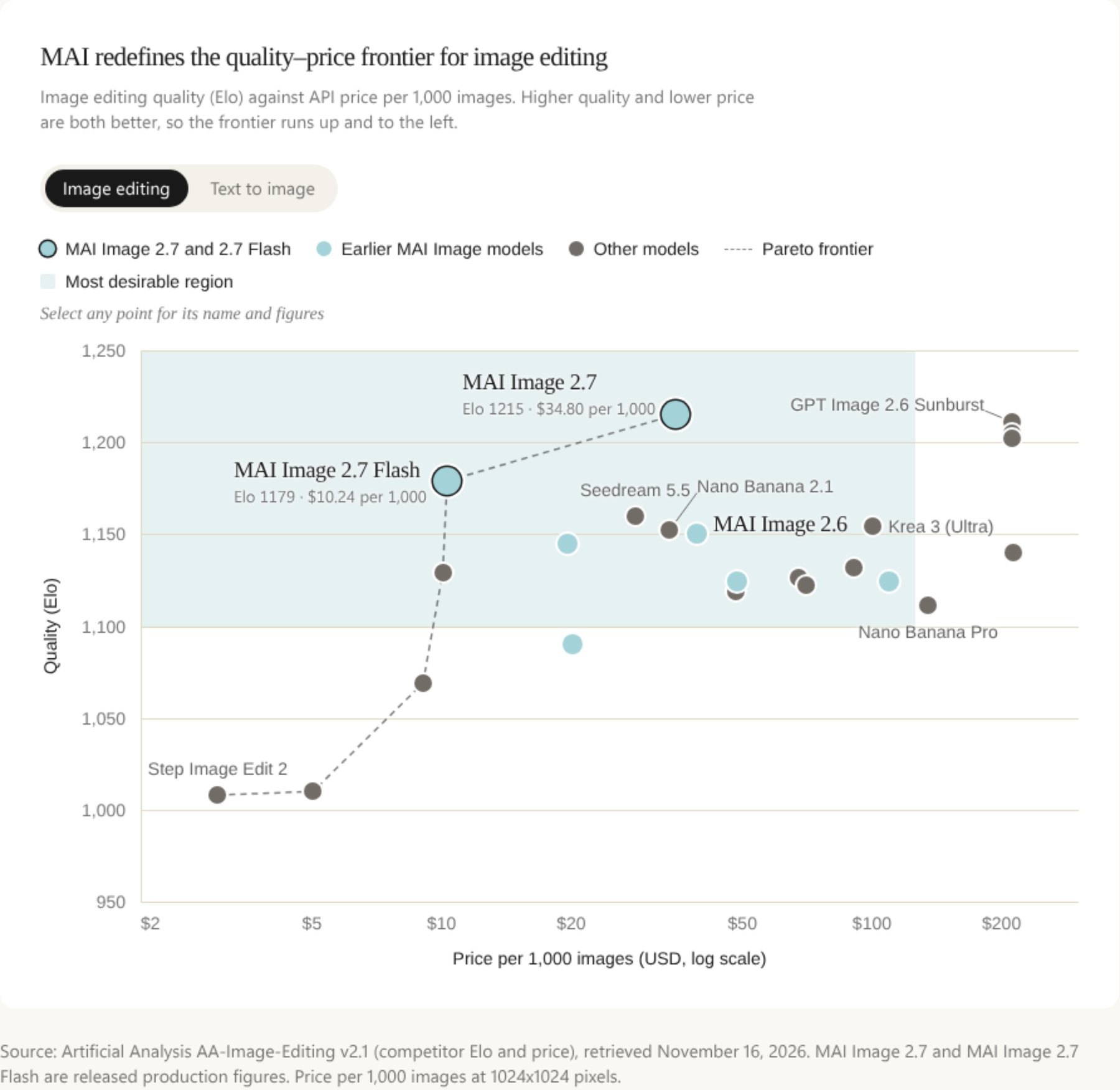
MAI Image 2.7 leads Artificial Analysis' image editing leaderboard with 1,215 Elo points from 5,478 votes, four points ahead of GPT Image 2.6 Sunburst (max) at one-fifth of the price. In text-to-image generation, the model ranks fourth on the same leaderboard. It can change the color, material, or position of individual objects without touching the rest of the image, and it can also produce transparent backgrounds. It costs about 35 USD per 1,000 images, while the Flash version costs about 10 USD, less than a third of that, and runs in Canvas, MAI Labs' new image editor. MAI Image has been the default model in Bing Image Creator since June, and Microsoft says Adobe, Figma Weave, Minute (Sports Illustrated), Wirestock, and Manus are working with MAI Image.
MAI Realtime 1 is Microsoft's first speech-to-speech model, designed to handle interruptions, wait for speakers to finish their sentences, and recognize requests even with background noise. For difficult tasks, it switches to a more powerful reasoning engine billed by token. The base rate is 0.01 USD per audio minute, plus 1 USD per 1 million input tokens and 5 USD per 1 million output tokens when the reasoning layer is used. Microsoft says it beats GPT Realtime 2.1 on Big Bench Audio, τ-Voice, and tests with Dynamics 365. Because it is compatible with the OpenAI Realtime API, existing voice apps can switch over fairly easily, and Agoda and Reservations.ai are testing the model.
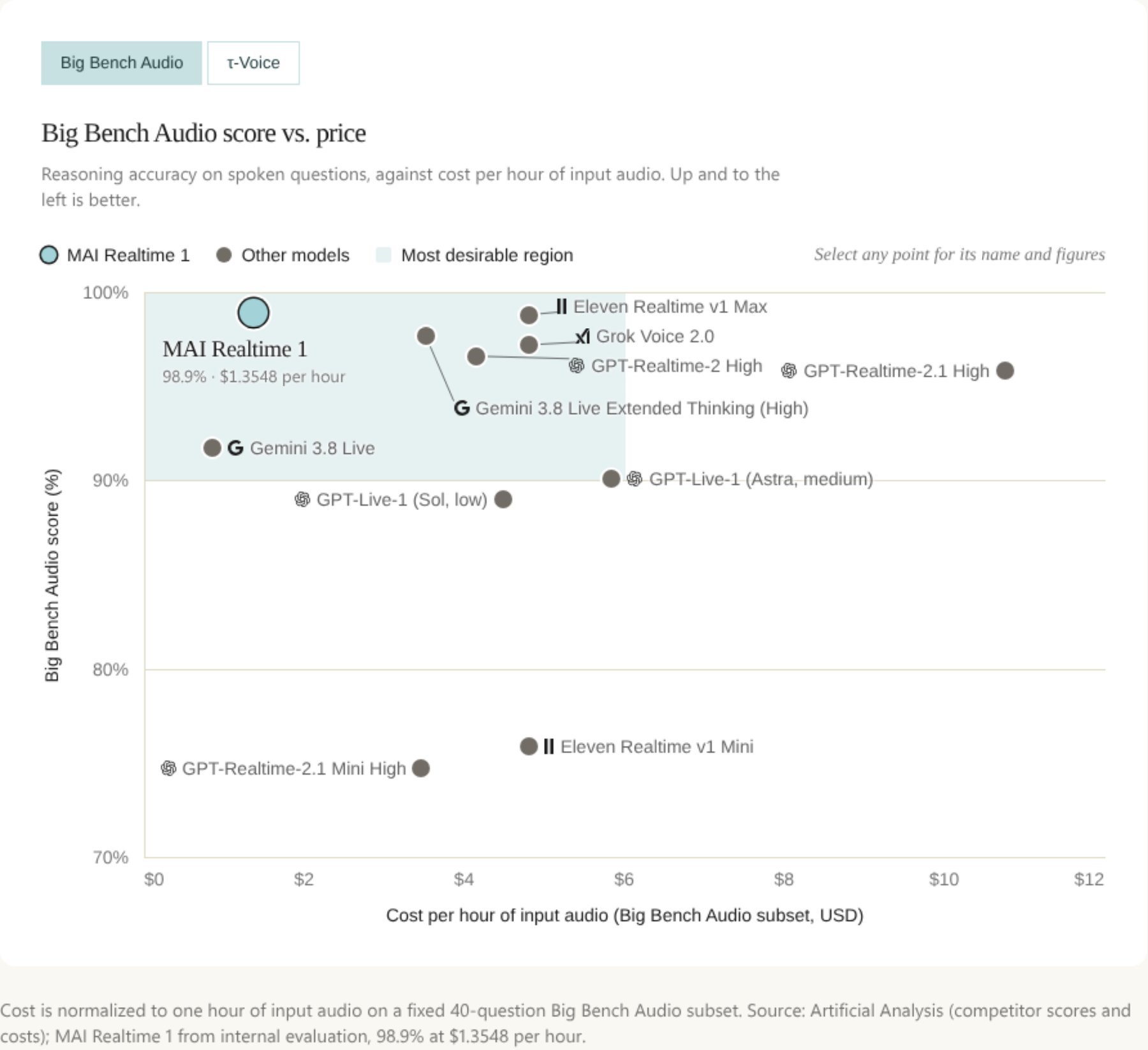
Microsoft also plans to bring MAI Realtime 1 to Dynamics 365 Contact Center and Dragon Copilot, where nurses could use it to practice conversations with patients. On the healthcare side, Dragon Copilot Transcribe, based on MAI Transcribe 2, now handles all doctor-patient conversation transcription in Dragon Copilot, about 10 million conversations a month, and error rates in multilingual workflows have been cut in half. For its large models, Microsoft now uses the Maia 200 chip, the second generation of its in-house AI accelerator, which is said to deliver 1.7 times more tokens per watt.
MAI Licensed Weights for enterprises
MAI Licensed Weights lets enterprises fine-tune MAI models on their own data and run them in their own Azure environment. The data and customizations remain the customer's, and Microsoft says it will use them to train its own models only with explicit consent. The company positions the package as an alternative to open weights, whose provenance and behavior are very hard for enterprises to verify. One example is US carrier AT&T, where a model customized for 5G network operations analytics reportedly beats GPT-6.1 Sol on benchmark tasks at roughly one-fiftieth of the cost. The release date and pricing have not been announced. Interested enterprises should contact their Microsoft account team, and the package is said to arrive soon through the Frontier Company program.
Release schedule
MAI Code 2 and Code 2 Flash are already in GitHub Copilot. The Flash version also has a limited preview in Foundry, while OpenRouter, Vercel, Hermes, Open Code, and Kilo are expected to follow. MAI Image 2.7 and its Flash version are in public preview on Foundry, fal, Genspark, OpenRouter, and Vercel. Decision 1.1 is generally available on Foundry, OpenRouter, and through Vercel's AI Gateway. MAI Realtime 1 can be tried in MAI Labs, is available as a preview on Foundry, and is free until the public preview launches.
Using OpenAI models as the yardstick for the MAI lineup is happening within a relationship that remains close. In April, Microsoft and OpenAI restructured their partnership: OpenAI can now sell products through any cloud provider, Azure remains the primary cloud partner, and Microsoft keeps a non-exclusive license to OpenAI's models and products through 2032.
What stands out most is not how much cheaper Microsoft is, but that the company is confident enough to benchmark itself against GPT and Claude inside its own products, a sign that token cost is becoming a bigger issue than benchmark scores. However, almost all of the figures were measured by Microsoft itself, some on its internal MSBench platform, and MAI Code 2's low price comes with a 50% promotion through May 17, 2027, so Migovi believes they should be read as promises rather than conclusions. The fact that Decision 1.1 runs on Google's Gemma 4 also shows that big players are willing to build on a rival's open foundation when it is good enough. For Vietnamese users already on GitHub Copilot or Azure, the sensible move is to try MAI Code 2 on their own work and compare real costs, rather than rushing to switch because of the vendor's comparison charts.
Source: The Decoder (AI)
Reviewed by: Hero Association