After the IPO, Anthropic has roughly 200 billion USD in the bank, but it has committed to spend more than 900 billion USD with suppliers over the next 19 years, mostly on data centers.
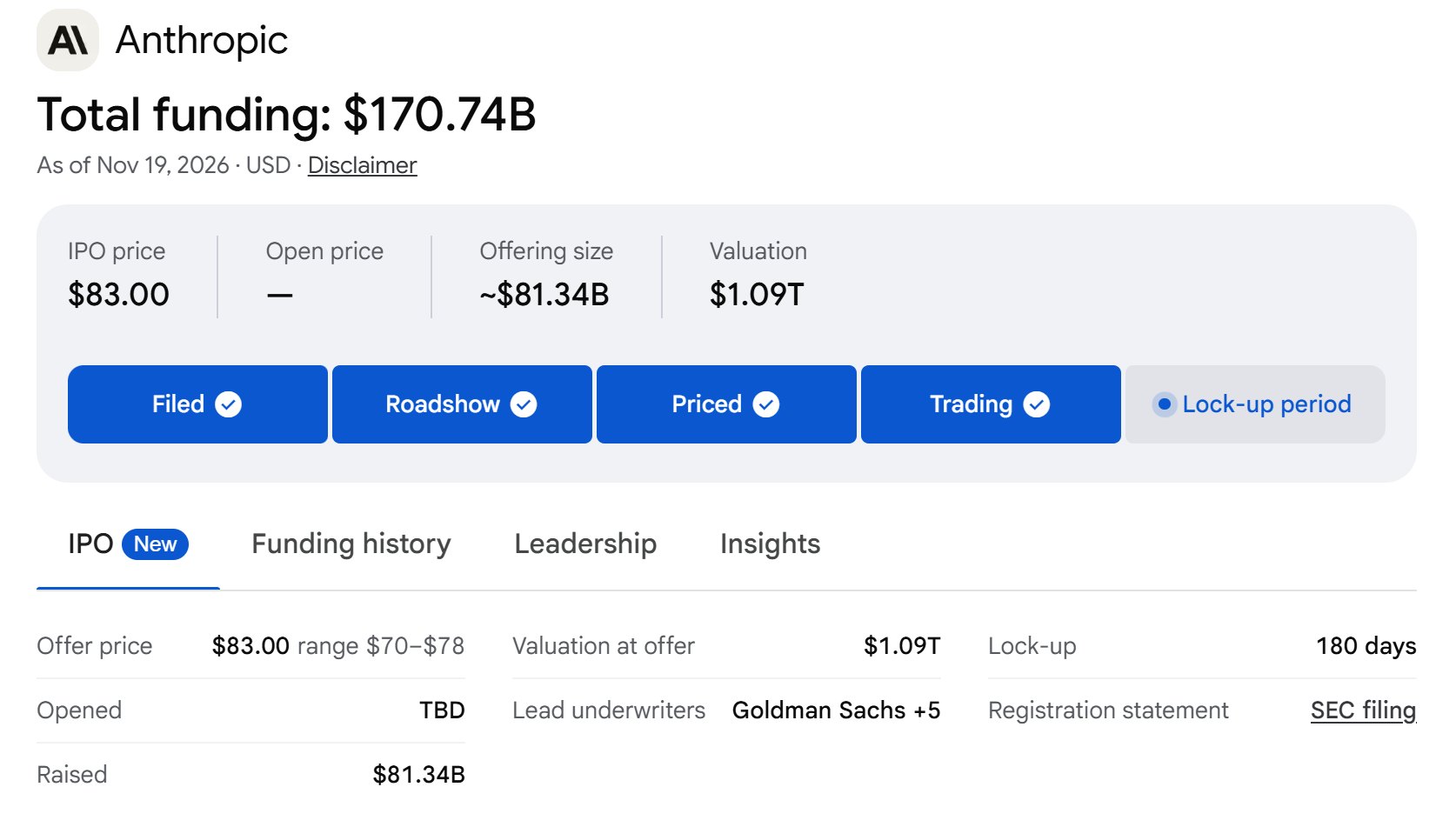
- Anthropic's IPO raised about 81 billion USD (more than 107 billion USD including private placements), at an initial valuation of about 1.5 trillion USD
- Shares begin trading on Nasdaq under the ticker ANT at midday Thursday
- Revenue last quarter was 17 billion USD, but the company lost more than 104 billion USD in the year through September
- It has committed to spend more than 900 billion USD over 19 years, mostly on data centers that run Claude
- Still open: how much the market can stomach in data center debt, and how fast new models will ship while the company puts safety first
Table of Contents
Scale and valuation
Anthropic has just closed the largest initial public offering (IPO) ever, raising about 81 billion USD, or more than 107 billion USD if you include shares sold privately. That tops the 75 billion USD SpaceX raised in June, though Anthropic's initial valuation of about 1.5 trillion USD is still below SpaceX's nearly 1.8 trillion USD, which reflects a business far broader than AI. For comparison, OpenAI is valued at 1.25 trillion USD in a funding round that has not yet closed. Anthropic's shares will begin trading on Nasdaq at midday Thursday under the ticker ANT.
Revenue is surging, but losses are still huge
After the offering, Anthropic has about 200 billion USD in cash, more than any other big tech company except Alphabet. Revenue last quarter hit 17 billion USD, up more than 1,100% year over year. The number of customers spending six figures a year grew 12-fold, and operating losses are narrowing. Tomasz Tunguz, a partner at the investment firm Theory Ventures, said it is hard to imagine a better IPO prospectus. Still, the company lost more than 104 billion USD in the year through September, largely because of how it must account for paying employees in stock. That has not scared off investors, who are eager to buy its shares and lend it money.
The 900 billion USD commitment and the worries
Alongside its large cash pile, Anthropic has also committed to pay suppliers more than 900 billion USD over the next 19 years, mainly to build data centers that run Claude and other AI models. Some analysts say that gap is not alarming given how fast revenue is growing, but not everyone is reassured. The company reportedly wanted a higher valuation and did not get it, concern is growing over the debt used to build AI data centers, and the prospect of Nvidia scaling back its investment after CEO Jensen Huang's abrupt departure adds to those worries.
Building data centers is not easy, either. Residents near several projects, including a facility Nscale is building for Anthropic in West Virginia, complain about rising electricity bills, disrupted traffic and housing, and pollution, while the financial benefit to the local community is small. Environmental activists also point out that Anthropic has not committed to using renewable power for its data centers and has never published an environmental impact report. According to Tunguz, getting permits for new data centers in the US will clearly be very hard, so Anthropic and other companies may have to look for sites outside the US, which brings added risk, complexity, and cost.
The model safety dilemma
At an investor meeting streamed online last week, CEO Dario Amodei said that building new safeguards is the factor limiting model deployment, and that he does not want AI agents running wild. He also said the company held back a new model earlier this year, accepting a hit to sales to avoid releasing technology that could cause harm. He added that it chooses to hire people oriented toward the public good for its 5,300-person workforce, even though that is "painful in the short term" because it means passing over some qualified candidates. Amodei also ranked safety as a bigger challenge than power for data centers, which many other AI companies see as their top problem.
That approach could slow the company down. To keep revenue growing, Anthropic and OpenAI must keep releasing more powerful models that let customers automate more kinds of work, or customers may switch to cheaper options. Some inside the company are even more worried than its leadership: researcher Jacob Coxon quit in September, arguing that without tighter control of models, humanity could be in danger within a few years. He recently said he might return, believing he can have more impact working on safety at Anthropic itself.
Corporate structure and control
Anthropic is headquartered in San Francisco and operates as a public benefit corporation, which allows it to weigh social impact alongside shareholder interests. This is the largest IPO ever by a company with that structure, and the first by a company focused on developing generative AI. Its founding group of engineers and executives split from OpenAI in the middle of the pandemic, nearly six years ago, over strategic disagreements, and the two have been rivals ever since. OpenAI was once expected to go public first, but senior departures, shifting priorities, and legal troubles have created extra obstacles.
On power, Amodei and his co-founders collectively hold most of the voting rights, leading some investor watchdogs to warn about the concentration of control. The IPO filing argues that part of the company's public benefit will come from employees and early investors becoming major philanthropists, but nothing guarantees that. And if employees donate shares to charitable foundations set up by the company, they also hand their voting rights to Amodei. ANT's first trading session will show whether investors are willing to entrust one of the world's largest companies to this group.
Anthropic's numbers sound impressive, but what Migovi pays more attention to is the commitment of more than 900 billion USD, because it shows that surging revenue still has to chase enormous infrastructure costs. The company is only fine as long as it keeps shipping models strong enough for customers to pay for, while data center construction runs into obstacles and the CEO himself says safety is the biggest bottleneck. For Claude users in Vietnam, nothing changes for now, but the pace of new model releases and the company's pricing policy over the next few quarters are worth watching, since that is where financial pressure will show up first. If you are building your work on Claude, keep a fallback plan with another model instead of depending entirely on a single provider.
Source: Wired
Reviewed by: Hero Association