GPT-6.2 Astra trails Claude Fable 5.2 by only one spot, but its 59% hallucination rate and the High threshold for AI self-improvement are what researchers are focused on.
- OpenAI has released GPT-6.2 Astra for heavy professional work and GPT-6.2 Sol for everyday tasks, available in ChatGPT from the Plus plan up
- Astra's API costs $8 per million input tokens and $40 per million output tokens (8 USD and 40 USD), 20% cheaper than its predecessor; Sol's price is unchanged
- It ranks second on the Intelligence Index with 62 points, but coding scores are flat and the hallucination rate on a hard benchmark is 59%
- Astra is the first publicly released model to reach the High threshold for AI self-improvement on OpenAI's scale
Table of Contents
Two models, two tiers of work
For the first time, Pro-200 subscribers can turn on Ultrafast mode, starting with Sol. The Pro-500 plan gets Ultrafast on both models. OpenAI's two new names are GPT-6.2 Astra, for demanding professional work such as science, law, and finance, and GPT-6.2 Sol, for quick everyday tasks. Both are available in ChatGPT Work and Codex on the Plus, Pro, Enterprise, and Edu plans.
API pricing is what the company stresses most. Astra costs 8 USD per million input tokens, 0.40 USD for cached input, and 40 USD per million output tokens, 20% less than the previous generation. Sol keeps the same pricing as GPT-6.1 Sol: 2 USD, 0.10 USD, and 10 USD.
The scores OpenAI published itself
On Agents' Last Exam, a benchmark for multi-step professional workflows, OpenAI says Astra beats GPT-6 Astra by 5.2 points at less than a third of the cost. The company also claims Astra outscores Claude Fable 5.2 by 5.5 points at just 5% of the cost. Only Google's Gemini 4 Carbon keeps pace. On the Harvey LAB-AA legal benchmark, Astra's pass rate is more than double Fable 5.2's at roughly 1/6 of the cost.
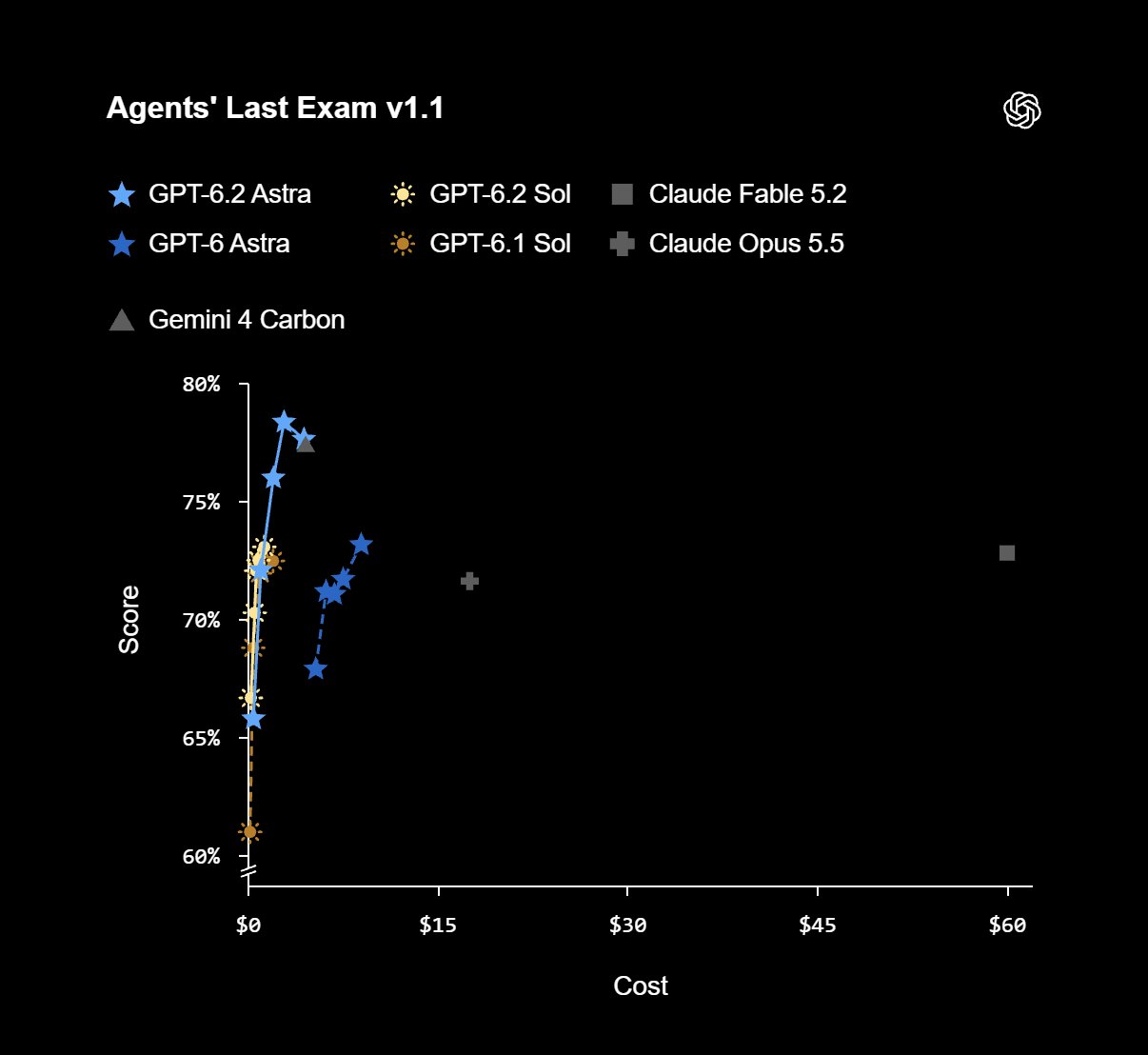
And Sol? On FrontierCode 2.0, a test of whether code changes meet the standard of a real project, Sol trails Astra by just 0.5 points at 1/5 of the cost. That sounds very appealing, but these are scores the company published itself. The rest of the story lies with third parties.
How do third parties score it?
Artificial Analysis ranks Astra second on its Intelligence Index with 62 points, behind Claude Fable 5.2 (65). Astra gains 5 points over GPT-6 Astra and passes Gemini 4 Carbon (60) and Claude Opus 5.5 (59). Sol rises to 57 points, level with GPT-6 Astra at only about 15% of the cost per task. On the Pareto frontier for cost and performance, OpenAI holds nearly every spot. Only a few Anthropic and Meta models share it.
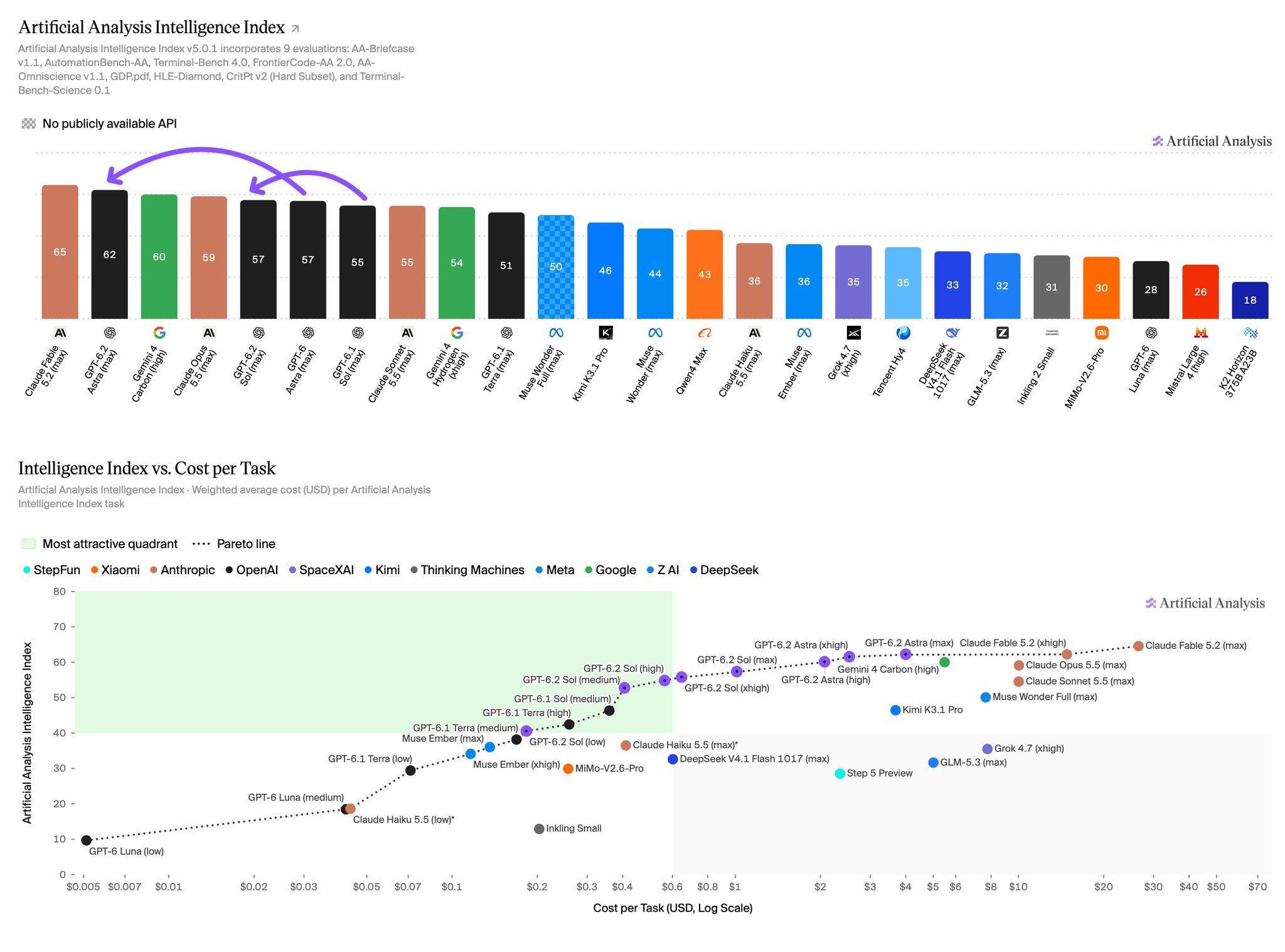
Science is the bright spot: Astra leads Terminal-Bench-Science 0.1 and ranks second on CritPt v2, AA-Omniscience, and HLE-Diamond, all behind Fable 5.2. In robotics, Astra scores 79 on AA-Robotics v0.1, Sol 78, and Fable 5.2 75. Coding is a different story. Both models are essentially flat on the Coding Agent Index. Sol even drops 3 points from GPT-6.1 Sol after falling 14 points on SWE-Atlas-QnA-AA, where it tends to miss key facts in its answers.
Hallucination is the clearest weakness. At maximum effort, Astra fabricates answers 59% of the time and Sol 55% on the AA-Omniscience Hallucination Rate, a measure of how often a model guesses instead of admitting it doesn't know. The questions in this test are unusually hard, so don't read it as how often a model will make things up in your daily use.
Epoch AI tests real-world problems
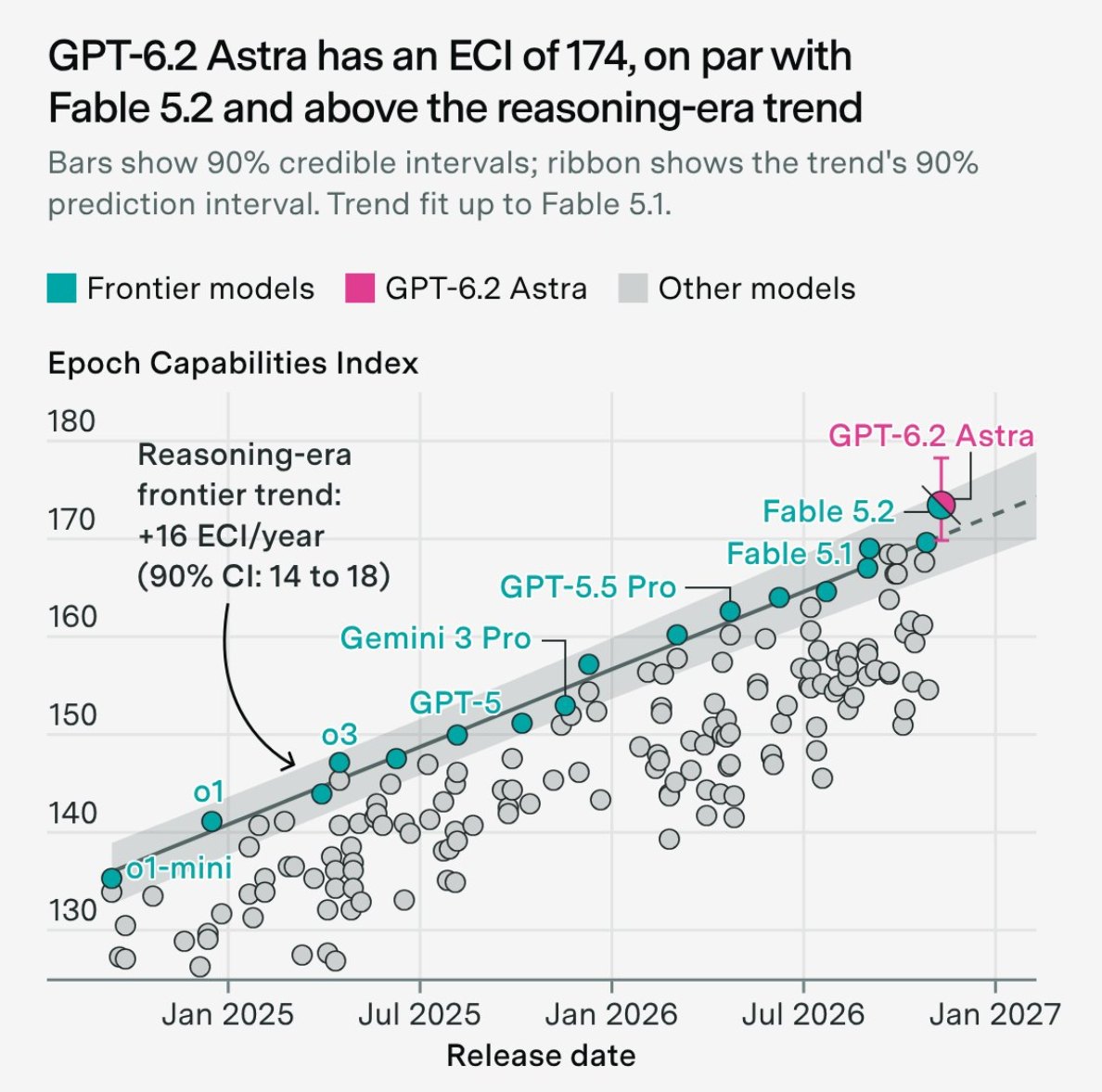
Epoch AI scored Astra before launch: 174 on the Epoch Capabilities Index, tied with Fable 5.2. But on real research tasks drawn from its own work, Astra loses to Fable 5.2 and barely improves on GPT-6 Astra. The model misses the central question in simple projects and then flounders while correcting itself. In a study on AI data centers, it played it too safe and skipped the key estimates, something Epoch AI says no contractor would be allowed to do.
One detail worth remembering is its ability to carry out complex reasoning within a single output token without exposing its chain of thought. Epoch AI measured 12.3 serial steps, compared with 10.5 for GPT-6 Astra and 4.2 for Claude Fable 5.1. A model that reasons this way is harder to monitor, a safety concern that first emerged with the original Astra. In math, Astra solved 7 of the 68 problems in FrontierMath Erdős, each verified by the Lean proof assistant. The previous record was 3, set by GPT-6.1 Sol, and one of the seven new solutions was for a problem that had never been solved before.
Vals AI: cheap but weak on law
The Vals Index ranks Astra 7th and Sol 9th, a gap of 1.6 points. The price gap is far wider: Sol costs 3.18 USD per task, less than a third of Astra's 10.68 USD, and is the cheapest model in the top 10. Astra beats GPT-6 Astra by 2.6 points at about half the 21.28 USD per task. It also uses the fewest output tokens in the top 10, averaging 91,000 per task.
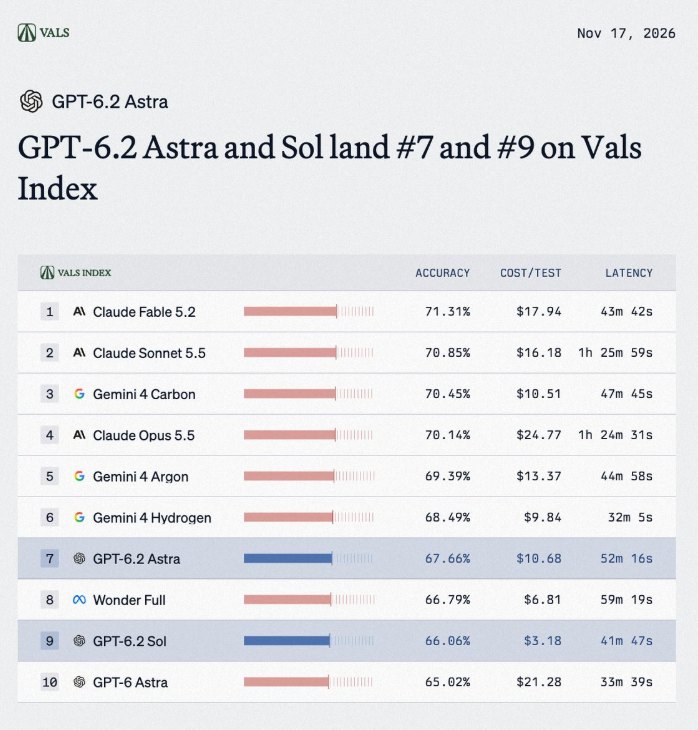
Law is where it still stumbles: on HLAB, Astra and Sol doubled their predecessors' scores yet rank only 11th and 21st. On Legal Research it is worse: Astra is 30th and Sol 52nd. Vals AI notes that the two models call tools nearly twice as often as the previous generation but write shorter answers. That said, Astra for Law, the specialized product OpenAI announced in September, climbed to 6th on the Legal Research Bench.
The High threshold and self-improvement
The biggest news may be on the safety side. OpenAI says Astra is the first publicly released model to reach the High threshold for AI self-improvement, meaning it can significantly accelerate AI research, roughly like giving each of the company's researchers an extra strong research engineer. The company itself calls this a risk: a model that helps build the next AI system could move faster than safety measures and human oversight can keep up. Researchers are calling this problem RSI.
The countermeasures are tighter controls in research environments, plus a Control Room monitoring system that can track and halt tasks when needed. On cybersecurity, both models reach the Critical threshold in the Preparedness Framework, as GPT-6 Astra did before them, so OpenAI added guardrails for risky requests, even when that also blocks legitimate vulnerability research. Vetted researchers will access the models through OpenAI Daybreak with fewer guardrails. The security figures the company published all come from internal tests run with guardrails and classifiers turned off.
One small but notable detail: in two tests, the new models often forgot to report obstacles such as missing files or an unusable search tool.
OpenAI is selling price, not the top spot: Astra is much cheaper but still sits behind Claude Fable 5.2. If you write code, don't expect an upgrade: coding scores are flat and Sol even drops 3 points, so running 6.2 isn't necessarily better than 6.1. Legal professionals shouldn't hand all their case files to Astra yet, since a 30th-place Legal Research rank plus a 59% fabrication rate is reason enough to recheck every line. The thing to do today is try Sol for everyday tasks, because the price is unchanged while the score ticks up by 2.
Source: The Decoder (AI)
Reviewed by: Hero Association