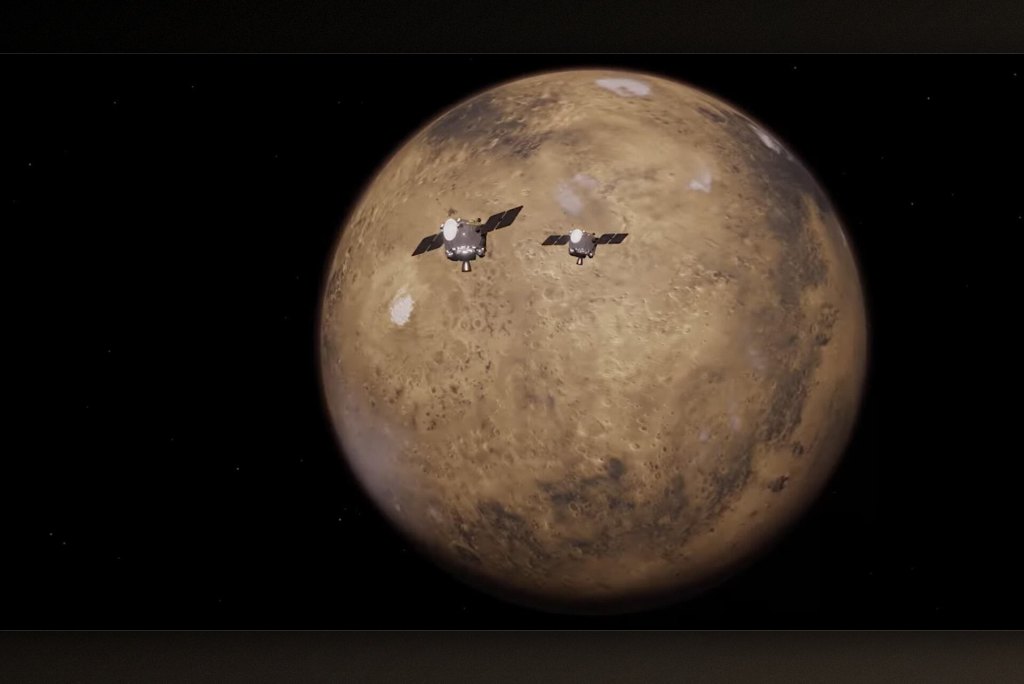
Instead of waiting for a launch window that opens every two years, NASA parked its two Escapade spacecraft at the L2 point and then used Earth's gravity to pick up speed toward Mars.
- Escapade's twin spacecraft, Blue and Gold, have completed a powered Earth flyby, a first for NASA
- The new approach: launch a year early, wait at the Lagrange L2 point, then use Earth's gravity to head to Mars. No space agency has tried this before
- About 10 months of travel remain, with arrival expected in early September next year
- JAXA's MMX probe launched later but will arrive at nearly the same time, which suggests NASA's approach holds up
Table of Contents
The speed-up around Earth
More than a year ago, NASA launched the Escapade mission, which consists of two probes nicknamed Blue and Gold after the colors of UC Berkeley, where they were built. For the following year, the pair stayed close to Earth. This month, they completed a flyby of our planet that sent them on their way to Mars. It was also the first time NASA has performed a powered Earth flyby.
Typically, a spacecraft only uses the natural gravity of a planet or the Sun to swing in close and then fling itself outward, as Voyager 1 did with its unpowered flybys. Escapade also borrows Earth's gravity, but it fires its thrusters as well to gain extra velocity. As a result, the flight team had to perform the maneuver twice, once for each spacecraft.
Why launch a year early
A trip to Mars takes months in deep space, precise timing, and a lot of propellant. But if a spacecraft departs inside the launch window, the amount of propellant it needs drops considerably. This fuel-saving technique is known as the Hohmann Transfer orbit. It is well documented, and NASA's JPL even has a small math exercise that illustrates how to calculate it. With Escapade, NASA deliberately launched a year early so that the two spacecraft could wait at the Sun-Earth Lagrange L2 point, a spot on the far side of Earth from the Sun, until the next launch window opened.
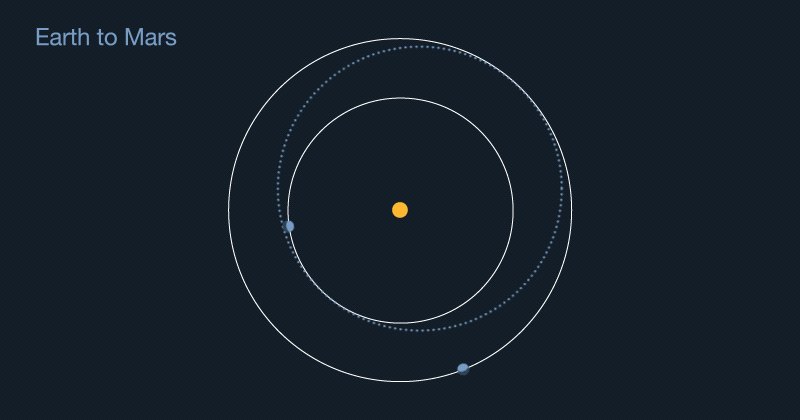
According to CNET, parking the spacecraft at L2 is the mission's biggest achievement, since no space agency has tried it before. Jeff Parker, chief technology officer at Advanced Space and the mission's lead designer, said the approach allows a launch at almost any time, with Earth's gravity then providing the boost. That's in contrast to waiting for the planets to align every two years to launch directly. In other words, launch scheduling is no longer tied to a single fixed date.
The rest of the journey
The new trajectory puts the two spacecraft on Mars' path, timed so that when they arrive, the planet is just sweeping past and can capture both into orbit. They will fly for about 10 more months and are expected to reach Mars in early September next year, by which point they will have spent a total of 22 months in space. Their job is to measure Mars' magnetosphere, which is believed to have been stripped away by the solar wind long ago, back when the planet likely still had liquid water.
NASA's idea also has a fairly convincing point of comparison. JAXA's MMX probe launched on October 20, squarely within the current launch window, and uses the standard Hohmann Transfer. It is heading for Phobos and Deimos, the two moons of Mars. MMX is expected to arrive in August next year, only a few weeks ahead of Escapade. Escapade performed its flyby on November 9, about two weeks after MMX left the launch pad, so the two travel times are nearly equal. That suggests NASA's orbital strategy is no worse than the traditional launch method.
Migovi sees Escapade's greatest value in how it loosens the constraints of launch scheduling. Any space agency could send a spacecraft up once it's ready and let Earth's gravity handle the rest, rather than waiting for a window that opens once every two years. The published numbers back this up: MMX, launched in the standard window, still arrives only a few weeks ahead of Escapade, even though Escapade began its speed-up about two weeks later. That said, the strategy has so far been proven only at departure. The real result will have to wait until the two spacecraft enter Mars orbit in early September next year. If you follow space exploration, that is the milestone to watch.
Source: CNET
Reviewed by: Hero Association