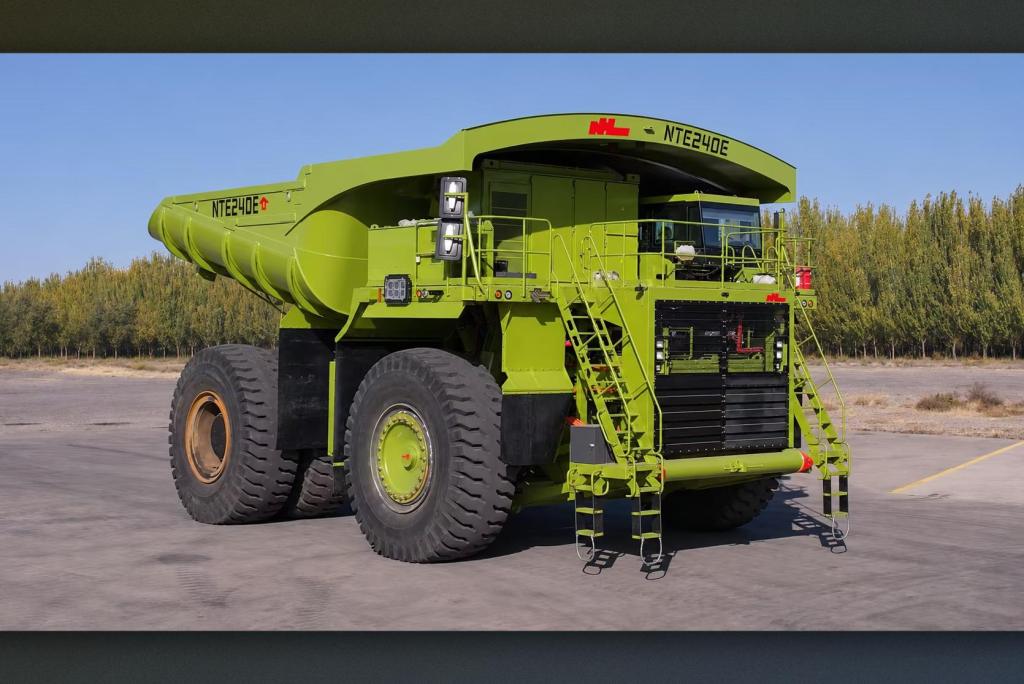
The NHL NTE240E charges through two MCS guns and also draws power from overhead lines on climbs, which the company says cuts operating costs by more than 60% compared with diesel trucks.
- NHL (China) has launched the NTE240E, a rigid-frame mining truck that runs entirely on batteries and has a 240-ton payload.
- The largest battery pack reaches 4,100 kWh (4.1 MWh) and charges from 20% to 90% in under 1 hour at 25 °C thanks to dual-gun MCS charging.
- The truck also draws power from overhead lines when climbing under load, then recovers energy on descents through regenerative braking.
- The company claims energy efficiency 15% above the average for trucks in its class, and operating costs more than 60% lower than a comparable diesel truck.
- Pricing and delivery dates have not been announced.
Table of Contents
NHL and the shift to electric mining trucks
NHL, formally Inner Mongolia North Hauler Joint Stock Co., Ltd., is a Chinese heavy equipment maker founded in 1988 that specializes in large rigid-frame trucks for open-pit mines. For decades, the company has supplied trucks to customers in many countries, including some of the largest diesel-electric hybrid models in the industry. The NTE240E is a clear departure from those, as it marks the company's first serious investment in fully battery-powered mining equipment, with a 240-ton payload, advanced regenerative braking, and a charging system that NHL bills as the world's first dual-gun MCS.
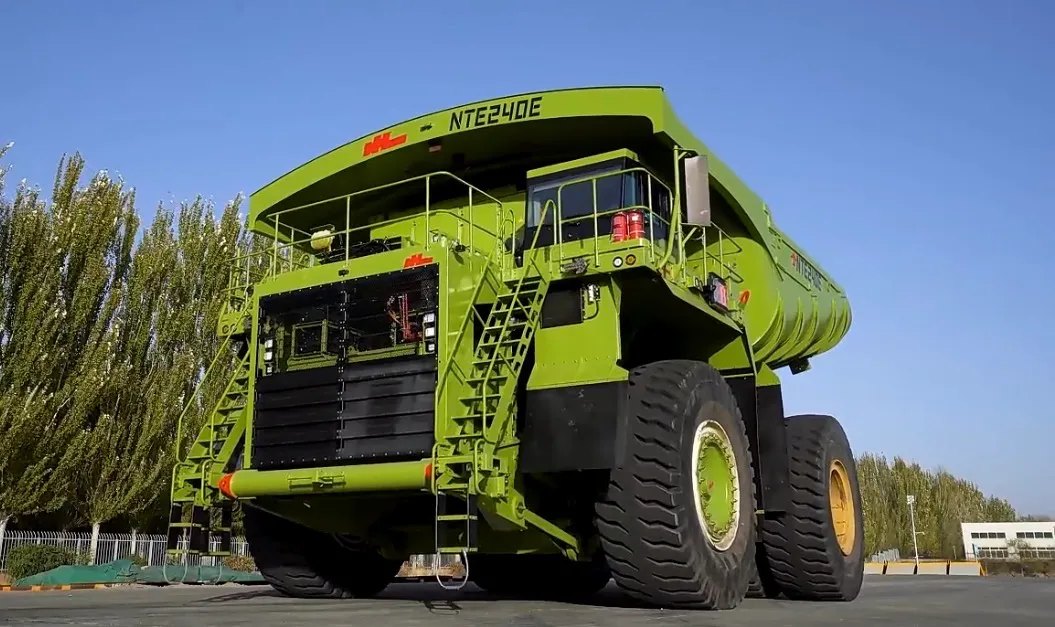
The battery is the truck's standout feature. The highest-capacity version carries up to 4,100 kWh (4.1 MWh) of energy, a huge figure compared with ordinary electric vehicles. A pack that size also creates a charging challenge, so NHL equipped the truck with the MCS (Megawatt Charging System) standard and two guns that plug in at the same time, getting as much power as possible into the battery in the shortest time.
Charging during shift breaks
According to NHL, dual-gun charging lets the battery go from 20% to 90% in under 1 hour. That allows mines to use shift changes or scheduled breaks to recharge, rather than sacrificing an entire shift to charging. More notably, the company says this speed is reached at a temperature of just 25 °C, meaning no special conditions are needed for the battery to take on power that quickly.
Drawing power on the climb
Plugging in is not the only way the truck gets its power. NHL's dynamic power system uses an overhead-mounted current collector to feed electricity straight to the truck while it climbs the mine's ramps fully loaded, so the battery doesn't have to carry the heaviest part of the workload. On the way down, the truck uses regenerative braking to recover energy, so the uphill-downhill cycle partly offsets itself. Combining these technologies, the company claims the truck is 15% more energy efficient than the average for its class, because it doesn't rely entirely on the onboard battery.
Costs and emissions
That energy saving translates into money saved, and NHL argues the NTE240E's economics are just as compelling as its emissions benefits. According to the company, each truck can cut more than 2,000 tons of carbon emissions per year, while operating costs are more than 60% lower than those of a diesel truck with comparable capability. The truck's electrical system also doesn't need engine-related components such as a generator, so the maintenance and overhaul costs tied to them disappear as well.
For a mining truck of this size, fuel and maintenance make up a very large share of total operating costs, so NHL aiming squarely at those two items is a sensible approach. The most notable idea, in Migovi's view, is drawing power from overhead lines right on the climb, because it eases the load on the battery instead of simply cramming in more capacity. That said, the figures of 15%, 60%, and 2,000 tons are all self-reported by the company, and real-world results depend on whether a mine is willing to invest in overhead line infrastructure and high-power MCS charging stations. For open-pit mines in Vietnam, that is the part to watch: once the company announces pricing and delivery schedules, mine owners should factor in infrastructure costs rather than comparing only the price of the truck.
Source: Electrek (electric vehicles)
Reviewed by: Hero Association