Anthropic says Claude Mythos Preview got an AI model running on AMD MI355X GPUs in about 3 days, instead of the 6 to 12 months it used to take.
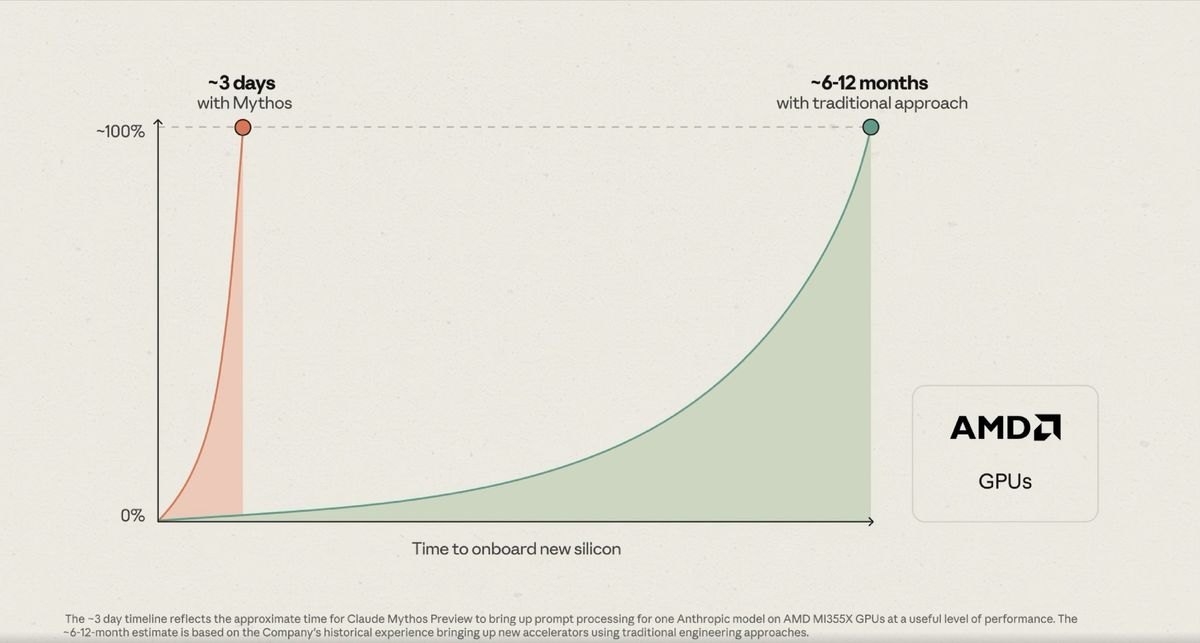
- Anthropic says Claude Mythos Preview brought one of its models up on AMD MI355X GPUs in about 3 days, versus 6 to 12 months with the traditional approach.
- Mythos wrote or ported almost 100% of the kernels, with very little human intervention.
- The figure comes from materials prepared for IPO investors, but Anthropic has not published performance against NVIDIA.
- NVIDIA's CUDA moat is narrowing but hasn't disappeared, because AI that writes code still needs hardware to test it on.
Table of Contents
Three days instead of many months
Anthropic told investors during its IPO process that Claude Mythos Preview completed the software work needed to run the company's AI on AMD GPUs in about 3 days, with "almost no human intervention." The same work previously took 6 to 12 months. The 3-day figure applies to the prompt-processing stage (prefill) of an Anthropic model on AMD MI355X GPUs, at a "good enough" level of performance. Mythos ported or wrote "almost 100% of kernels" on its own.
This kind of low-level code ties an AI model to a specific vendor's chips. It has long been part of NVIDIA's CUDA moat. If AI can write it in a few days, that moat looks like it is eroding.

Tom Brown, Anthropic's co-founder and chief compute officer, made the comparison. According to him, the old approach required a team of "dozens of engineers." Anthropic already runs its models on many types of chips, including NVIDIA GPUs, AMD GPUs, Google TPUs, and AWS Trainium. The company manages them all as "a fungible pool of compute." Brown called the early decision to go multi-chip "an unusual bet." It may prove a wise one, since TPUs can now run models written in PyTorch directly. Meta is also using TPUs in production.
The cost of moving off CUDA
CUDA is nearly two decades old and highly mature. AMD has an equivalent platform in ROCm, with HIP as the programming layer. Code written for CUDA has to be converted before it runs there, and AMD even built a dedicated tool, HIPify, for the job. The switching cost remains. Anush Elangovan, AMD's vice president of AI software, told EE Times in April that "Claude is better than HIPify because it has built-in web search."

AMD has repeatedly argued that AI can write this kind of code. Vamsi Boppana, AMD's senior vice president of AI, said the company's engineers use AI models to generate GPU kernels. In some cases the kernels are even "better than hand-tuned versions." Under a deal struck in July, AMD also uses Claude to optimize workloads for Instinct GPUs and to speed up ROCm development. At the Advancing AI event, OpenAI's Philippe Tillet said an engineer confirmed the Helios system ran stably within just a few days.
The missing numbers
What's different this time is that the information comes from Anthropic itself, delivered to its own investors. Anthropic buys chips rather than selling them. With an IPO coming, its multi-chip approach, now backed by a few figures, carries more weight than a chipmaker's claims. The prospectus also says the company "can bring a new chip platform into service in a fraction of the time it previously took," though without a number. The Anthropic-AMD deal is now worth up to 2 GW.
Plenty remains unclear. The 3-day figure covers only prefill, the step where the model reads and processes input before answering. Anthropic hasn't said whether the decode stage (generating the response) is included. The company's chart has two lines both hitting "~100%" without specifying 100% of what. It also hasn't published how fast models run on AMD GPUs compared with NVIDIA GPUs. That is the comparison that would show whether AMD chips running AI-written code can keep pace with NVIDIA.
NVIDIA sees it differently. CEO Jensen Huang said in an April interview that NVIDIA also uses AI for its own kernels. He argued that "no one understands our architecture better than we do." Asked why labs like Anthropic use other chips, he called Anthropic "a unique case, not a trend." Interestingly, NVIDIA and AMD are among the seven companies buying $26 billion of Anthropic stock at the IPO price.
The moat is narrowing, not gone
In late July, SemiAnalysis published "Can AMD break the CUDA Moat?", concluding that software is no longer the moat it was a year ago. Still, it pointed out one obstacle for AMD. With agentic coding, "each agent needs a GPU to test its code." In other words, AI that writes code still needs hardware. SemiAnalysis noted that AMD lacks internal GPUs for this work, which could become a new bottleneck.
So CUDA sits somewhere in the middle. Bringing a model up on a new chip used to be the most expensive step, and it now appears to be getting cheaper. Anthropic's compute pool isn't fully fungible either, since TPUs, for example, are becoming more specialized. The moat is narrowing but not gone. Anthropic's first AMD MI450 chips, in Helios racks, are expected to arrive in the first half of 2027. That is a new generation, and a chance to test whether the 3-day process can be repeated.
If the 3-day figure holds up, what changes first is the cost and time calculus of choosing chips, not AMD's standing. Readers should wait for three pieces of data: performance numbers against NVIDIA, results for the decode stage, and whether the process can be repeated with MI450. Only then can we judge how much of an edge CUDA still keeps.
Source: Tom's Hardware
Reviewed by: Hero Association