TSMC's new roadmap suggests the 2 nm node will have a long shelf life, while A16 with Super Power Rail mainly appeals to AI chips like NVIDIA's Feynman.
- Most TSMC customers are expected to follow the N2P path, then N2U, and only then move to A14
- N2U is the final refinement of 2 nm: about 4% more performance than N2P, or about 10% lower power
- A16 is essentially N2P plus backside power delivery, and so far it has only drawn interest from AI chips
- NVIDIA has reportedly reserved A16 capacity for its Feynman GPUs, while Apple has not yet started talks with TSMC
- Phones, laptops, and PC chips will likely stay on 2 nm-class nodes for the foreseeable future
Table of Contents
A new roadmap from the OIP forum
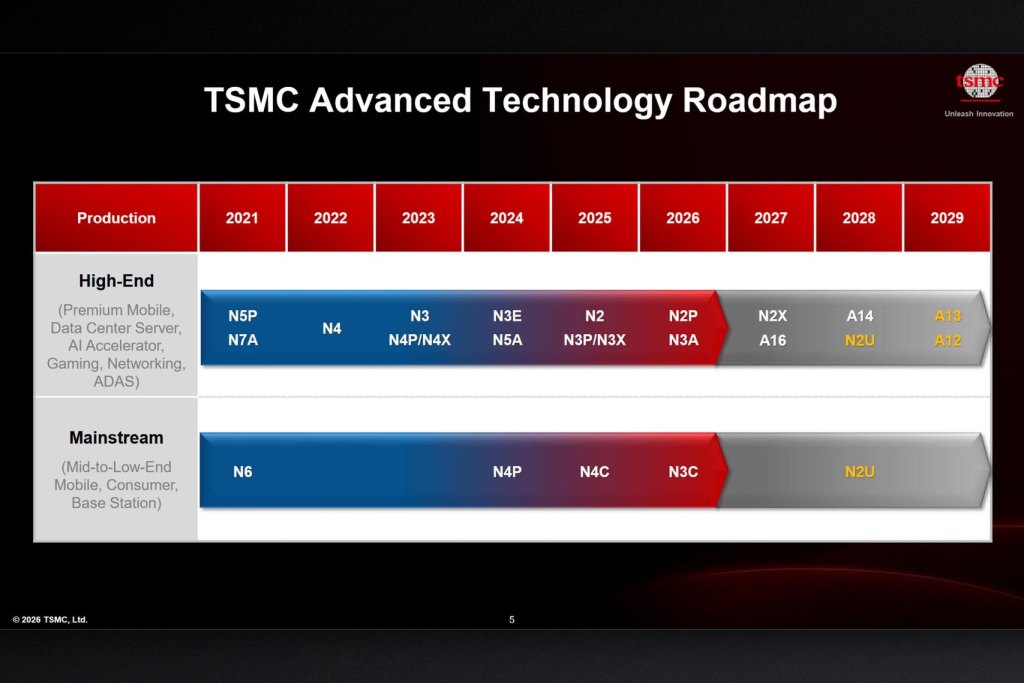
This week TSMC held its Open Innovation Platform (OIP) forum in Munich, the first time the event has been staged in the city. According to ComputerBase's coverage, the company revisited its process roadmap and positioned the 2 nm family as a long-lived node: most customers will stay on N2P, then move to N2U, and only after that jump to A14.
N2U is the last refinement of 2 nm and is expected to arrive in 2028. Compared with N2P, TSMC says it delivers roughly 4% higher performance at the same power, or about 10% lower power at the same performance. That is an incremental improvement, much like Intel's step from 18A to 18A-P, so users shouldn't expect a major generational change.
A16 sits in an awkward spot
The next mainstream node is A14, also scheduled for 2028, which leaves A16 in a rather awkward position. In essence, A16 is N2P with backside power delivery added, a technology TSMC calls Super Power Rail. Because its benefits currently suit AI chips best, other customers apparently see little reason to stop here.
NVIDIA is likely to be the first A16 customer, as an earlier report said the company has reserved the node for its next-generation GPU line, codenamed Feynman. Apple was once rumored to be an A16 customer, but earlier reports said Apple had not yet begun discussions with TSMC about the node. Meanwhile, most of TSMC's big customers are aiming for the leap to A14.
Further out
The roadmap also places A13 and A12 in 2029, but plans this far out can easily change or slip. For now, phones, laptops, and PC chips will most likely keep using silicon from the 2 nm family.
Migovi believes the most notable thing about this roadmap is that the pace of node changes for mainstream chips is slowing, since even TSMC expects most customers to stay in the 2 nm family until A14 arrives. If so, the differences between upcoming generations of phones and laptops will come more from refinements of around 4% in performance or 10% in power than from a big technological leap. Users in Vietnam therefore don't need to wait for a new node before upgrading, and should compare devices on real-world specs such as performance, battery life, and price. As for A16 and Super Power Rail, they will most likely show up in high-end AI chips first, so they are unlikely to reach mid-range devices anytime soon.
Source: TechPowerUp
Reviewed by: Hero Association