
A study of 44 teenagers finds that screen time goes hand in hand with differences in brain regions tied to memory, but it does not prove cause and effect.
- The University of Eastern Finland ran MRI scans on 44 healthy teenagers aged 16 to 19, with results published in NeuroImage: Reports
- Heavier screen use was associated with less grey matter in memory-related regions, but more in some regions tied to attention and visual processing
- More grey matter is not necessarily better, since it may reflect slower brain maturation
- The sample is small and the scans were taken at a single point in time, so it is too early to say that screens cause these differences
Table of Contents
The link between screens and the brain
How phones and tablets affect young people's brains is a question that comes up constantly, so it is notable that someone has looked directly at the brain for answers. A research team at the University of Eastern Finland used magnetic resonance imaging (MRI) to do just that, and the results were published in the journal NeuroImage: Reports. They found that screen time was associated with differences in grey matter volume in regions responsible for memory, attention, decision-making, and visual processing. But this is only a correlation, not evidence that screens directly cause these changes.
The study included 44 healthy teenagers aged 16 to 19, 25 girls and 19 boys. Grey matter volume was measured with MRI, while recreational screen time, smart device use, and physical activity levels were collected through questionnaires. The team also assessed the teens' physical fitness with a shuttle run and a standing long jump, which made it possible to compare screen habits against activity levels.
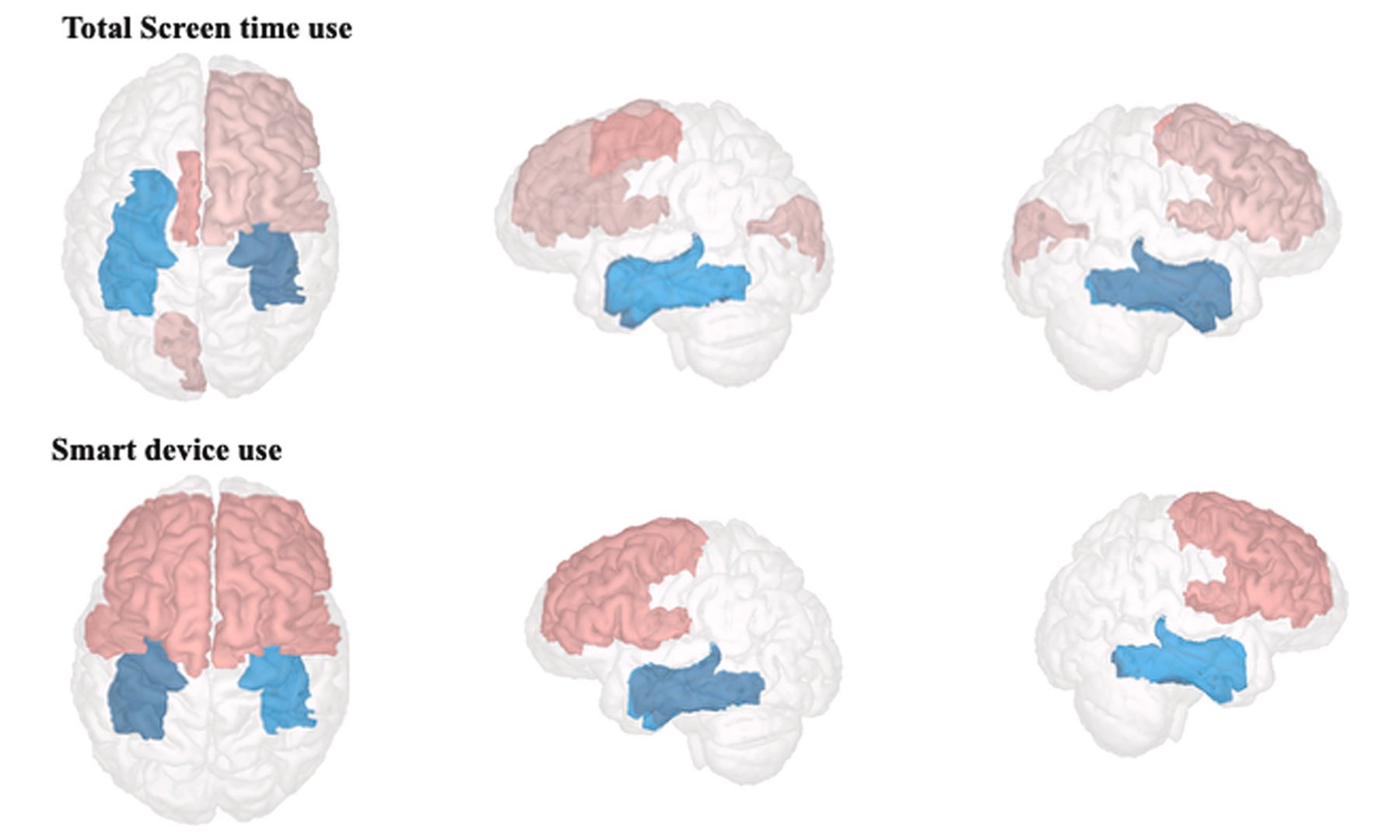
Which brain regions differ
Teens who reported using screens and smart devices more tended to have lower grey matter volume in the medial temporal lobe, a region that plays a key role in memory and learning. In the opposite direction, higher screen use went along with greater grey matter volume in parts of the frontal lobe, which is involved in attention, working memory, decision-making, and motor planning. The team also noted an association with a region in the occipital lobe, where visual information is processed.
More grey matter is not necessarily better
Two explanations are offered for the larger volumes in the frontal and visual regions. The first is that apps and games demand constant attention, movement, and image processing, so these regions may develop in response to that demand. The second is less optimistic: the brain may be maturing more slowly. In adolescence the brain naturally undergoes synaptic pruning, which trims little-used connections so that neural networks work more efficiently, and larger volumes in some regions could indicate that this process is unfolding differently.

The authors themselves are cautious about what the results can say. Lead researcher Hannamari Skog said the findings offer more insight into how lifestyle factors such as screen time, physical activity, and fitness relate to brain structure in adolescence, but that the relationships are complex and more research is needed to understand their long-term significance. For physical activity and fitness, the results were also linked to brain structure but were messier, and some associations were no longer statistically significant after correcting for multiple comparisons.
Limitations of the study
The study is relatively small and captures a snapshot at one point in time rather than tracking changes over several years. It therefore cannot be used to claim that scrolling through short videos day after day is shrinking anyone's brain. What it does is add another piece to a growing picture of how digital habits and physical activity relate to the developing brain.
Migovi's view is that the takeaway here is not whether screens are good or bad, but that the results point in opposite directions: some regions are smaller, some are larger, and even the authors are unsure that larger means better. With 44 participants and a single scan, it is hard to draw any strong conclusion about how much phone time is too much for your kids. A more sensible approach is to treat this as a signal to watch, meaning you should wait for multi-year studies with larger groups before changing your household's habits over a specific number. In the meantime, keeping kids physically active is a sure benefit that needs no further evidence.
Source: Digital Trends
Reviewed by: Hero Association