With eHAIR, a conductive polymer coating on hair strands enables gel-free EEG recording, and can even turn individual hairs into transistors that amplify neural signals.
- Researchers at Ghent University (Belgium) and Linköping University (Sweden) coated hair with conductive polymers to record EEG without gel
- There are two approaches: a coating that is easy to apply and remove, or polymer grown directly on each hair strand
- In tests, it delivered better signal amplitude, spectral power, and SNR than conventional gel electrodes
- Implants like Neuralink place electrodes inside brain tissue, so a significant gap remains
Table of Contents
Why hair gets in the way of brain recording
Electroencephalography (EEG) has always had a problem with hair, because hair and scalp sit between the sensor and the signal it needs to pick up. To get good results, people sometimes have to shave their heads and lightly scrub the scalp clean, while brain-computer interface (BCI) systems that need the highest signal quality are implanted directly into the head through surgery. Researchers at Ghent University and Linköping University took a different route: instead of avoiding hair, they treated it with a dye containing conductive polymers so that it becomes part of the sensing interface. The project is called Electronic Hair, or eHAIR for short, and the team hopes it can offer a more stable and natural platform than current methods.
Two ways to coat hair with polymer
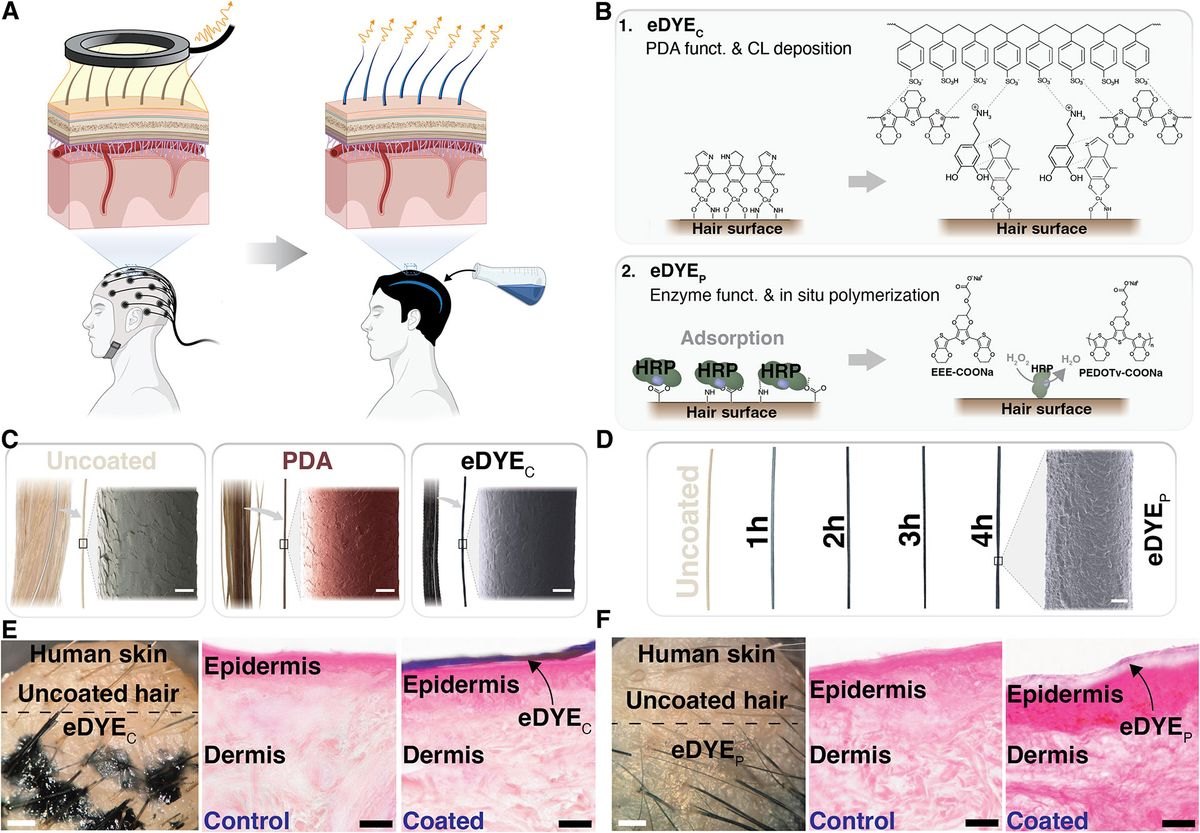
The team tested two complementary approaches. The first uses a highly conductive, low-impedance coating that is easy to apply and just as easy to remove. The second works from the bottom up, letting conductive polymer grow directly on each hair strand. According to the authors, both create a stable, low-impedance interface that allows comfortable EEG recording without gel, and both work with standard equipment as well as with real human hair and skin.
From passive electrode to hair-based transistor
What makes eHAIR interesting is that it doesn't stop at acting as a passive electrode. The team showed that organic electrochemical transistors (OECTs) can be made from single hairs or entire bundles, meaning a strand of hair can serve as the transistor's channel. As a result, signals can be amplified right at the source, before they reach the recording equipment.
Test results and maintenance
In testing, eHAIR delivered better signal amplitude, spectral power, and signal-to-noise ratio (SNR) than traditional gel electrodes. As hair grows out, electrical contact may degrade, but a clinician only needs to reapply the coating or repeat the polymer growth process. The scientists compare this to familiar home hair dyeing, so it isn't overly complicated. From there, they see opportunities for electrophysiology interfaces, BCIs, and wearable health monitors that are both scalable and user-friendly.
How far is it from implants?
Several non-surgical alternatives to Neuralink are in development, but their effectiveness is limited by the hair, skin, and skull between the sensor and the brain. eHAIR could help those solutions take another step forward. Still, Neuralink's electrodes sit beneath the skull, right in brain tissue, so the gap may narrow but will likely remain very significant.
Migovi believes eHAIR's biggest value lies in removing the everyday hassles of EEG recording, such as shaving hair, applying gel, and scrubbing the scalp, rather than in competing with brain implants. The reason is that electrodes placed on hair are still separated from the brain by skin and skull, a limit that even an excellent conductive coating can hardly eliminate. For users in Vietnam, this is a direction worth watching for future wearable health monitors and non-invasive BCI systems, but for now it is only a research result, with no information on a commercial product. To judge how feasible it is, the things to wait for are trials with more participants and data on durability in daily use.
Source: Tom's Hardware
Reviewed by: Hero Association