UCIe 4.0 standardizes memory links and security for chiplets
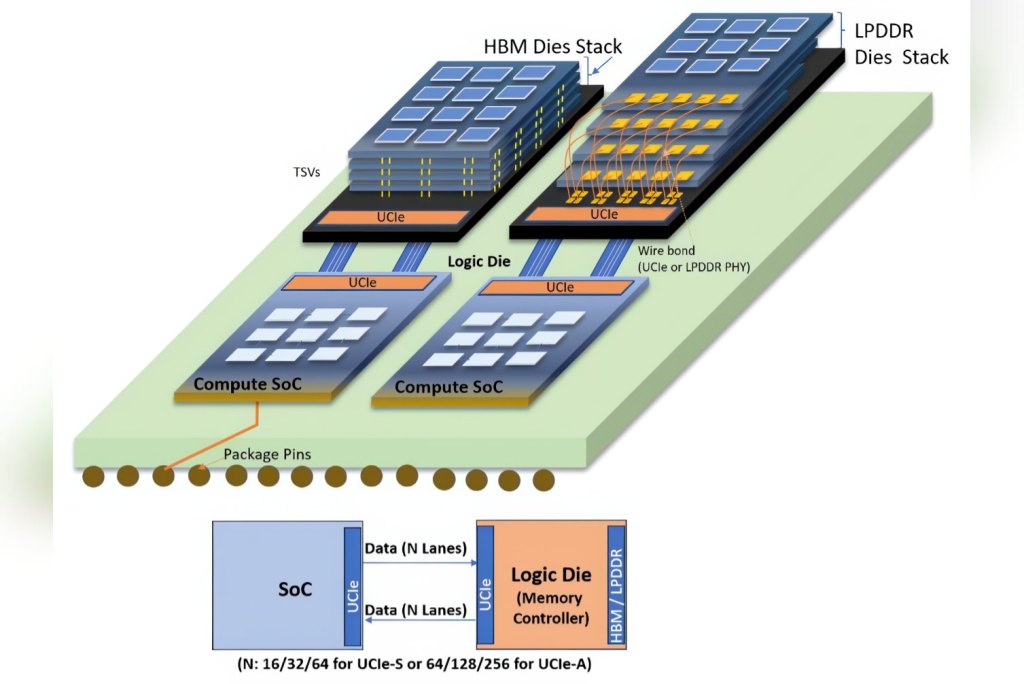
UCIe 4.0 adds standardized memory interconnects, security mechanisms, and reliability monitoring, transitioning the chiplet standard from simple connectivity to system-level integration.
- The UCIe Consortium has published the UCIe 4.0 specification, expanding the standard from basic chiplet connectivity to system-level management and in-package integration.
- The UCIe.mem protocol standardizes memory links between SoCs and memory logic chiplets, delivering up to 93.75% data efficiency.
- New power-optimized profiles and bump maps boost energy efficiency and bandwidth density.
- The TRoCs mechanism and an integrity-protected management channel enable secure multi-vendor chiplet operation.
- The new specification remains fully backward compatible with all previous UCIe releases.
Table of Contents
From chiplet connectivity to system-level integration
The UCIe Consortium, the open industry group standardizing die-to-die interconnects within a package, has officially released the UCIe 4.0 specification. This revision moves beyond individual chiplet interface design, focusing instead on assembling multi-die silicon into a cohesive, in-package system.
According to the consortium, as multi-chiplet architectures grow increasingly complex, connectivity is only one piece of the puzzle. Systems built from compute, accelerator, and memory chiplets must also be managed, secured, and monitored - all while maximizing power efficiency, die area, and package substrate resources.
Standardizing memory and boosting system efficiency

UCIe 4.0 introduces a standardized on-package memory link connecting SoCs to memory logic chiplets. The UCIe.mem protocol leverages the existing UCIe PHY and Adapter ecosystem, simplifying memory integration. It achieves up to 93.75% data efficiency, with an edge bandwidth density of around 2.5 TB/s/mm. This approach enables memory bandwidth scaling with existing memory technologies while saving power and costs.
On the efficiency front, the specification introduces optional power-optimized profiles, offering 30 - 80% higher energy savings at 64 GT/s. An improved bump map for UCIe-S at 48 GT/s and 64 GT/s delivers roughly a 20% increase in shoreline bandwidth density and a 10% increase in areal density. Designers can either extract more bandwidth from the same footprint or free up packaging resources for other components.
Security, management, and automotive reliability
For security, UCIe 4.0 incorporates Trusted Reporting of Chiplet State (TRoCs). This mechanism allows the system to trust telemetry from each chiplet, verify that dies operate as expected, and guard against spoofed or tampered state data. In addition, an integrity-protected bidirectional management channel prevents unauthorized modifications during inter-chiplet communication. Combined with enhanced reset management, this builds a more resilient foundation for heterogeneous multi-vendor chiplet environments.
The specification also introduces optional error reporting and link-health monitoring tailored for automotive applications. This telemetry tracks connection integrity and enables early fault detection, helping fulfill functional safety and reliability standards across vehicular systems. UCIe 4.0 remains fully backward compatible with all prior UCIe specifications. The document is available upon request at http://www.uciexpress.org/specifications.
The defining shift in UCIe 4.0 is moving the spotlight from raw interconnect speed to manageability and security. When multi-vendor chiplets share a single package, mutual trust between components becomes non-negotiable. Standardizing memory links also positions the open chiplet ecosystem to compete more effectively against proprietary closed designs. That said, these performance metrics currently reflect consortium targets; real-world benefits will depend on the first commercial implementations.
Source: TechPowerUp
Reviewed by: Hero Association