
OWC showcases full Thunderbolt 5 ecosystem at CES 2026
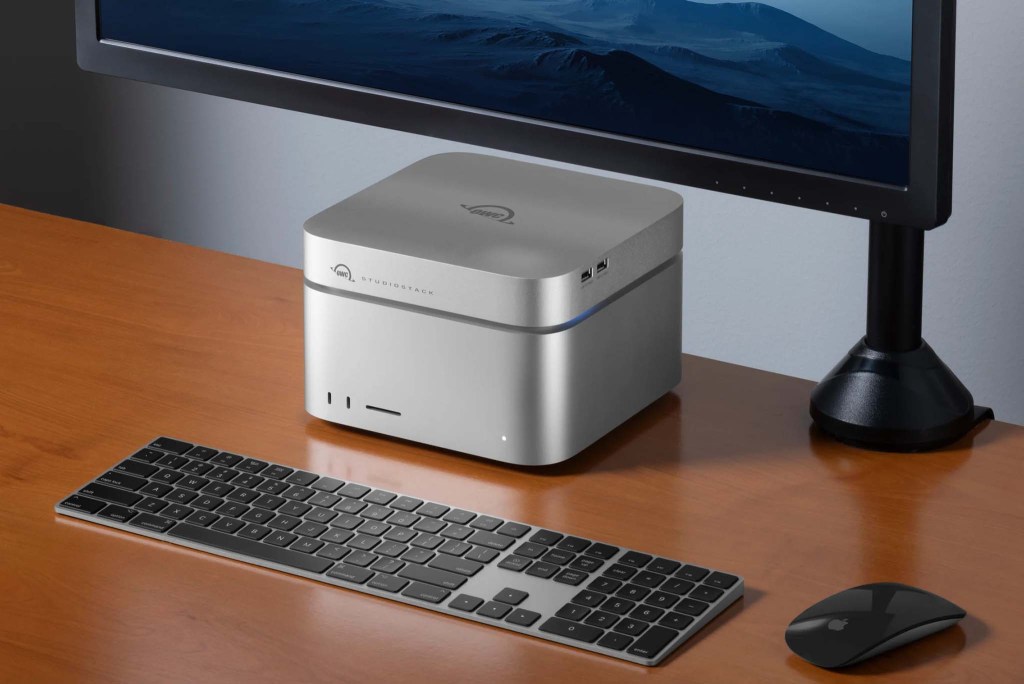
OWC is bringing a complete Thunderbolt 5 lineup to CES 2026, including its hybrid StudioStack storage system, professional networking gear, a broader connectivity ecosystem, and companion software.
- Hybrid storage with StudioStack: A storage solution tailored for Mac Studio and Mac mini, offering speeds up to 6,302 MBps and a combined capacity of up to 32 TB (8 TB SSD + 24 TB HDD), with Thunderbolt 5 support.
- Professional networking: The Thunderbolt 5 Dual 10GbE Network Dock delivers aggregated bandwidth up to 20 Gbps, supports three independent networks, and can drive three 8K displays.
- Connectivity and software ecosystem: A new 2-meter Thunderbolt 5 cable with 240 W charging support, plus Strada, a collaboration platform built around remote video editing without cloud uploads.
Article content
Optimize your workspace with StudioStack

At CES 2026, Other World Computing (OWC) is introducing StudioStack, a hybrid storage solution that mirrors the footprint and aesthetic of Apple’s Mac Studio and Mac mini. The key pitch for StudioStack is its tiered storage architecture, offering real-world throughput up to 6,302 MBps via NVMe SSD while pairing that with high-capacity traditional HDDs. Fully configured, StudioStack supports up to 8 TB of SSD and 24 TB of HDD storage, targeting the balance content creators often struggle with: fast 8K video workflows on one side, and large “cold data” archives on the other. The enclosure uses an aircraft-grade aluminum chassis for passive heat dissipation, backed by an intelligent cooling fan that only spins up when needed to keep studio environments quiet.
More bandwidth, more pixels
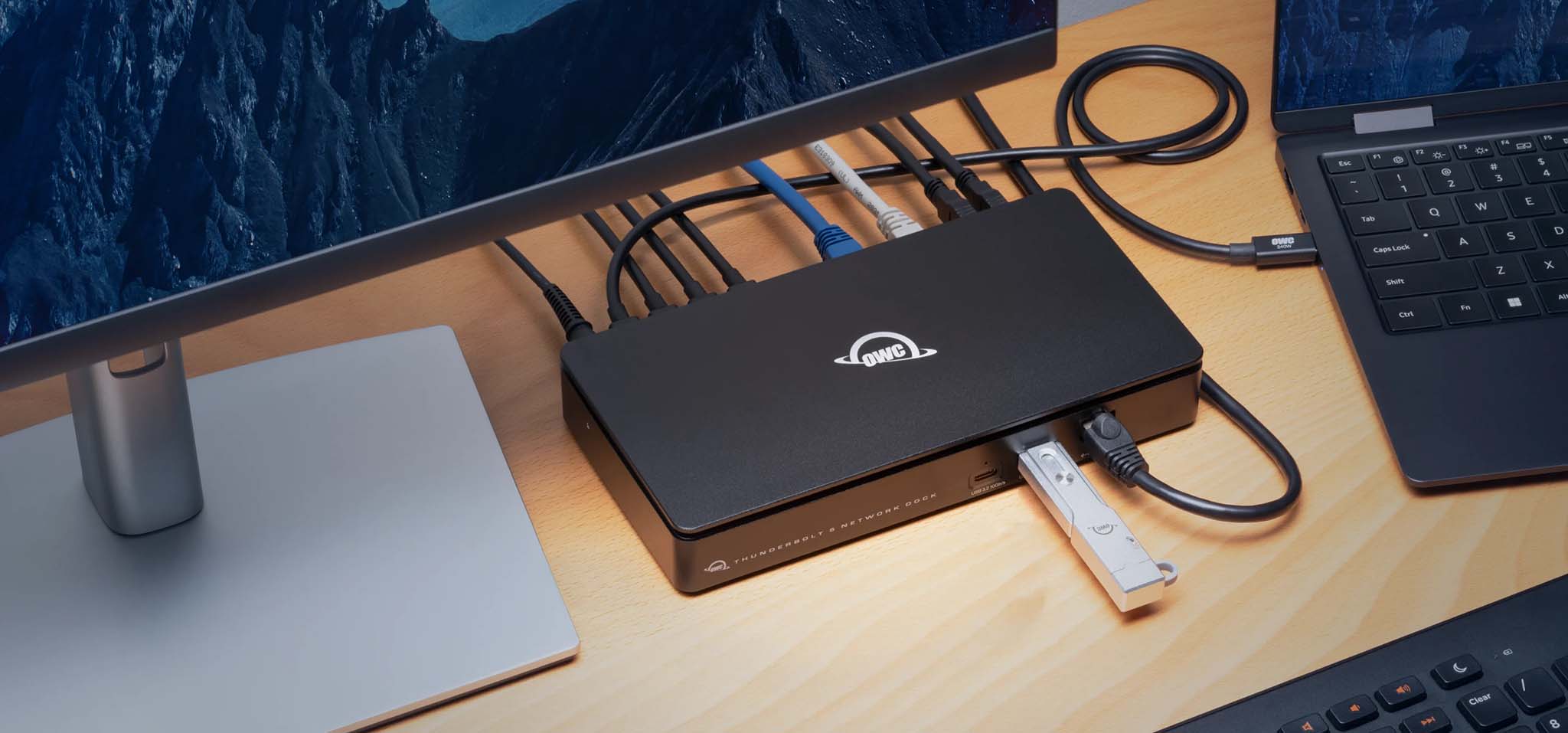
Alongside StudioStack, OWC is unveiling the Thunderbolt 5 Dual 10GbE Network Dock, designed for professionals who need high-speed access to NAS or shared storage. The dock includes two independent 10 Gbps Ethernet ports and a 2.5 Gbps port on the front, allowing simultaneous connectivity to three separate networks. Link aggregation enables combined throughput to a NAS of up to 20 Gbps. Beyond networking, the dock doubles as a central hub, capable of driving three 8K displays, giving power users significantly more screen real estate for multitasking.
Cabling and infrastructure, standardized

To round out the hardware ecosystem, OWC is offering a 2-meter Thunderbolt 5 (USB-C) cable. The cable is independently certified to deliver full-duplex data transfer at 80 Gbps and video bandwidth up to 120 Gbps, targeting workflows that demand extreme throughput. It also supports up to 240 W Power Delivery, making it suitable for powering high-performance mobile workstations over a single cable. The cable is fully backward compatible with Thunderbolt 3, Thunderbolt 4, and USB4, giving users flexibility across mixed-device setups.
Rethinking collaboration with Strada
Beyond hardware, OWC is moving deeper into software via its investment and collaboration with the Strada platform. At CES 2026, Strada is demonstrating a peer-to-peer-based video editing workflow that lets editors remotely access and work directly on large locally stored video files - without uploading them to the cloud. The approach aims squarely at one of post-production’s biggest bottlenecks: upload and download times. Strada’s patent-pending virtual file editing technology lets users drag and drop remote files straight into their editing timeline, even on constrained network connections, potentially reshaping collaboration on distributed film and TV projects.
By pairing advanced Thunderbolt 5 hardware (such as StudioStack and the Network Dock) with smarter software (like Strada), OWC is signaling a push toward tightly integrated, end-to-end workflows. The company will also be present at CES satellite events like Pepcom and ShowStoppers, giving attendees hands-on time with its Thunderbolt 5 ecosystem.
Thunderbolt 5 (TB5) devices support Bandwidth Boost, dynamically allocating up to 120 Gbps for video signals. That said, to actually hit StudioStack’s advertised 6,302 MBps throughput or the Network Dock’s 20 Gbps aggregated bandwidth, the host system must support TB5 - a standard that, for now, remains relatively scarce in the Vietnamese market. Given Vietnam’s current internet infrastructure, Strada’s software-driven approach could be a genuine lifeline for remote teams, reducing dependence on often-fragile international links for uploading massive files to overseas cloud servers. And with their solid aluminum builds and largely passive cooling, OWC’s new devices will also need to prove how well they handle thermals in Vietnam’s hot, humid conditions - something real-world reviews are likely to scrutinize closely.